Nepal: A First-Timer's Guide to the Himalayan Nation
A clear, factual overview of Nepal for travellers: geography, the eight-thousanders, culture, visas, currency, when to go, and how to plan a first trip.
A small, landlocked country that holds eight of the ten highest mountains on Earth — Nepal is one of the most concentrated travel experiences anywhere.
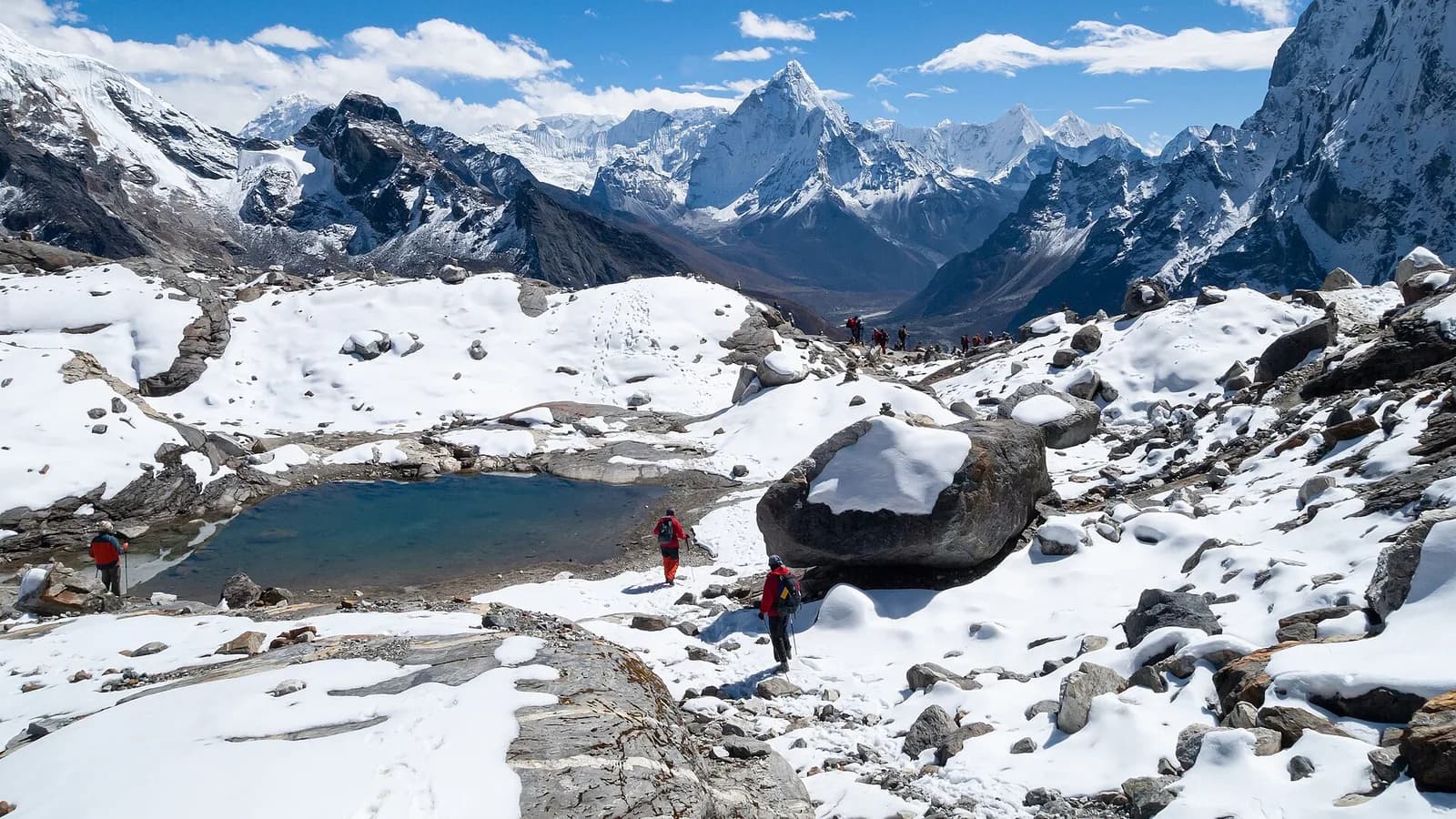
Nepal is a small, landlocked country in South Asia that punches far above its size. Wedged between China and India along the spine of the Himalaya, it holds eight of the world's ten highest mountains — including Mount Everest — alongside medieval temple cities, lowland jungles full of rhinos and tigers, and a culture where Hinduism and Buddhism have intertwined for centuries. This guide is a plain-language first look at Nepal: what and where it is, the facts worth knowing, and how to think about a first trip.
It is built for travellers and trekkers who are still in the orientation stage. For deeper dives — itineraries, treks, costs, and language — you will find links throughout to more detailed companion guides.
Key takeaways
- Nepal is a landlocked Himalayan nation between China (Tibet) and India, about 800 km long east to west, with the capital at Kathmandu.
- It is a federal republic of seven provinces and 77 districts, secular by constitution, with Hinduism and Buddhism both deeply rooted.
- The mountains are the headline: eight of the world's ten highest peaks sit in Nepal, including Everest, the highest point on Earth.
- Tourism is healthy: Nepal welcomed about 1.16 million international visitors in 2025, near its pre-pandemic peak.
- Entry is straightforward: most travellers get a visa on arrival; as of June 2026 the fees are USD 30 / 50 / 125 for 15 / 30 / 90 days.
- Go in autumn or spring for the clearest skies, and budget 10 to 14 days to see the highlights without rushing.
Where is Nepal, and what is it?
Nepal is a landlocked country in South Asia, sharing its northern border with the Tibet Autonomous Region of China and its eastern, southern, and western borders with India. It stretches roughly 800 km from east to west and only about 150 km to 250 km from north to south, yet within that narrow band the land climbs from steamy lowland plains barely above sea level to the summit of Everest at 8,849 m.
That vertical range is the single most important fact about Nepal. It produces three broad geographic belts:
- The Terai — flat, fertile lowland plains along the Indian border, home to farmland, cities, and jungle national parks.
- The hills — the temperate mid-country where most of the population lives, including the Kathmandu and Pokhara valleys.
- The high Himalaya — the snow-capped north, where the great peaks and the most famous trekking routes are found.
If you are still asking the basic orientation questions, our short explainers on where Nepal is and whether Nepal is a country cover them directly.
Fast facts about Nepal
| Fact | Detail | | --- | --- | | Capital | Kathmandu | | Region | South Asia (landlocked) | | Neighbours | China (Tibet) to the north; India to the east, south, and west | | Government | Federal democratic republic (constitution adopted 2015) | | Administrative divisions | 7 provinces, 77 districts | | Population | About 29.16 million (2021 census) | | Currency | Nepalese rupee (NPR) | | Highest point | Mount Everest, 8,849 m | | Time zone | Nepal Standard Time, UTC +5:45 |
A couple of these deserve a note. Nepal's time zone is one of only a handful in the world offset by 45 minutes, sitting at UTC +5:45 — a small quirk worth knowing when you book flights. And the flag is famously the only national flag that is not a rectangle, formed instead by two stacked pennants; we explain why Nepal's flag is not rectangular in a dedicated piece.
The mountains: eight-thousanders and Everest
Nepal is, above all, a mountain country. It contains eight of the world's ten highest peaks and eight of the fourteen mountains on Earth that rise above 8,000 m: Everest, Kanchenjunga, Lhotse, Makalu, Cho Oyu, Dhaulagiri, Manaslu, and Annapurna I. Everest — known in Nepali as Sagarmatha — is the highest point on the planet above sea level.
You do not need to be a mountaineer to experience this. Most visitors encounter the Himalaya in one of three ways:
- Scenic mountain flights out of Kathmandu that fly close to the Everest massif.
- Viewpoint hikes and sunrises, such as the Annapurna panorama from a hilltop near Pokhara.
- Teahouse treks, where a network of village lodges lets ordinary travellers walk to extraordinary places.
Trekking is Nepal's signature experience, and it is well-supported and accessible. If the mountains are your main reason to come, start with our overview of trekking in Nepal and the head-to-head comparison of Everest Base Camp vs Annapurna Base Camp, the two most popular routes. For the showpiece walk, the Everest Base Camp trek guide covers the essentials.
Culture, religion, and heritage
Nepal's cultural depth is, for many visitors, the genuine surprise. It is a secular republic by constitution, but religion is woven into daily life: Hinduism is the most widely practised faith, Buddhism is deeply rooted, and the two frequently blend at shared festivals and sacred sites. Nepal is also the birthplace of Siddhartha Gautama — the Buddha — at Lumbini, making it a major pilgrimage destination.
The country is strikingly diverse for its size, home to dozens of ethnic groups and more than a hundred languages, with Nepali (written in the Devanagari script) serving as the lingua franca. You can get a feel for that diversity in our overview of Nepali culture and the languages of Nepal.
UNESCO World Heritage
Nepal holds four UNESCO World Heritage properties, and the figure is often quoted as higher because the Kathmandu Valley listing alone bundles seven distinct monument zones — including the durbar (palace) squares of Kathmandu, Patan, and Bhaktapur; the great stupas of Boudhanath and Swayambhunath; and the Hindu temple complex of Pashupatinath. The other three properties are Lumbini, Chitwan National Park, and Sagarmatha (Everest) National Park.
Easy starting points in and around the capital:
- Bhaktapur, the most intact of the valley's medieval cities and a simple day trip.
- Boudhanath Stupa, one of the largest stupas in the world and the centre of Tibetan Buddhist life in Kathmandu.
- Lumbini, the Buddha's birthplace and a quiet pilgrimage town in the Terai.
A note on greetings
The Nepali greeting you will hear most is namaste, offered with palms pressed together. It works for hello and goodbye and is a polite, universally welcome gesture from visitors. If you want to pick up a few words before you go, our learning section has a practical guide to greetings in Nepali.
Wildlife and the lowlands
The mountains get the attention, but Nepal's southern Terai delivers a genuine wildlife experience. Chitwan National Park, a UNESCO site, is one of the best places in Asia to see the greater one-horned rhino, and it is also home to Bengal tigers, wild elephants, and abundant birdlife. A jungle safari makes an excellent counterweight to the high country — our Chitwan safari guide explains how to plan it, and the one-horned rhino in Nepal overview covers what you are likely to see.
Tourism today
Tourism is one of Nepal's most important industries, and the numbers are strong. In 2025 the country recorded about 1,158,459 international visitor arrivals, a small rise on 2024 and roughly 97% of its pre-pandemic peak. India was by far the largest source market, followed by the United States and China. The year was not without disruption — a period of political unrest in early September affected travel briefly — but arrivals recovered toward the end of the year.
The practical takeaway for a traveller is reassuring: Nepal is well set up for visitors, with established infrastructure for trekking, sightseeing, and safaris, and a deep bench of local guides and lodges. For an honest, balanced verdict on the experience, see our companion piece on whether Nepal is worth visiting.
Planning a trip: the essentials
Visas and entry
Most nationalities can obtain a tourist visa on arrival at Tribhuvan International Airport in Kathmandu and at major land border crossings. As of June 2026, the Department of Immigration's on-arrival fees are:
| Visa length | Fee (as of June 2026) | | --- | --- | | 15 days (multiple entry) | USD 30 | | 30 days (multiple entry) | USD 50 | | 90 days (multiple entry) | USD 125 |
Fees are paid in cash in US dollars or other major currencies at the entry point, and you will need a passport valid for at least six months. A small number of nationalities are not eligible for visa on arrival and must apply in advance, so check your status before you fly. Our detailed Nepal visa on arrival guide walks through the process step by step.
Money and currency
The Nepalese rupee (NPR) is the official currency. Card acceptance is growing in Kathmandu and Pokhara, but cash remains essential outside the cities and on treks, where ATMs and card machines are scarce. Carry enough rupees for rural stretches and keep some small denominations for tea houses and tips. Our Nepal currency guide covers exchange and ATMs in more depth.
When to go
| Season | Months | What to expect | | --- | --- | --- | | Autumn | Late Sept – Nov | Prime season: clear skies, stable weather, the best mountain views | | Winter | Dec – Feb | Cold at altitude, clear in the hills; high passes can close with snow | | Spring | Mar – May | Second prime season: warm, rhododendrons in bloom, good trekking | | Monsoon | Jun – Sep | Rain, cloud, leeches on trails; the rain-shadow north stays drier |
Autumn and spring are the windows most travellers aim for. The full month-by-month breakdown is in our best time to visit Nepal guide.
How long, and a sample shape
Most first-time visitors find 10 to 14 days strikes the right balance: enough to combine the Kathmandu Valley, Pokhara, a Chitwan safari, and either a short trek or a scenic mountain flight. With only a week, focus tightly — the valley plus Pokhara makes a satisfying loop. For a ready-made template, see our two-week Nepal itinerary.
A realistic word on the rough edges
Nepal is a developing country, and a fair overview should say so. Kathmandu's air quality can be poor, especially in the dry winter months; power supply and roads can be patchy; and domestic flights into mountain airstrips are weather-dependent and prone to delays. None of this should deter a well-planned trip — time your visit for the clear seasons, build buffer days around internal flights, and keep your comfort expectations calibrated to a country that is authentic rather than highly polished. The reward is one of the most rewarding and varied destinations in Asia.
Sources
- Nepal — Britannica
- Nepal — Wikipedia
- Provinces of Nepal — Wikipedia
- Tourist Visa — Department of Immigration, Government of Nepal
- Visa on Arrival — Department of Immigration, Government of Nepal
- Nepal Achieves Record-Breaking 1.158 Million International Tourists in 2025 — Tourism Info Nepal
- More than 1.1 million foreign visitors arrived in Nepal in 2025 — The Himalayan Times
- Nepal Travel Advisory — U.S. Department of State
Frequently asked questions
- Where is Nepal located?
- Nepal is a landlocked country in South Asia, sitting between China (Tibet) to the north and India to the east, south, and west. It runs roughly 800 km east to west along the central Himalaya.
- What is the capital of Nepal?
- Kathmandu is the capital and largest city. It sits in the Kathmandu Valley and is the main international gateway, served by Tribhuvan International Airport.
- How many people live in Nepal?
- Nepal's 2021 national census recorded a population of about 29.16 million people, spread across seven provinces and 77 districts.
- Is Nepal a Hindu country?
- Nepal is a secular federal republic, though Hinduism is the most widely followed religion and Buddhism is also deeply rooted. The two traditions often blend in everyday practice and shared sacred sites.
- Do I need a visa to visit Nepal?
- Most nationalities can get a tourist visa on arrival at Kathmandu airport and major land borders. As of June 2026 the on-arrival fees are USD 30 for 15 days, USD 50 for 30 days, and USD 125 for 90 days.
- What currency is used in Nepal?
- The Nepalese rupee (NPR) is the official currency. Cash is still widely used, especially outside the cities and on treks, so carry enough for rural stretches.
- When is the best time to visit Nepal?
- Autumn (late September to November) and spring (March to May) are the prime seasons for clear skies and stable weather. The June to September monsoon brings rain and cloud, and winter is cold at altitude but clear in the hills.
- How many days do you need in Nepal?
- Around 10 to 14 days suits most first visits, enough to combine the Kathmandu Valley, Pokhara, a Chitwan safari, and a short trek or scenic mountain flight. A focused week can still cover the valley and Pokhara.
Related posts
Is Nepal Worth Visiting? An Honest 2026 Answer
Is Nepal worth visiting in 2026? An honest look at the mountains, culture, wildlife, cost, and the real downsides to weigh before you book.
Read postGay Nepal: LGBTQ Travel Guide for 2026
A practical, up-to-date guide to gay Nepal for LGBTQ travelers — the legal picture in 2026, where the scene is, and how to travel comfortably and safely.
Read postThe Himalayas: A Traveller's Guide to the Range
The Himalayas explained for travellers — how the range formed, its highest peaks, the rivers it feeds, and the best ways to see it from Nepal.
Read post