Why Is Nepal's Flag Not Rectangular? The Only One
Why is Nepal's flag not rectangular? It is the world's only non-quadrilateral national flag — two stacked pennants with sun and moon. History explained.
Every other nation folded its banner into a neat rectangle. Nepal kept its mountains, and its two triangles, exactly as they were.
Why is Nepal's flag not rectangular? Because Nepal is the one country on Earth that never traded its ancient banner for the tidy four-cornered rectangle the rest of the world settled on. Nepal's flag is a double pennant — two stacked triangles forming a five-sided shape — topped by a white moon and sun on a crimson field with a blue border. It is, officially, the only non-quadrilateral national flag flown by any sovereign state. This guide unpacks where that shape comes from, what every element means, and why a flag is written into Nepal's constitution as a geometry problem.
Key takeaways
- Nepal has the only non-rectangular (non-quadrilateral) national flag in the world — a five-sided double pennant.
- The shape descends from two triangular war pennants of Nepal's ruling dynasty, unified by Prithvi Narayan Shah.
- The current standardised flag was adopted on 16 December 1962.
- Crimson signals bravery and echoes the rhododendron (the national flower); the blue border means peace.
- The moon represents peace and the cool Himalayas; the sun represents heat and resolve — and together, endurance.
- Nepal's constitution literally defines how to draw the flag, step by step, as a geometric construction.
The one flag that isn't a rectangle
Nearly every national flag is a rectangle. A few, like Switzerland's and the Vatican's, are squares. But all of them are four-sided — quadrilaterals. Nepal's is the lone exception: a pentagon formed by placing one triangular pennant above another, so the right-hand edge zig-zags out to two points instead of running straight down to a corner.
That makes Nepal's flag a genuine one-of-a-kind among the world's nations, and it is the reason the flag turns up in every quiz about unusual geography — right alongside the country's unique UTC+5:45 time zone. The shape is not a stylistic flourish or a modern design statement. It is the survival of something very old.
Why it stayed this shape while every other flag became a rectangle
For most of history, banners across Asia were triangular pennants and streamers, not rectangles. The rectangular flag is largely a European convention that spread around the globe with trade, diplomacy and colonial influence. As that convention took hold, one country after another reshaped its banner into a rectangle to fit the international norm.
Nepal, never colonised, simply kept its traditional form. Where neighbours folded their pennants into rectangles, Nepal left its two triangles stacked as they had always flown. So the more accurate way to frame the question is not "why did Nepal make a weird flag?" but "why did everyone else change theirs?" Nepal is the holdout that still carries the older Asian flag tradition into the present day.
The history behind the two triangles
The double-pennant shape traces back centuries. The banner began as the single triangular pennon of the Shah kings of the Gorkha kingdom, carried into battle and marked with royal and religious symbols. When Prithvi Narayan Shah unified the small hill principalities into modern Nepal in the eighteenth century, the double-pennant flag became the standard of the new state.
The two pennants are linked to banners used by rival branches of Nepal's ruling house — later combined into a single flag stacked one above the other. Over time the design was simplified and, eventually, precisely standardised, but its core never changed: two triangles, sun and moon, crimson and blue.
Modern standardisation in 1962
For a long stretch the flag's exact proportions were loose. That changed under King Mahendra, who had the design formalised. The civil engineer Shankar Nath Rimal worked out precise specifications, and the modern flag was adopted on 16 December 1962 alongside a new constitution. Those specifications still govern the flag today and are carried forward in the current Constitution of Nepal (2015).
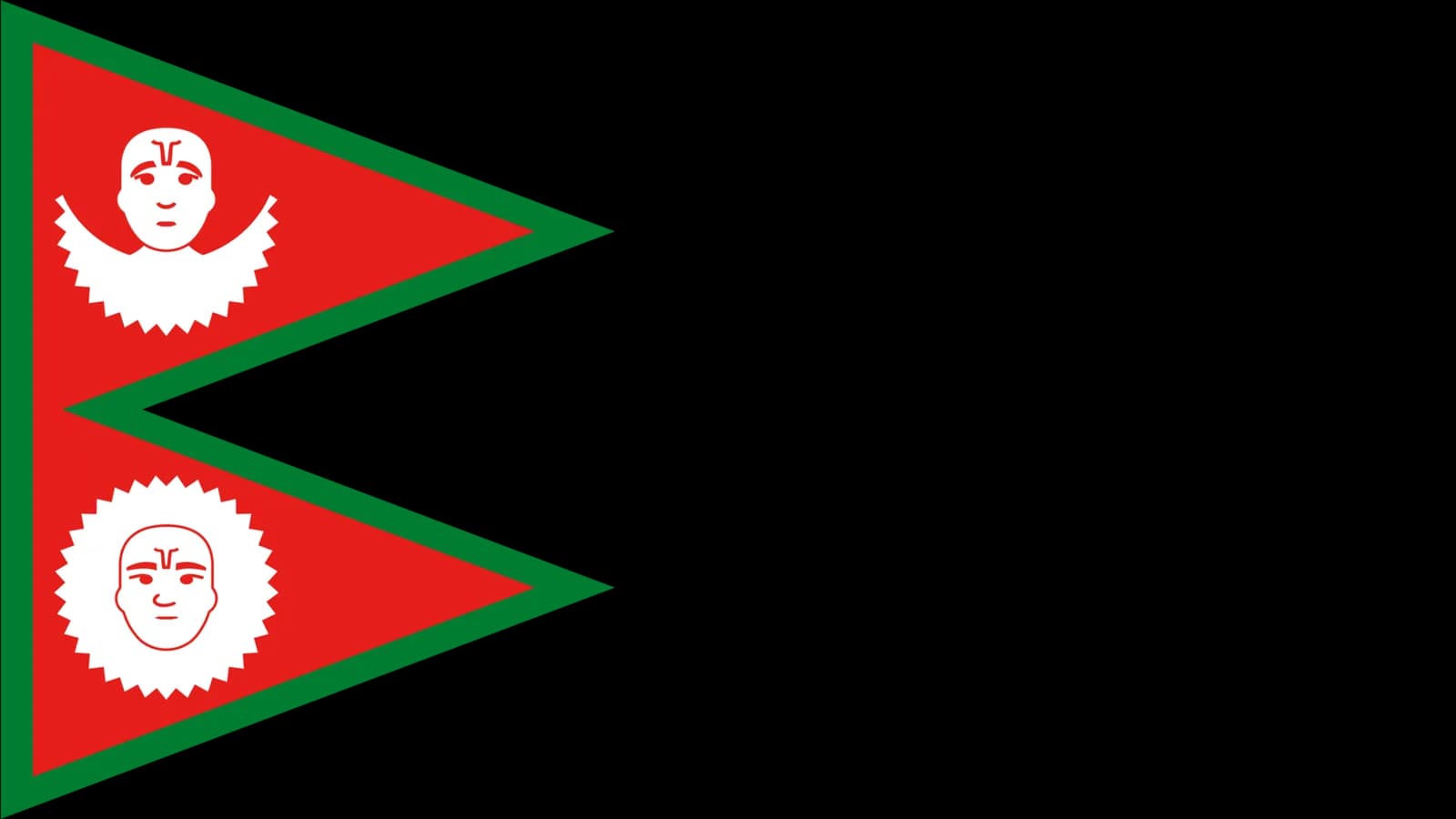
One visible change came with the redesign: earlier flags showed the sun and moon with human faces, which were removed in 1962 to give the cleaner, more abstract emblems flown now.
What every element means
Nepal's flag packs a lot of meaning into a small, sharply defined shape.
The colours
| Element | Colour | Meaning | |---|---|---| | Main field | Crimson red | Bravery; the colour of the rhododendron, Nepal's national flower | | Border | Deep blue | Peace and harmony |
The crimson is the dominant colour you see first, framed all the way around by a thin blue edge. Both shades are fixed exactly in the constitution, so an official Nepali flag is never an approximation of these colours — it is the precise ones the law names.
The sun and the moon
The two white emblems are the heart of the flag's symbolism:
- The moon, in the upper pennant, stands for peace, the cool Himalayan climate, and the calm, composed nature of the Nepali people.
- The sun, in the lower pennant, stands for heat, the warmth of the southern lowlands, and fierce resolve.
Read together, the sun and moon also carry an old hope: that Nepal will last as long as these heavenly bodies endure. They have additionally been linked to the Lunar and Solar dynasties of Nepal's royal history.
The two triangles, read symbolically
Beyond their dynastic origin, the two stacked triangles are popularly understood to echo the Himalayan peaks that define the country, and to represent its two great religious traditions — Hinduism and Buddhism — coexisting. It is a fittingly layered meaning for a nation whose temples and stupas so often stand within sight of one another.
A flag written as a geometry problem
Here is the detail that delights mathematicians: Nepal's constitution does not just describe the flag — it tells you how to build it. The official text lays out a sequence of construction steps using straight lines and arcs, the kind you would draw with a ruler and compass, to generate the exact outline, the border width, and the placement and size of the sun and moon.
In other words, Nepal's founding law contains a step-by-step geometric recipe for drawing the national flag by hand. Almost no other country specifies its flag this way. The proportions that result are unusual too: because the shape is built from these constructions rather than a simple ratio of width to height, the flag's overall dimensions don't reduce to a clean number like 2:3. It is a banner defined by geometry, not by a tape measure — which feels entirely appropriate for the world's only flag that refused to become a rectangle.
Why the shape causes real-world headaches
The double pennant is beautiful, but its five-sided outline creates genuinely awkward problems that rectangular flags never face. Flagpoles, brackets and fittings worldwide are built for rectangles, so Nepali flags often need custom mounting. Software and emoji sets struggled for years to render a non-rectangular flag inside the rectangular box every other flag occupies, leaving Nepal's emoji looking cramped or oddly padded. Even international sporting events and the United Nations, where rows of identical-sized rectangular flags fly side by side, have to make a special accommodation for the one banner that refuses to fit the row.
These are minor inconveniences, and Nepal has never shown the slightest inclination to "fix" them by squaring off its flag. The shape is a point of national pride precisely because it is difficult — a small country's insistence on keeping its own form in a world that standardised around someone else's.
A note on respect
If you photograph or fly the flag as a visitor, a little awareness goes a long way. Nepalis are proud of their flag, and like national flags everywhere it is treated with respect — it should not be used as decoration draped on the ground, worn casually, or shown upside down. The sun should sit in the lower pennant and the moon in the upper one; flying it inverted is both incorrect and disrespectful. This is the same courtesy worth extending at the country's temples and sacred sites, where a respectful approach is always appreciated.
Seeing the flag in Nepal
You will see the double pennant everywhere once you arrive — over government buildings, schools, army posts, shopfronts and temple courtyards. It looks especially striking flying above the tiered pagoda roofs of Kathmandu Durbar Square, where the old Asia the flag belongs to is still standing all around it. You will also spot it stitched onto trekking packs and waved on the trail toward Everest Base Camp, a little two-pointed badge of the country underfoot. For visitors, picking out that unmistakable silhouette against the skyline is a small, quietly memorable part of being in the one country that kept its flag exactly as it always was.
Sources
Frequently asked questions
- Why is Nepal's flag not rectangular?
- Nepal simply never switched. Its flag grew from two ancient triangular pennants flown by the ruling dynasty, and unlike the rest of the world Nepal kept that shape instead of adopting the rectangular banner that European convention spread everywhere else. The result is the only non-rectangular national flag in use today.
- Is Nepal the only country with a non-rectangular flag?
- Yes. Nepal has the only non-quadrilateral national flag in the world. Every other sovereign country flies a four-sided flag, whether rectangular or square, while Nepal's is a five-sided shape made of two stacked triangles.
- What do the two triangles on Nepal's flag mean?
- The two triangular pennants come from banners historically used by rival branches of Nepal's ruling house, later joined into one flag. They are also commonly said to represent the Himalayan mountains and the country's two main religions, Hinduism and Buddhism, living side by side.
- What do the sun and moon on Nepal's flag symbolise?
- The moon in the upper pennant stands for peace, the cool Himalayan climate and the calm nature of Nepalis, while the sun in the lower pennant represents heat, resolve and fierce determination. Together they are also read as a wish that Nepal endure as long as the sun and moon themselves.
- What do the colours of Nepal's flag mean?
- The deep crimson field is the colour of the rhododendron, Nepal's national flower, and signifies bravery. The blue border that frames the whole flag stands for peace and harmony. Both colours are fixed precisely in the constitution.
- When was Nepal's current flag adopted?
- The modern standardised flag was adopted on 16 December 1962, when Nepal introduced a new constitution. The shape itself is far older, but the exact geometry and proportions date from that 1962 specification.
- How is Nepal's flag drawn?
- The constitution lays out the flag as a geometry exercise, building the shape step by step with lines and arcs rather than fixed measurements. This makes Nepal one of the very few countries whose founding law literally explains how to construct its flag by hand.
- Did Nepal's flag once have faces on the sun and moon?
- Yes. Older versions of the flag showed the sun and moon with human faces. The faces were removed in the 1962 redesign to modernise and simplify the emblems, leaving the plain sun and crescent moon used today.
Related posts
The Nepal Flag: Meaning, Colours & History Explained
A clear guide to the Nepal flag — its crimson and blue colours, the sun and moon, the double-pennant shape, its history, and how it is drawn by geometry.
Read postKathmandu Durbar Square: A Visitor's Guide (2026)
The old royal palace square at the heart of Kathmandu — what to see, the entry fee, the living goddess, and how the 2015 earthquake reshaped it.
Read postLanguages of Nepal: Official Language & 124 Mother Tongues
Languages of Nepal explained: Nepali is the official language, but the 2021 census counted 124 mother tongues from Maithili to Newar. A clear guide.
Read post