Tibetan Buddhism in Nepal: A Traveler's Guide
Tibetan Buddhism in Nepal explained for travelers — its four schools, the Boudhanath diaspora, Himalayan gompas, festivals and how to visit respectfully.
It arrived on a trade route and stayed: the maroon-robed, prayer-flag world you meet from Boudha's kora to a gompa above the snow line.
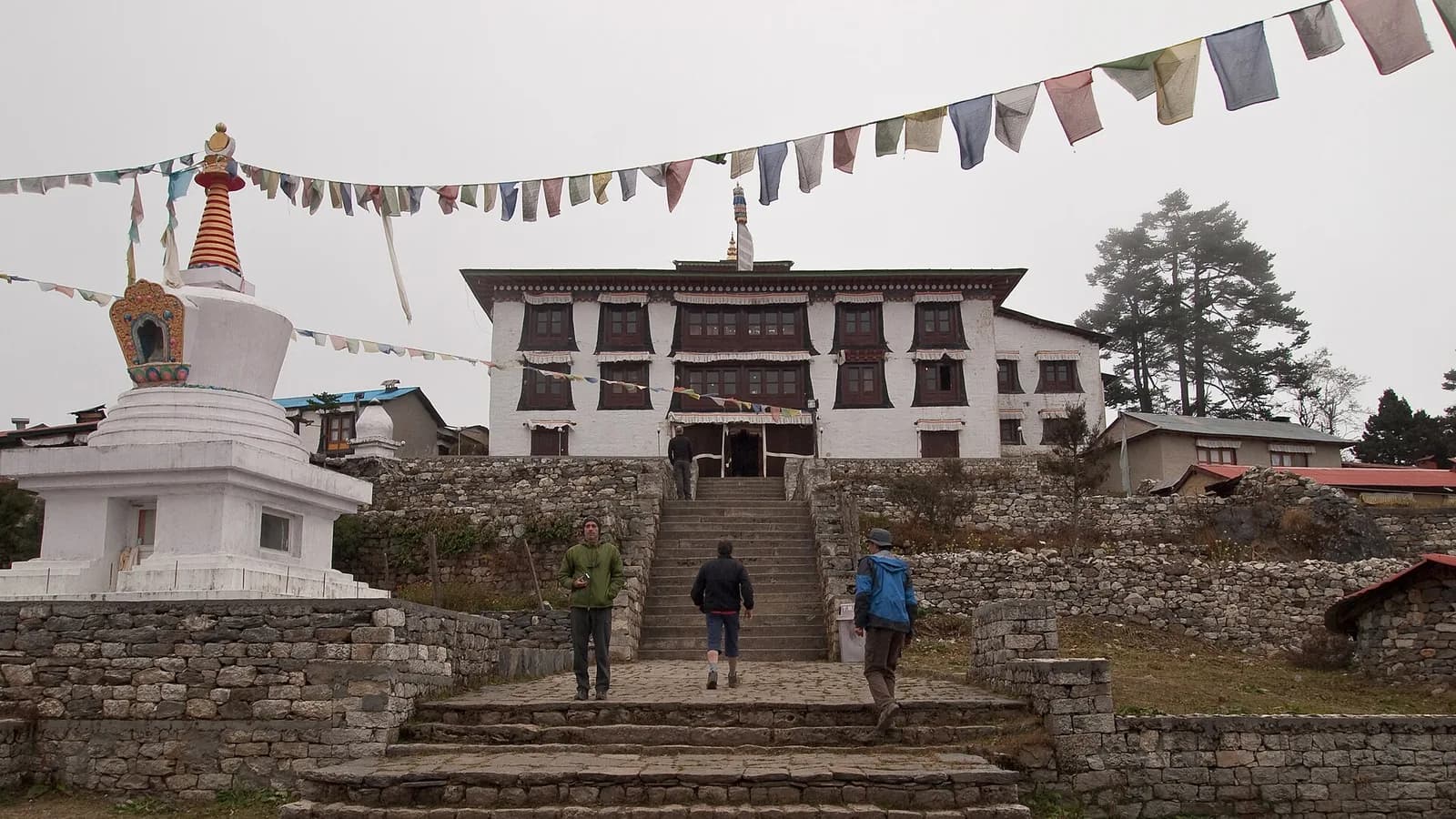
Tibetan Buddhism in Nepal is the maroon-robed, prayer-flag world most travelers picture when they imagine the Himalaya — but it is also one of three distinct Buddhist traditions living in the country, and it is worth understanding on its own terms. It is the Vajrayana school of the Tibetan plateau, carried south over centuries of trade and then anchored in Kathmandu by refugees who arrived after 1959. Today you meet it in two very different settings: the dense monastery quarter around the great Boudhanath stupa, and the high mountain valleys where Sherpa, Tamang and Lopa communities have practised it for generations.
This guide focuses on the Tibetan strand specifically — its history in Nepal, its four schools, where to encounter it, the festivals that bring it alive, and how to visit with respect. For the bigger picture of how it sits alongside Newar Vajrayana and the Theravada revival, see our companion guide to Buddhism in Nepal.
Key takeaways
- Tibetan Buddhism is the Himalayan Vajrayana tradition, distinct from the older Newar Buddhism of the Kathmandu Valley.
- Boudhanath, in northeast Kathmandu, is its spiritual center in Nepal — a UNESCO World Heritage Site since 1979.
- The tradition grew sharply after the 1959 Tibetan uprising, when refugees settled around Boudha and built over 50 monasteries there.
- There are four main schools: Nyingma, Kagyu, Sakya and Gelug, all represented in Nepal.
- In the high country it is the everyday faith of communities such as the Sherpa, Tamang, Gurung and Lopa of Mustang and Dolpo.
- Roughly 10,000 Tibetan refugees now live in Nepal, down from about 20,000 in the mid-1990s.
How Tibetan Buddhism reached Nepal
The Tibetan presence in Nepal is not new. For centuries, traders crossing between the Kathmandu Valley and Lhasa rested and prayed at the Boudhanath stupa, which sat on the old trade route north. Tibetan Buddhism established itself as a meaningful presence here long before the modern era, with the stupa serving as a natural waypoint for merchants beginning the long haul toward Tibet.
The decisive modern shift came in 1959. After the failed uprising in Lhasa against Chinese rule, a large number of Tibetan refugees crossed the Himalaya, and many settled around Boudhanath. That community transformed Boudha from a revered but quiet pilgrimage site into the beating heart of Tibetan Buddhism in exile, ringed by monasteries, guesthouses and Tibetan-run businesses.
It is worth being precise about what "Tibetan Buddhism" means in Nepal, because the country is unusually layered. The indigenous Newar Vajrayana of the valley is older still — by scholarly consensus the oldest surviving Vajrayana tradition — and works quite differently, with hereditary, non-celibate priests rather than monastic gompas. Tibetan Buddhism is the plateau tradition: monasteries, reincarnate lamas, and the four schools described below. For how the two compare with the wider Himalayan picture, our Nepal vs Tibet guide is a useful companion.
The four schools you will encounter
Tibetan Buddhism is not monolithic. It is organized into four main schools that share a common goal — liberation on the bodhisattva path — but differ in their lineages, their key texts, and which practices they emphasize. All four are present in Nepal, and several have major monasteries clustered around Boudhanath.
| School | Tibetan meaning | Roughly when | Known for | |---|---|---|---| | Nyingma | "Ancient" | 8th century | Oldest school; Dzogchen meditation; ties to Guru Padmasambhava | | Kagyu | "Oral lineage" | 11th century | Whispered transmission from master to disciple; yogic practice | | Sakya | "Pale earth" | 11th century | Scholarship; the Lamdre "path and fruit" teaching | | Gelug | "Virtuous" | 14th–15th century | Newest and largest; founded in the lineage of Je Tsongkhapa |
A few orientation notes. Nyingma, the "ancient translation school," dates to the first wave of translating Buddhist scriptures from Sanskrit into Tibetan in the 8th century. Kagyu takes its name from a Tibetan term meaning "oral lineage," reflecting how its practices passed by direct transmission through a chain of masters. Sakya is named for the pale, grey earth near its founding monastery in Tibet. Gelug, the newest and largest, grew from the reform movement associated with the teacher Je Tsongkhapa (1357–1419), who founded Ganden Monastery in 1409.
You do not need to memorize the differences to appreciate a monastery, but recognizing the names helps: a sign reading "Ka-Nying" or "Sakya" or "Gelug" on a Boudha gompa is telling you which lineage you are about to step into.
Boudhanath: the center of it all
If Tibetan Buddhism in Nepal has a single address, it is Boudhanath (locally "Boudha"). The white dome topped by the painted Buddha eyes is the largest stupa in the country and among the largest anywhere, and it functions as the spiritual nucleus of the Tibetan community.
The present structure is most likely 14th century, though Newar chronicles record a stupa here as early as the 5th century. It became a UNESCO World Heritage Site in 1979. After the April 2015 earthquake cracked the spire, an international restoration — reportedly using more than 30 kilograms of gold — saw the stupa reopen on 22 November 2016.
What makes Boudha extraordinary is not just the monument but the living scene around it. The Tibetan diaspora built over 50 gompas in the immediate area, representing different schools and regional lineages. From before dawn until late at night, pilgrims walk the kora — the clockwise circuit — spinning rows of prayer wheels, while butter lamps glow and monks chant in the surrounding monasteries.
Practical visiting facts
- Entry fee: NPR 400 for foreign visitors (as of 2025); NPR 100 for SAARC nationals; free for Nepalis and young children.
- Hours: The square is effectively open around the clock for circumambulation; the ticket counters typically run roughly 5 AM to 7 PM, varying by season and festival.
- Best moments: Dawn and dusk, when the kora is busiest and the light is kindest.
Our dedicated Boudhanath stupa visitor guide covers the layout, the meaning of the eyes, and how to spend a half-day there well.
Beyond Boudha: the Tibetan quarter and the valley
Boudhanath is the focus, but it is not the only place in Kathmandu to encounter the tradition. The hilltop Swayambhunath — the "Monkey Temple" — carries both Tibetan and Newar significance, and its Buddha eyes are the city's other great Buddhist landmark. To the southeast of the valley, Namo Buddha is a hill stupa tied to a story of the Buddha's compassion in a past life, and it hosts a significant Kagyu monastery.
These valley sites make Tibetan Buddhism accessible to any visitor with a free afternoon — no trek required. They also show how the Tibetan tradition has woven itself into a city it shares with Hindu and Newar Buddhist sacred geography.
Tibetan Buddhism in the high Himalaya
Leave the valley and Tibetan Buddhism stops being a quarter of a city and becomes the fabric of whole landscapes. Across Nepal's northern belt — close to the Tibetan border in culture as well as geography — highland communities have practised the plateau tradition for centuries.
The communities who keep it
- The Sherpa of the Everest (Solu-Khumbu) region, historically traders and herders with deep Tibetan Buddhist roots. Read more in our Sherpa people guide.
- The Tamang, among the oldest Himalayan inhabitants of Nepal, culturally linked to Tibetan groups and concentrated around the Langtang region.
- The Gurung of the Annapurna foothills, many of whom follow Tibetan Buddhist practice alongside older traditions.
- The Lopa (Loba) of Upper Mustang and the people of Dolpo, whose remote valleys preserve some of the most intact Tibetan Buddhist culture in the Himalaya.
Gompas along the trails
For trekkers, the tradition is constant and unmistakable: prayer flags strung across passes, mani walls carved with the mantra om mani padme hum, chortens (the Tibetan term for a stupa) marking village edges, and gompas perched above the rooftops.
| Region | Notable monastic sites | Tradition on display | |---|---|---| | Everest / Khumbu | Tengboche, Pangboche gompas | Sherpa Buddhism; mountain festivals | | Langtang | Kyanjin Gompa and village shrines | Tamang Buddhist culture | | Upper Mustang | Lo Manthang's Thubchen, Jampa and Chode gompas | Centuries-old royal monasteries | | Dolpo | Shey Gompa near Crystal Mountain | Vajrayana blended with older Bon elements |
In Upper Mustang, the walled capital of Lo Manthang holds three major monasteries — Thubchen, Jampa and Chode — that have preserved the region's Buddhist art and ritual for centuries; Jampa Gompa's origins trace to the early 14th century. In Dolpo, monasteries such as Shey Gompa, built in the 11th century near the sacred Crystal Mountain, anchor a culture where Tibetan Vajrayana mingles with the older indigenous Bon religion. If these remote valleys call to you, our guides to the Upper Mustang trek and the Dolpo trek explain the permits and logistics involved.
The refugee community today
The Tibetan community that gives Boudha its character is, quietly, under pressure. Estimates put the number of Tibetan refugees in Nepal at roughly 10,000 today, down from about 20,000 in the mid-1990s — part of a broader, steady decline across South Asia since the mid-2000s. The Central Tibetan Administration counts a spread of settlements in Nepal, including agriculture-based and handicraft-based communities, each overseen by an appointed representative.
For visitors, this context matters because it shapes what you are seeing. The monasteries, the craft workshops, the Losar celebrations around Boudha — these are the institutions of an exile community working to keep a tradition alive far from its homeland. Treating that with curiosity and respect, rather than as a backdrop for photos, is part of visiting well.
Festivals that bring it alive
Timing a visit to a Tibetan Buddhist festival turns sightseeing into something closer to participation. The calendar follows the Tibetan lunar system, so dates shift year to year — confirm locally before you plan around one.
- Losar (Tibetan New Year) — usually February, the biggest celebration, centered on Boudhanath and the refugee settlements, with masked cham dances, processions, feasting and color. Several communities mark their own Losars (Gyalpo, Tamu, Sonam) at slightly different times.
- Saga Dawa — a sacred month around May–June commemorating the Buddha's birth, enlightenment and passing, when merit-making peaks and thousands of butter lamps are lit.
- Mani Rimdu — a Sherpa monastic festival in the Everest region, famous for its masked dances at monasteries such as Tengboche, typically in autumn.
For how these sit within Nepal's wider, often overlapping Hindu and Buddhist festival calendar, see our overviews of Buddha Jayanti and the broader cultural year in Nepali culture.
Reading the symbols
Part of the pleasure of Tibetan Buddhism is that its visual language is everywhere once you can read it.
- Prayer flags carry mantras the wind is believed to scatter as blessings; a faded flag has done its work, not failed. Our prayer flags guide explains the five colors and the wind horse.
- Prayer wheels hold rolled mantras; spinning one clockwise is a way of releasing those blessings.
- Mani walls and chortens are passed on the left, keeping the structure on your right, in the clockwise spirit of the kora.
- Thangka and paubha paintings depict deities and mandalas used in meditation and teaching; see our thangka painting guide.
- Singing bowls, sold across Kathmandu, are associated with the tradition's meditative and ritual soundscape — more in our singing bowls guide.
Visiting respectfully
Tibetan Buddhist sites in Nepal are active places of worship. A little awareness goes a long way and is genuinely appreciated.
- Walk clockwise around every stupa, chorten and mani wall — never against the flow.
- Spin prayer wheels gently with your right hand, clockwise.
- Remove your shoes before entering a gompa's shrine room.
- Dress modestly, shoulders and knees covered, and keep your voice low during prayers.
- Ask before photographing monks at prayer or shrine interiors, and avoid flash near old murals.
- Do not point your feet at altars, statues or monks; tuck them under you when seated.
These overlap with general practice across the country, which our Nepal temple etiquette guide covers in depth. A few warm words help too — the greetings in our Nepali phrases every trekker should know travel well in monastery towns.
Sources
- Boudha Stupa — Wikipedia
- Tibetan Buddhism — Wikipedia
- The Four Schools of Tibetan Buddhism — Tibetan Nuns Project
- Tibetan diaspora — Wikipedia
- South Asia's Tibetan Refugee Community Is Shrinking — Migration Policy Institute
- Three Major Monasteries of Lo-Manthang — Himalayan Wander Walkers
- Monasteries of the Dolpo Region — Himalayan Wander Walkers
Frequently asked questions
- What is Tibetan Buddhism in Nepal?
- It is the Vajrayana tradition of the Tibetan plateau, practised across Nepal's high Himalaya by communities like the Sherpa, Tamang and Lopa, and centred in Kathmandu around the Boudhanath stupa.
- Where is the centre of Tibetan Buddhism in Nepal?
- Boudhanath in northeast Kathmandu, the largest stupa in the country, became the spiritual heart of the Tibetan community after refugees settled there following the 1959 uprising.
- What are the four schools of Tibetan Buddhism?
- Nyingma, Kagyu, Sakya and Gelug. They share the same goal but differ in their lineages, key texts and emphasis, and all four are represented in Nepal's monasteries.
- Is Tibetan Buddhism the same as Newar Buddhism?
- No. Newar Vajrayana is the older indigenous tradition of the Kathmandu Valley with hereditary priests, while Tibetan Buddhism is the Himalayan plateau tradition with monastic gompas.
- How many Tibetan refugees live in Nepal?
- Recent estimates put the figure at roughly 10,000, down from about 20,000 in the mid-1990s, spread across settlements supervised by the Central Tibetan Administration.
- Can tourists visit Tibetan Buddhist monasteries in Nepal?
- Yes. Boudhanath and many gompas welcome respectful visitors. Remove your shoes, walk clockwise around stupas, keep quiet during prayers and ask before photographing monks.
- What is a gompa?
- A gompa is a Tibetan Buddhist monastery or temple. You will see them perched above villages throughout the Everest, Langtang, Manaslu, Mustang and Dolpo regions.
- When is the best Tibetan Buddhist festival to see in Nepal?
- Losar, the Tibetan New Year around February, is the biggest celebration, centred on Boudhanath with masked dances, processions and feasting.
Related posts
Boudhanath Stupa — Visitor Guide to Kathmandu's Tibetan Buddhist Heart
The largest stupa in Asia, the spiritual center of Tibetan Buddhism in exile, and one of Kathmandu's most accessible cultural experiences.
Read postBoudhanath Stupa: Architecture & Symbolism Guide
How to read the Boudhanath stupa — its mandala shape, the Buddha eyes, the 13 golden steps, and the meaning behind the clockwise kora walk.
Read postBuddha Jayanti at Lumbini — Buddha Purnima Festival Guide
Buddha Jayanti at Lumbini marks Buddha's birth on the May full moon. What the festival looks like, when it falls, and how to attend respectfully.
Read post