Swayambhunath — The Monkey Temple Visitor Guide (and Monkey Etiquette)
Kathmandu's other great stupa, the 365-step climb, the panoramic view, and how to navigate the resident macaques without getting bitten.
Two hundred macaques. One stupa. They were here first.
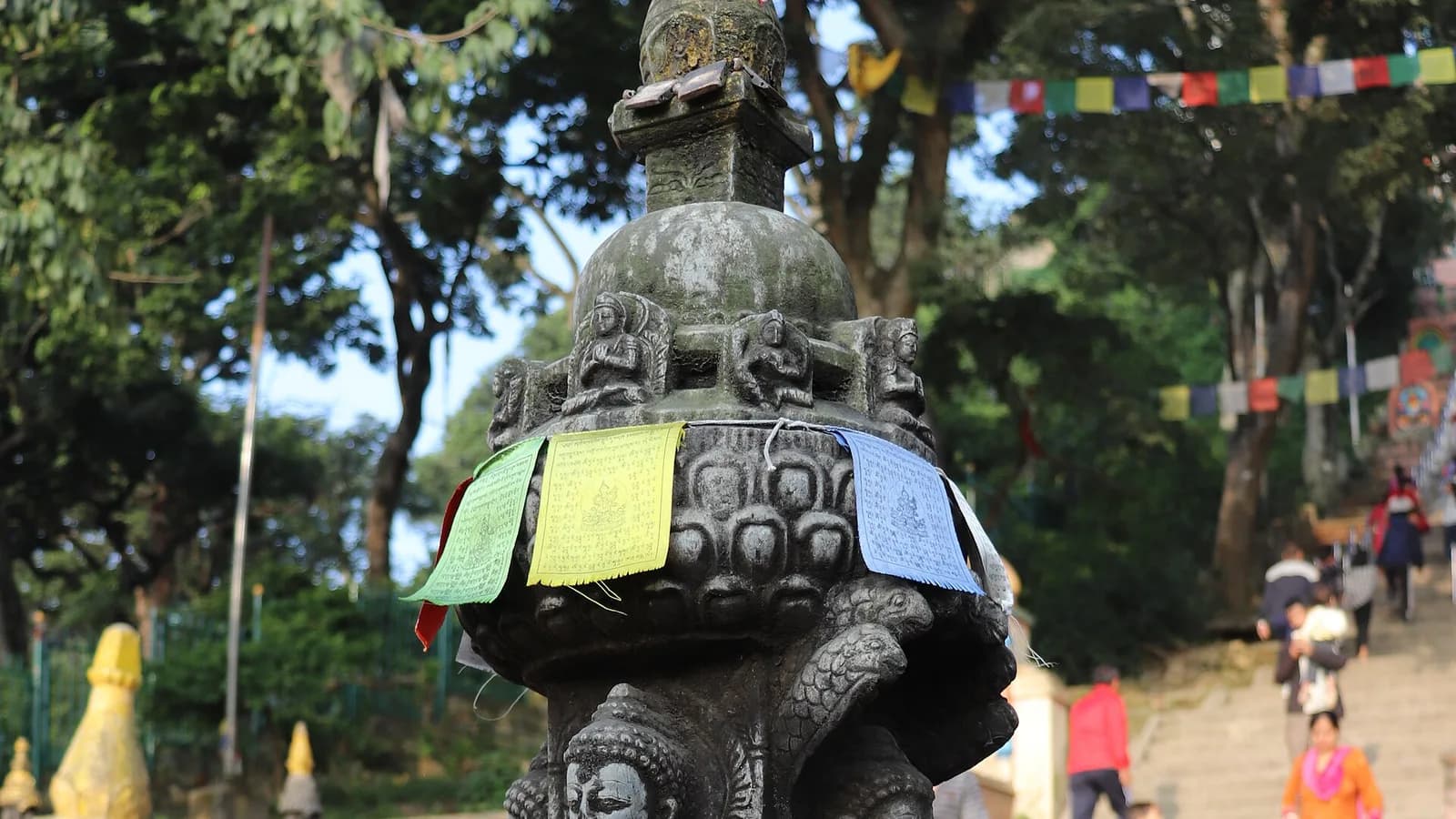
Swayambhunath sits on a hill in west Kathmandu, visible from most of the valley. Like Boudhanath, it's a Buddhist stupa with the Buddha's eyes painted on its tower. Unlike Boudhanath, it sits on a small mountain reached by climbing 365 steep stone steps — and that hill is home to a population of roughly 200 rhesus macaques.
The temple is 2,000+ years old. The monkeys are uninvited but permanent residents, and they shape the visiting experience as much as the stupa does.
The basics
Entry fee for foreigners: NPR 200 (~$1.50). Paid at the main staircase entrance.
Hours: 24/7, but visitors should go in daylight. The hill is genuinely steep and dimly lit at night.
Time to visit: 2-3 hours including the climb.
Location: about 5 km west of Thamel. Taxi takes 20 minutes; walking takes 60-90 minutes through the city.
There are two routes up the hill:
- The east staircase: 365 steep stone steps. The classic approach. Steep but direct.
- The road: a winding road on the west side. Taxis can drive most of the way up, dropping you near the upper plaza. Easier but less of an arrival experience.
Most travelers take the staircase up and the road (or a downhill walk via the road) down.
The climb
The 365 steps are steep. They're divided into sections, with periodic landings. The climb takes 15-25 minutes depending on fitness. At Kathmandu's 1,400m altitude, it's not strenuous for most travelers but isn't a casual walk either.
The lower steps have stalls selling religious items and souvenirs. The upper steps pass small shrines and statues. About two-thirds of the way up, the views start opening — you can look back at the valley and see Kathmandu spread below.
The monkeys
There are roughly 200 rhesus macaques living at Swayambhunath. They've been there for centuries — the temple has cultural significance and the monkeys are considered sacred (Hanuman, the monkey god, is venerated).
The monkeys are:
- Used to humans — they don't run from you
- Opportunistic — they will grab food, water bottles, shiny objects, sunglasses, hats
- Sometimes aggressive — especially when food is involved
- Disease-carriers — rabies risk is real (see our vaccinations guide)
The standard tourist mistake: holding food visibly, especially fruit or snacks. The monkeys will track you, approach you, and sometimes leap at you to grab the food. They are remarkably fast.
Monkey etiquette
- Don't bring visible food — keep snacks deep in a closed bag
- Don't hold water bottles in your hand — they'll grab them, then bite the top off and drink
- Don't make eye contact for long — male macaques interpret prolonged eye contact as a challenge
- Don't smile with teeth showing — macaque "smiling" (showing teeth) is an aggressive display, and they sometimes read human smiles the same way
- Don't reach toward them — even to take a photo
- Don't approach babies — adult macaques are protective of infants and will attack
- If a macaque approaches you aggressively: stand tall, look slightly away (not directly at it), back away slowly without turning your back
- If a macaque steals something: let it go. Don't fight a macaque for a hat. They have stronger arms than you and 32 teeth they're willing to use.
The monkeys are usually fine if you respect them. Bites happen most often to tourists who don't.
If you're bitten
Wash the wound thoroughly with soap and water for at least 15 minutes. Apply iodine if you have it.
Get to CIWEC Clinic in Kathmandu (Lazimpat, +977-1-4424111) or Norvic International Hospital as soon as possible. Rabies post-exposure prophylaxis is time-sensitive.
If you got the pre-exposure rabies vaccination (see Nepal vaccinations guide), the post-exposure treatment is two more shots (no rabies immunoglobulin required). If you didn't, it's more complicated and rabies immunoglobulin is sometimes unavailable in Nepal — you may need to travel to Bangkok or Delhi.
At the top
The upper plaza has:
- The main stupa with the iconic Buddha eyes
- The Vajra — a giant ornamental thunderbolt symbol at the front of the plaza
- Multiple smaller temples — both Buddhist and Hindu (Swayambhunath is one of the rare sites venerated by both traditions)
- A small monastery with butter lamps and ongoing chanting
- The panoramic view of the Kathmandu Valley — the best free viewpoint of the city
The combination of view, religious activity, and monkey watching keeps most travelers at the top for an hour or more.
What to photograph
- The stupa itself
- The Buddha eyes
- The Vajra in the foreground with the stupa behind
- The Kathmandu Valley view (best in late afternoon when the air clears)
- Monkeys from a safe distance (no close-ups)
The lighting is best in the late afternoon (3-5 PM in winter, 4-6 PM in summer). The valley view is at its clearest after rain.
The west-side viewpoint
Most travelers stop at the main stupa. A few minutes' walk past the back of the plaza, on the west side of the hill, there's a quieter viewpoint with a smaller stupa and meditation area. Far fewer tourists; same view; usually fewer monkeys. Worth the extra walk.
When to visit
- Morning (7-9 AM): religious activity is at its peak. Monks chant. Pilgrims circumambulate. Light is good. Monkeys are calmer.
- Late afternoon (3-5 PM): best light for photos. Valley view at its clearest.
- Avoid mid-day in summer — the climb in 30°C heat is exhausting.
The bigger context
Swayambhunath is older than Boudhanath. Some Tibetan Buddhist traditions hold that the original stupa here was built in the 5th century BCE, making it 2,500+ years old. The site was significantly damaged in the 2015 earthquake; restoration completed in 2021.
The site is technically more "Hindu-Buddhist syncretic" than purely Buddhist — Hindu shrines coexist with Buddhist ones, reflecting Nepal's blending of the two traditions.
Pre-visit checklist
- NPR 200 for entry
- Sturdy shoes (the steps are steep and uneven)
- Water bottle (in a CLOSED bag — monkeys will grab it from your hand)
- No visible food
- Sunglasses you can afford to lose
- Camera or phone
- Cover shoulders/legs (this is a religious site)
- The vaccinations guide — confirm rabies pre-exposure if not already done
- A few hours of energy
Swayambhunath is one of Kathmandu's most accessible significant cultural sites. The climb is real but the reward is the panoramic view, the ancient stupa, and a population of monkeys who've made the place their own.
Related posts
Monkey Temple Kathmandu: History, Myth & Meaning
The story behind the Monkey Temple in Kathmandu (Swayambhunath): its self-arisen legend, 5th-century roots, UNESCO status, and why it matters.
Read postBoudhanath Stupa: Architecture & Symbolism Guide
How to read the Boudhanath stupa — its mandala shape, the Buddha eyes, the 13 golden steps, and the meaning behind the clockwise kora walk.
Read postBuddha Statue Nepal: A Traveller's Guide to the Best
Where to see the most striking Buddha statue sites in Nepal, from the giant golden trio at Swayambhu to the stone Buddha of Mustang.
Read post