Manaslu Expedition: Climbing the 8,163m Eighth-Highest Peak
A Manaslu expedition guide for the 8,163m peak — 2026 permit royalty, costs, the route and camps, best season, the true-summit debate and safety.
Often called the gentlest 8,000er — which is exactly why it deserves your respect, not your complacency.
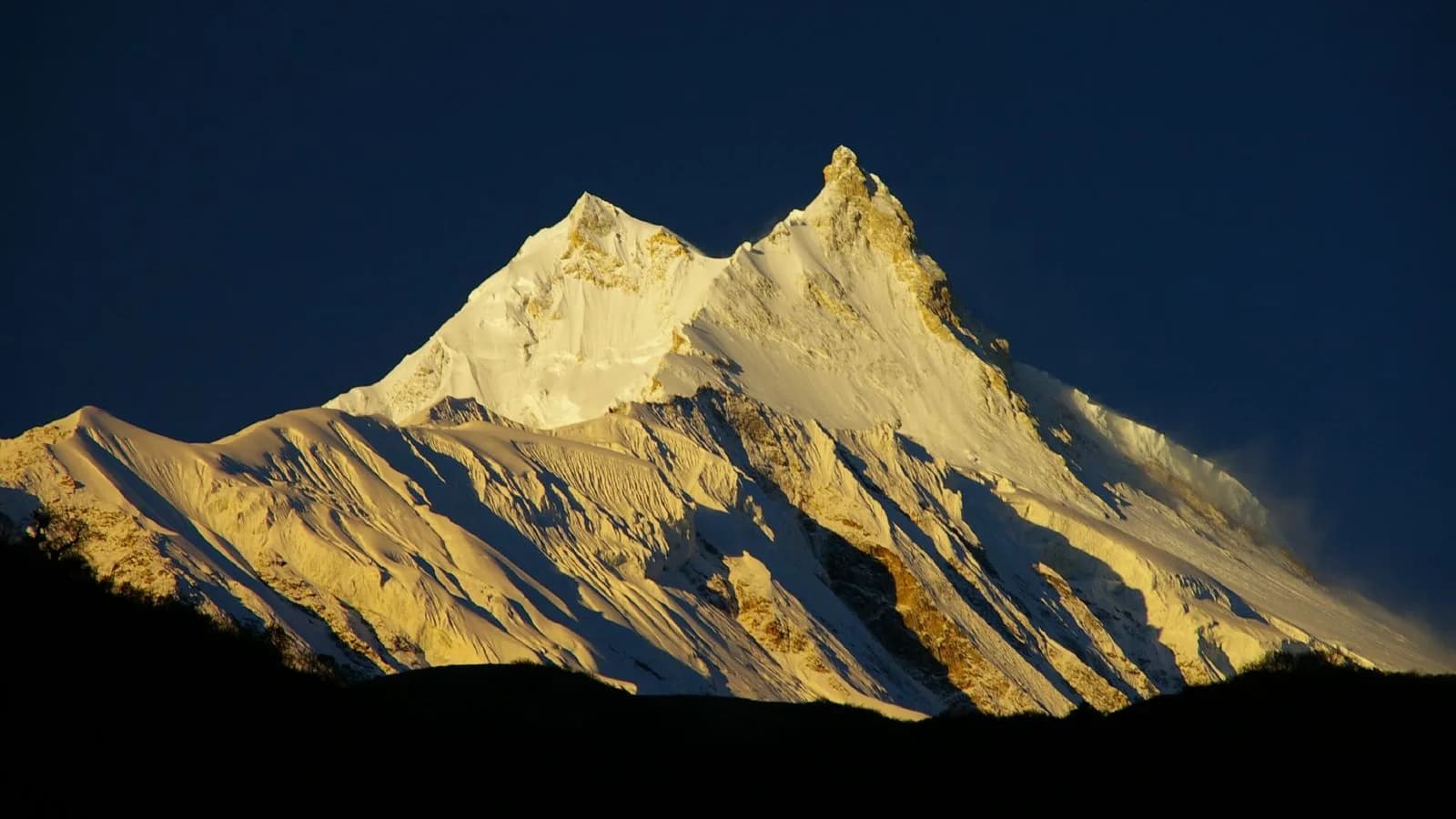
A Manaslu expedition is, for many climbers, the moment the dream of an 8,000-metre peak stops being abstract. At 8,163m (26,781ft) Manaslu is the world's eighth-highest mountain, and over the past decade it has become one of the most climbed of the fourteen 8,000ers — often pitched as the "gentlest" gateway to the death zone and a logical rehearsal for Everest. This guide covers what that reputation gets right, what it dangerously glosses over, and the practical facts you need: the 2026 permit royalty, realistic costs, the route and camps, the best season, and the honest safety picture, including the foresummit debate that rewrote how summits on this peak are counted.
To be clear from the outset, this is about summiting the mountain — a major mountaineering undertaking. If you are looking to walk the famous valley loop beneath the peak instead, that is a completely different trip; see our Manaslu Circuit trek guide.
Key takeaways
- Manaslu is 8,163m, the eighth-highest peak, in Nepal's Gorkha district; first climbed on 9 May 1956 by a Japanese team.
- The climbing permit royalty is USD 3,000 in spring and USD 1,500 in autumn/winter (effective 1 Sep 2025), far below Everest's USD 15,000 spring fee.
- Full-service guided packages typically run USD 9,500–18,000, with VIP options above USD 25,000 (as of June 2026).
- Autumn (late September–October) is the prime commercial season — unusual among 8,000ers, which mostly peak in spring.
- It is marketed as an accessible first 8,000er, but it is also rated among the more avalanche-prone and dangerous of the high peaks.
- A 2022 investigation found most "summits" stopped at a foresummit, not the true top.
The mountain: facts and context
Manaslu rises in the Mansiri Himal of west-central Nepal and is the highest point of the Gorkha district, sitting about 64km east of Annapurna. The name comes from the Sanskrit manasa, often translated as "mountain of the spirit" or "mountain of the intellect/soul." It was first summited on 9 May 1956 by Toshio Imanishi and Sherpa Gyalzen Norbu, members of a Japanese expedition led by Maki Yūkō — a heritage so strong that Manaslu is sometimes called Japan's mountain, much as Everest was long associated with British attempts.
For mountaineers, three things make Manaslu stand out among the 8,000ers:
- Accessibility. The normal route is technically moderate by 8,000m standards and is fully fixed with rope each season, which is why it draws commercial teams in large numbers.
- An autumn peak season, when most other high peaks are out of favour.
- A genuine summit problem — the true top is harder and far less often reached than the headline ascent numbers suggest.
How it compares to other Nepali peaks
If you are weighing Manaslu against other objectives, two of our guides are useful: the Annapurna vs Manaslu comparison (focused on trekking, but helpful on the region) and, for the ultimate goal most Manaslu climbers have in mind, the Everest expedition cost breakdown.
Permits and the 2026 royalty
Manaslu lies in a restricted area, so an expedition needs several permits, all arranged through your registered Nepali operator — you cannot organise this independently. The headline figure is the climbing royalty paid to Nepal's Department of Tourism.
Under the revised royalty schedule that took effect on 1 September 2025, the fees for foreign climbers are:
| Peak | Spring | Autumn | Winter/Summer | |---|---|---|---| | Manaslu (8,163m) | USD 3,000 | USD 1,500 | USD 1,500 | | Other 8,000m peaks (general) | USD 3,000 | USD 1,500 | USD 750 | | Everest — normal route | USD 15,000 | USD 7,500 | USD 3,750 |
All figures above are as of June 2026. On top of the climbing royalty you also pay the Manaslu Restricted Area Permit (around USD 15 per day in autumn) and the Manaslu Conservation Area Permit (around USD 30), plus garbage/liaison deposits that your operator handles. For more on the trekking-side permits used to reach the area, see our Manaslu trek permit cost guide.
Note that Manaslu's autumn royalty (USD 1,500) is double the general autumn fee for most other 8,000ers (USD 750) — a reflection of how popular and commercially busy the peak has become.
What an expedition costs in 2026
The permit is only one line in a much larger budget. A guided Manaslu climb bundles logistics, base-camp infrastructure, Sherpa support, fixed ropes, oxygen and rescue arrangements. Published 2026 pricing from Nepal-based operators clusters as follows.
| Service level | Typical 2026 price (per climber) | |---|---| | Base-camp-only / logistics support | from roughly USD 8,500 | | Full guided expedition | ~USD 9,500–18,000 | | VIP / premium package | USD 25,000 and up |
These are guide figures (as of June 2026), and the spread is driven by the same factors that move any 8,000m quote: the Sherpa-to-client ratio, how many bottles of supplemental oxygen are included, the quality of base-camp food and tents, weather forecasting, and the safety margin built in. A headline price that looks unusually low almost always means a longer list of exclusions — international flights, Nepal visa, personal climbing gear, high-altitude rescue insurance, summit bonuses and tips are commonly extra. Compare offers on what is included, not just the total.
Insurance is non-negotiable
At these altitudes, helicopter evacuation and high-altitude rescue cover are essential, not optional. Read our guide to Nepal trekking insurance and helicopter evacuation and make sure your policy explicitly covers mountaineering above 6,000m and the cost of a rescue flight.
The route, the camps and the timeline
The standard line is the northeast face / normal route. Most teams reach base camp on foot, trekking in from the road head over the better part of two weeks via Soti Khola or Machha Khola, then up the Budhi Gandaki valley through Jagat, Namrung, Lho and the large village of Samagaun before climbing to base camp. That walk-in doubles as acclimatisation; many of the villages along it are the same ones trekkers pass on the circuit.
Base camp sits at roughly 4,800m. Above it, climbers establish a series of high camps and run repeated up-and-down rotations to acclimatise before committing to a summit push during a settled weather window. Exact camp positions vary between operators and seasons, but the approximate ladder is:
| Camp | Approximate altitude | |---|---| | Base Camp | ~4,800m | | Camp 1 | ~5,700m | | Camp 2 | ~6,400m | | Camp 3 | ~6,800m | | Camp 4 | ~7,400m | | Summit | 8,163m |
(Treat these as indicative; some teams place Camp 1 nearer 5,500m and shift the higher camps accordingly.)
The whole expedition typically spans about 40 days, or four to six weeks: trek in, acclimatisation rotations, a waiting period for the weather, the summit bid from the top camp, and the journey out. On the normal route, fixed ropes generally run from Camp 1 to the summit, and most commercial climbers use supplemental oxygen higher on the mountain together with a private climbing Sherpa, often at a 1:1 ratio.
Acclimatisation and altitude
No amount of fixed rope removes the physiology of extreme altitude. Rotations exist precisely so your body can adapt, and rushing them is how people get hurt. If you are new to serious altitude, our altitude sickness guide covers the warning signs of AMS, HAPE and HACE that every high-mountain climber must be able to recognise in themselves and others.
Best season to climb
Manaslu is one of the rare 8,000ers where autumn is the main season. The post-monsoon window of late September into October usually brings the most stable weather, clear skies and good visibility, which is why the bulk of commercial teams converge then. Spring (March to May) is a viable second option but sees fewer Manaslu teams than autumn.
This is the opposite of Everest, where spring dominates. If you are coordinating a wider Himalayan plan or simply curious about seasonal weather patterns, our best season to trek in Nepal overview gives the broader picture for the region.
The true-summit debate
Manaslu's reputation as an "easy" 8,000er collided with reality in 2022, when an investigation published in the American Alpine Journal concluded that the large majority of climbers who claimed to have summited Manaslu had in fact turned around at a foresummit — a lower point short of the genuine top. The true summit is separated from that foresummit by a long, sharp, heavily corniced ridge that is both technically harder and considerably more dangerous to traverse.
The fallout was significant. Record-keepers and chroniclers began distinguishing between foresummit and true-summit ascents, and many climbers who had counted Manaslu among their 8,000ers found that distinction newly contested. The practical lesson for anyone planning a climb today: clarify with your operator exactly which point they will guide you to, and understand that standing on the true summit is a more committing proposition than the crowded photos near the top might suggest.
Safety and the honest risk picture
For all the talk of accessibility, Manaslu is regularly rated among the most dangerous of the high peaks — in some analyses fourth, behind only Annapurna, Nanga Parbat and K2. Avalanche is the dominant hazard. The mountain has seen multiple disasters:
- 23 September 2012: an avalanche killed eleven climbers high on the peak.
- 10 April 1972: an avalanche at around 6,500m killed fifteen people, including Sherpas, the Korean expedition leader and a Japanese climber.
Crevasses, falling seracs, sudden weather and the raw effects of altitude in the death zone compound the danger. The takeaway is not to be scared off, but to be clear-eyed: "the gentlest 8,000er" is a relative phrase. Manaslu rewards prior high-altitude experience, conservative decision-making around weather and snow conditions, a reputable operator with a strong Sherpa team, and the discipline to turn back. None of those are optional.
Building up to it
Few climbers go straight to an 8,000m peak. A common progression in Nepal runs through accessible 6,000m objectives first — for example Island Peak or Mera Peak for altitude and basic glacier skills, then a more technical climb such as Ama Dablam — before stepping up to Manaslu. If your ultimate goal is the highest mountain, our Everest climbing permit cost guide is the natural next read.
Sources
- Manaslu — Wikipedia
- Manaslu, 8th highest mountain — Nepal Tourism Board
- Permit Fees of Mountains under the Government of Nepal effective from 1 September 2025 — Seven Summit Treks
- Increased royalty on Mountain Climbing to be implemented from 1 September 2025 — Wilderness Excursion
- Manaslu Expedition — permit, cost and itinerary — Mount Mania
- Mount Manaslu Expedition Cost 2026 — Summit 8000
- Manaslu Expedition (8163m) cost and itinerary — 8K Expeditions
Frequently asked questions
- How high is Mount Manaslu?
- Manaslu stands 8,163m (26,781ft), making it the eighth-highest mountain on Earth. It is the high point of the Mansiri Himal in the Gorkha district of west-central Nepal, roughly 64km east of Annapurna.
- How much does a Manaslu expedition cost in 2026?
- Full-service guided packages from Nepal-based operators commonly run from about USD 9,500 to USD 18,000 per climber, with budget base-camp-only services lower and VIP packages above USD 25,000. Figures vary by group size and support level, so confirm the live quote with your operator (as of June 2026).
- What is the Manaslu climbing permit fee?
- Under Nepal's royalty schedule effective 1 September 2025, the climbing permit for foreigners is USD 3,000 in spring and USD 1,500 in autumn or winter. You also need the Manaslu restricted-area and conservation-area permits on top, all arranged by your operator (as of June 2026).
- When is the best season to climb Manaslu?
- Autumn, roughly late September into October, is the prime commercial window thanks to stable weather and clear skies after the monsoon. Spring (March to May) is the second option. Manaslu is one of the few 8,000m peaks where autumn, not spring, draws the largest crowds.
- Is Manaslu a good first 8,000m peak?
- Many operators market it as an accessible introduction to 8,000m climbing and preparation for Everest, because the normal route is fully fixed with rope and uses supplemental oxygen. That said, it remains a serious, avalanche-prone Himalayan peak that demands prior high-altitude experience and full mountaineering competence.
- What is the true-summit controversy on Manaslu?
- A 2022 investigation in the American Alpine Journal reported that most climbers who claimed a Manaslu summit had actually stopped at a lower foresummit, short of the true top. A long, corniced, knife-edge ridge separates the two, and reaching the genuine summit is more dangerous and rarely completed.
- How dangerous is Manaslu?
- It is frequently described as one of the more dangerous 8,000m peaks, ranked behind only Annapurna, Nanga Parbat and K2 in some analyses. Avalanches are the chief hazard: disasters in 2012 and 1972 each killed large groups of climbers. Crevasses, serac fall and extreme altitude add further risk.
- How long does a Manaslu expedition take?
- Plan for roughly four to six weeks. A typical itinerary runs about 40 days in total, including the trek in to base camp, several weeks of acclimatisation rotations between the high camps, a weather window for the summit push, and the return journey to Kathmandu.
Related posts
Manaslu Circuit Trek: Route, Permits & Larkya La Guide
A complete Manaslu Circuit trek guide — the route around the world's 8th-highest peak, Larkya La pass, 2026 restricted-area permits, costs and best season.
Read postManaslu Trek Permit Cost 2026: Fees & Rules
A clear 2026 breakdown of the Manaslu trek permit cost — RAP, MCAP, ACAP and local fees, the new solo rule, and how to budget per person.
Read postManaslu Trek: A Practical Planning Companion
A practical Manaslu trek companion — getting there, the Tsum Valley extension, wildlife, day-by-day feel and how to decide if it suits you.
Read post