Ama Dablam Climb: 2026 Expedition Guide (6,812m)
An Ama Dablam climb and expedition guide for 2026 — height, the Southwest Ridge route, camps, fixed ropes, difficulty, permits, cost and the best seasons.
At 6,812 metres, Ama Dablam is the most beautiful mountain in the Khumbu — and a real technical climb, not a walk-up.
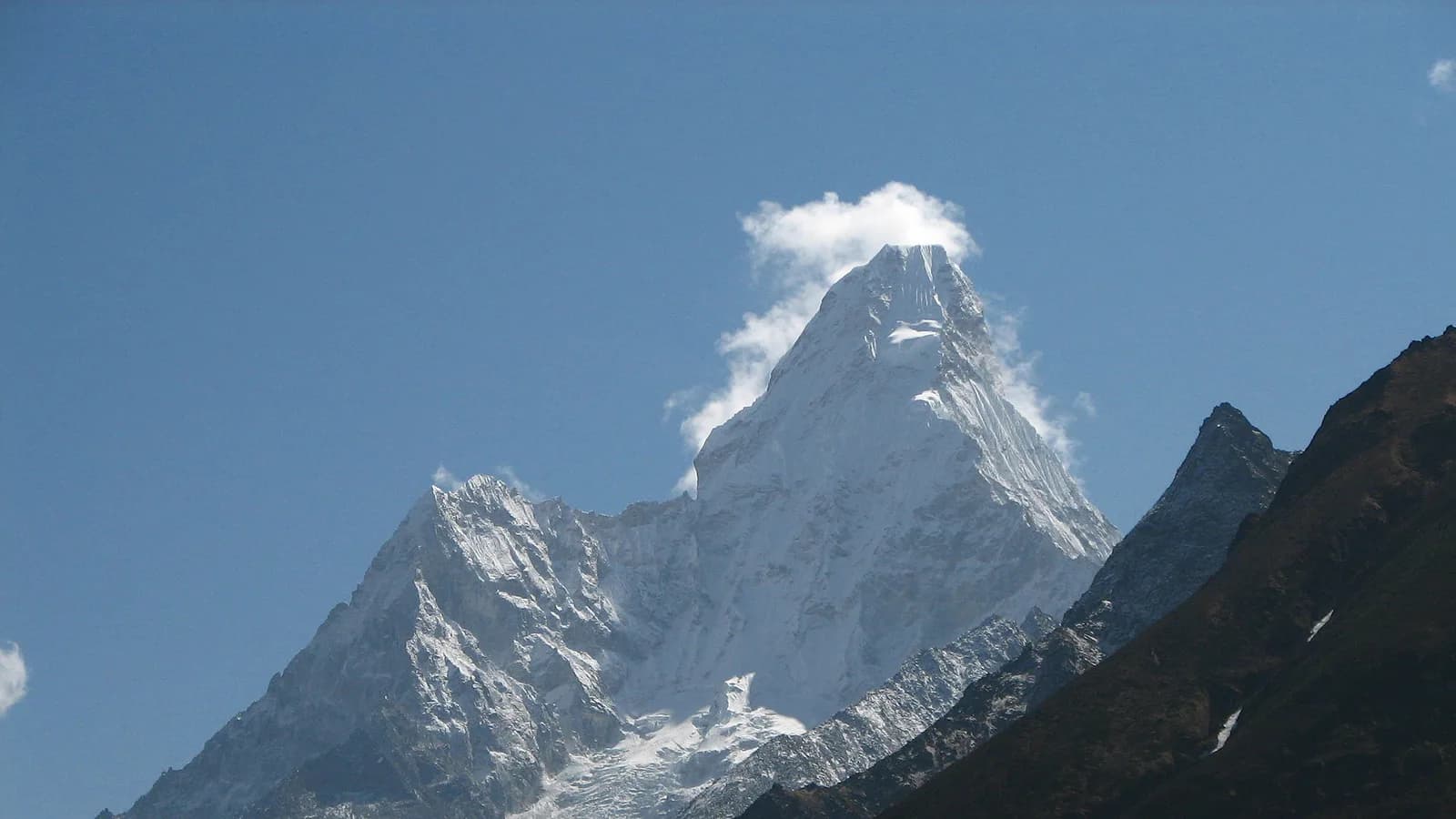
The Ama Dablam climb is the dream that hooks trekkers the moment they round the trail above Tengboche and see that impossible fang of rock and ice hanging over the valley. Often called the Matterhorn of the Himalaya, Ama Dablam stands at 6,812 metres (22,349 feet) and is widely considered the most beautiful mountain in the Everest region. But beauty is not the same as ease: this is a genuine technical expedition, a world apart from the walk-up trekking peaks nearby, and it demands real mountaineering skill. This guide covers the height, the Southwest Ridge route, the camps and fixed ropes, the honest difficulty, the permits and costs, and the best seasons, stamped to mid-2026.
If you are still deciding where Ama Dablam fits in a wider Khumbu plan, our Everest Base Camp itinerary shows the trail you will share on the way in, and our guides to Island Peak and Mera Peak cover the trekking peaks that many climbers use as stepping stones before tackling Ama Dablam.
Key takeaways
- Ama Dablam is 6,812 metres (22,349 feet) high, with a prominence of about 1,041 metres, in Nepal's Khumbu region.
- It is a technical expedition peak, not a trekking peak — expect steep rock, snow and ice and a lot of fixed-rope work, commonly graded around AD to TD.
- The standard line is the Southwest Ridge (the 1961 first-ascent route), through Camp 1, Camp 2 and Camp 3.
- The Nepal climbing permit is USD 1,000 per person in spring and autumn, USD 500 in winter and summer, under the rates effective 1 September 2025 (as of June 2026).
- Guided trips typically cost about USD 7,000–12,000+ per person and run 25 to 30 days door to door (as of June 2026).
- Autumn is the prime season; previous technical mountaineering experience is effectively required.
The mountain: what makes Ama Dablam special
Ama Dablam rises on the south side of the Khumbu, between the villages of the main Everest trail and the high peaks of the border. Its name comes from Sherpa: ama means mother and dablam refers to the ornate pendant box that Sherpa women traditionally wear. The long ridges are imagined as a mother's arms, and the hanging glacier slung below the summit is the dablam — the charm box pressed to her chest. That hanging glacier is not just poetic; it is a real feature climbers watch closely, because seracs and ice on the upper mountain shape the route's risk.
The peak was first climbed on 13 March 1961 by Mike Gill, Barry Bishop, Mike Ward and Wally Romanes, a team that had wintered high in the Khumbu as part of Edmund Hillary's Silver Hut scientific expedition. They climbed the Southwest Ridge, which remains the normal route to this day.
Where it sits relative to Everest
From the summit and high camps, the view is one of the great panoramas of the range, with Everest, Lhotse, Makalu and the wall of the border peaks. On the trek in, Ama Dablam dominates the skyline around Tengboche and Dingboche, which is exactly why so many Everest Base Camp trekkers come home wanting to climb it. It is lower than the 8,000-metre giants, but its steepness and shape make it look, and climb, far more serious than its altitude alone suggests.
How hard is the Ama Dablam climb?
This is the crucial point that the postcard image hides. Ama Dablam is not a trekking peak. Where Mera and Island Peak are mostly about altitude and endurance, Ama Dablam is a technical climb with sustained exposure.
The Southwest Ridge involves steep rock pitches, snow and ice slopes commonly in the 40 to 60 degree range, and notoriously airy ridge sections. The rock crux, the Yellow Tower above Camp 2, is a steep wall that climbers ascend on fixed rope. Overall the route is usually graded around AD to TD in the alpine system, with rock moves often described in the mid-fifth-class range. None of that is extreme by hard-alpinism standards, but on a remote 6,800-metre peak, in cold and thin air, with big drops below your boots, it asks for genuine competence and a cool head.
| Aspect | What to expect | |---|---| | Terrain | Steep rock, snow and ice; exposed ridges | | Typical grade | Around AD to TD (alpine) | | Slope angles | Roughly 40–60 degrees on the steep sections | | Key crux | The Yellow Tower rock pitch above Camp 2 | | Skills needed | Jumaring, abseiling, front-pointing, fixed-rope safety |
Reported summit success for well-prepared climbers with reputable operators is often cited around 60 to 75 percent, with weather and conditions the main variables. Turning back short of the top because of a storm or unsafe ice is normal and is the right call.
The route, camp by camp
Almost every commercial expedition climbs the Southwest Ridge, because it is the established line with fixed ropes installed in season. Above a comfortable base camp on grassy moraine, the route builds through three higher camps.
| Stage | Approx. altitude | Character | |---|---|---| | Base Camp | ~4,600 m | Grassy moraine; the expedition hub | | Camp 1 | above ~5,700 m | Reached over rock slabs and boulders | | Camp 2 | above ~5,900 m | Perched on the ridge; near the Yellow Tower | | Camp 3 | around ~6,300 m | High camp below the summit slopes | | Summit | 6,812 m | Snow and ice above the hanging glacier |
Exact camp heights vary between operators and seasons, and some teams skip or combine camps depending on conditions and strategy. The pattern of the climb is rotations: you move up to a camp, sleep, and descend to rest, gradually acclimatising before a final summit push timed to a weather window. Fixed ropes are placed on the technical ground during the main seasons, and competent, efficient movement on those ropes is the single most useful skill on the mountain.
Acclimatisation and the trek in
Because Ama Dablam sits deep in the high Khumbu, the expedition begins with the same flight to Lukla and the same walk up through Namche Bazaar that Everest trekkers know. That trek in is not filler — it is your acclimatisation, and the days spent gaining height gradually are what make a safe summit possible. Treat every acclimatisation day as essential. Before you go, read our altitude sickness guide for Nepal treks and learn the warning signs of AMS, HACE and HAPE, because on a peak this high the mountain is unforgiving of altitude shortcuts.
Permits and rules
Here is where Ama Dablam differs sharply from the trekking peaks. Ama Dablam is an expedition peak administered by Nepal's Department of Tourism, not one of the Nepal Mountaineering Association's trekking peaks. Its climbing permit follows the government royalty rates, which were revised effective 1 September 2025.
| Permit / fee | Amount (as of June 2026) | Notes | |---|---|---| | Ama Dablam climbing permit (spring/autumn) | USD 1,000 per person | Government royalty, eff. 1 Sep 2025 | | Ama Dablam climbing permit (winter/summer) | USD 500 per person | Lower off-season rate | | Sagarmatha National Park entry | NPR 3,000 | Same as the Everest trek | | Khumbu Pasang Lhamu Rural Municipality | ~NPR 2,000 | Local municipal permit |
Be careful with older blog posts: many still quote an Ama Dablam permit of USD 400, which was the pre-September-2025 figure and is now out of date. Expeditions must be organised through a registered Nepali operator, and a liaison officer and garbage deposit are part of the team-level arrangements your operator handles. The trekking permits are the same two documents used on the standard Everest route — our Everest Base Camp permits explainer covers why the old TIMS card is no longer needed in the Khumbu.
What an Ama Dablam expedition costs
Beyond the permit, the headline number is the guided package. A full commercial Ama Dablam expedition typically costs somewhere in the region of USD 7,000 to USD 12,000 or more per person (as of June 2026), and the spread is wide because it depends heavily on the operator, the guide-to-client ratio, oxygen policy (most climb without supplementary oxygen, but some use it), and the level of base-camp comfort and support.
What you are paying for, broadly, is:
- Logistics and permits, including the climbing royalty and park fees.
- Guiding and Sherpa support, the single biggest driver of safety and success.
- Rope fixing, camps and equipment on the mountain.
- Food and accommodation on the trek in and at base camp.
- Domestic flights to and from Lukla, the most weather-exposed link in the chain.
On the trek in, the familiar Khumbu economics apply, and our teahouse food and accommodation guide covers what the lodges are like and how prices climb with altitude. Carry enough rupees from Kathmandu, because mountain ATMs are unreliable.
Whatever the trip costs, do not economise on travel insurance. On a technical 6,800-metre peak, a helicopter evacuation can be lifesaving, and standard travel policies usually exclude both the altitude and the mountaineering. Our guide to trekking insurance with helicopter evacuation explains what a policy must cover for a climb like this — including high-altitude mountaineering and rescue.
When to climb Ama Dablam
Ama Dablam has a clear prime season, and it is the opposite emphasis to many treks.
- Autumn (roughly late October to early December) is the main climbing season. The post-monsoon weather is at its most stable, the air is clear and cold, and the ropes are fixed and busy with expeditions.
- Spring (around April to May) is also climbed, overlapping with the Everest summit season. It is warmer and the lower trail is greener, but base-camp logistics share the Khumbu with the big Everest push.
The monsoon (June to August) brings cloud, rain and unstable snow, and deep winter is bitterly cold and quiet on the mountain; neither is a normal commercial window. For a broader view of seasons across the country, see our guide to the best time to visit Nepal.
Who should attempt Ama Dablam
Ama Dablam rewards climbers who arrive prepared and humble. You should be genuinely fit, comfortable on glaciated and technical ground, and fluent with the basic tools of the climb: crampons and ice axe, harness, jumar and abseil device. Crucially, you should have previous mountaineering experience — this is not a first peak, and operators will expect a climbing background.
A common and sensible progression is to climb a trekking peak first. Many Ama Dablam climbers cut their teeth on Island Peak or Mera Peak, learning to move on fixed ropes and to perform at altitude before committing to a technical objective. If that path appeals, start with our Island Peak guide and Mera Peak guide, then step up. And whichever peak you climb, a handful of Nepali phrases every trekker should know will warm the long evenings at base camp with your Sherpa team.
Is it right for you?
Choose Ama Dablam if you already have mountaineering experience, you are drawn to one of the most striking summits on earth, and you want a true technical challenge rather than a high walk. It is harder and more committing than its modest-sounding altitude implies, and the steepness, exposure and fixed-rope work separate it firmly from the trekking peaks. But for climbers ready to meet it, standing on that slim summit ridge, with the hanging dablam glacier below and Everest filling the horizon, is one of the great experiences in the Himalaya.
Sources
- Ama Dablam — Wikipedia
- Permit Fees of Mountains under the Government of Nepal, effective from 1 September 2025 — Seven Summit Treks
- Increased royalty on mountain climbing from 1 September 2025 — Wilderness Excursion
- Ama Dablam Expedition guide — Himalaya King
- Ama Dablam challenges and success rate — Mountain Rock Treks
- Nepal Tourism Board — national park entry fees
Frequently asked questions
- How tall is Ama Dablam?
- Ama Dablam stands at 6,812 metres (22,349 feet) in Nepal's Khumbu region, with a prominence of about 1,041 metres. It sits south of Everest and Lhotse and is one of the most recognisable mountains in the Himalaya, framing the classic Everest Base Camp trail near Tengboche and Dingboche.
- Is Ama Dablam a technical climb?
- Yes. Unlike the trekking peaks Mera and Island Peak, Ama Dablam is a genuine technical mountaineering objective. The Southwest Ridge involves steep rock, snow and ice, exposed sections and fixed-rope work, and is commonly graded around AD to TD. You should be comfortable on fixed ropes, jumaring, abseiling and front-pointing in crampons before you attempt it.
- What is the standard route up Ama Dablam?
- Almost all commercial climbs follow the Southwest Ridge, the line of the 1961 first ascent. From base camp the route passes through Camp 1, Camp 2 and Camp 3, with the famous Yellow Tower rock pitch and the exposed ridge above. Fixed ropes are installed on the technical sections during the main seasons.
- How much does it cost to climb Ama Dablam?
- Guided expeditions typically run from roughly USD 7,000 to USD 12,000 or more per person depending on operator, group size and service level (as of June 2026). On top of that, Nepal's climbing permit for Ama Dablam is USD 1,000 per person in spring and autumn and USD 500 in winter and summer under the royalty rates effective 1 September 2025.
- Do you need a permit to climb Ama Dablam?
- Yes. Ama Dablam is an expedition peak administered by Nepal's Department of Tourism, so you need a climbing permit (USD 1,000 in spring or autumn as of June 2026), plus the Sagarmatha National Park entry permit at NPR 3,000 and the Khumbu Pasang Lhamu Rural Municipality permit at around NPR 2,000. Expeditions are arranged through a registered Nepali operator.
- How long does an Ama Dablam expedition take?
- Most commercial Ama Dablam trips run about 25 to 30 days door to door. That includes the trek in from Lukla, acclimatisation in the Khumbu, rotations between base camp and the higher camps, a summit window with weather contingency, and the trek and flight back out.
- What is the success rate on Ama Dablam?
- Reported summit success for well-prepared climbers with reputable operators is often cited in the region of 60 to 75 percent, varying year to year with weather, conditions and individual fitness. It is a serious mountain, and turning back for weather or condition is common and sensible.
- When is the best time to climb Ama Dablam?
- Autumn, roughly late October to early December, is the prime Ama Dablam season, with stable post-monsoon weather and fixed ropes in place. Spring (around April to May) is also climbed but is busier on the trekking trail and warmer. The monsoon and deep winter are generally avoided for commercial climbs.
Related posts
Cho Oyu Expedition: 8,188m Guide for 2026
A Cho Oyu expedition guide for 2026 — height, the Tibet normal route, why it's the easiest 8000m peak, CTMA rules, permits, seasons and how hard it really is.
Read postEverest Expedition Cost 2026: A Buyer's Guide to the Quote
Everest expedition cost in 2026 — how to read an operator quote, what drives the price, season and route differences, deposits, and what's excluded.
Read postHow Long to Climb Everest: The Real Timeline
How long to climb Everest from arrival to summit: roughly two months, broken into the trek-in, acclimatization rotations, the weather wait, and summit day.
Read post