Himalayan Glacier Melt: Causes and What It Means
Himalayan glacier melt explained — why the ice is vanishing 65% faster, what 80% loss by 2100 would mean for 2 billion people, and the risks downstream.
The Himalaya hold more ice than anywhere outside the poles — and they're losing it faster than almost anyone predicted, with two billion people downstream.
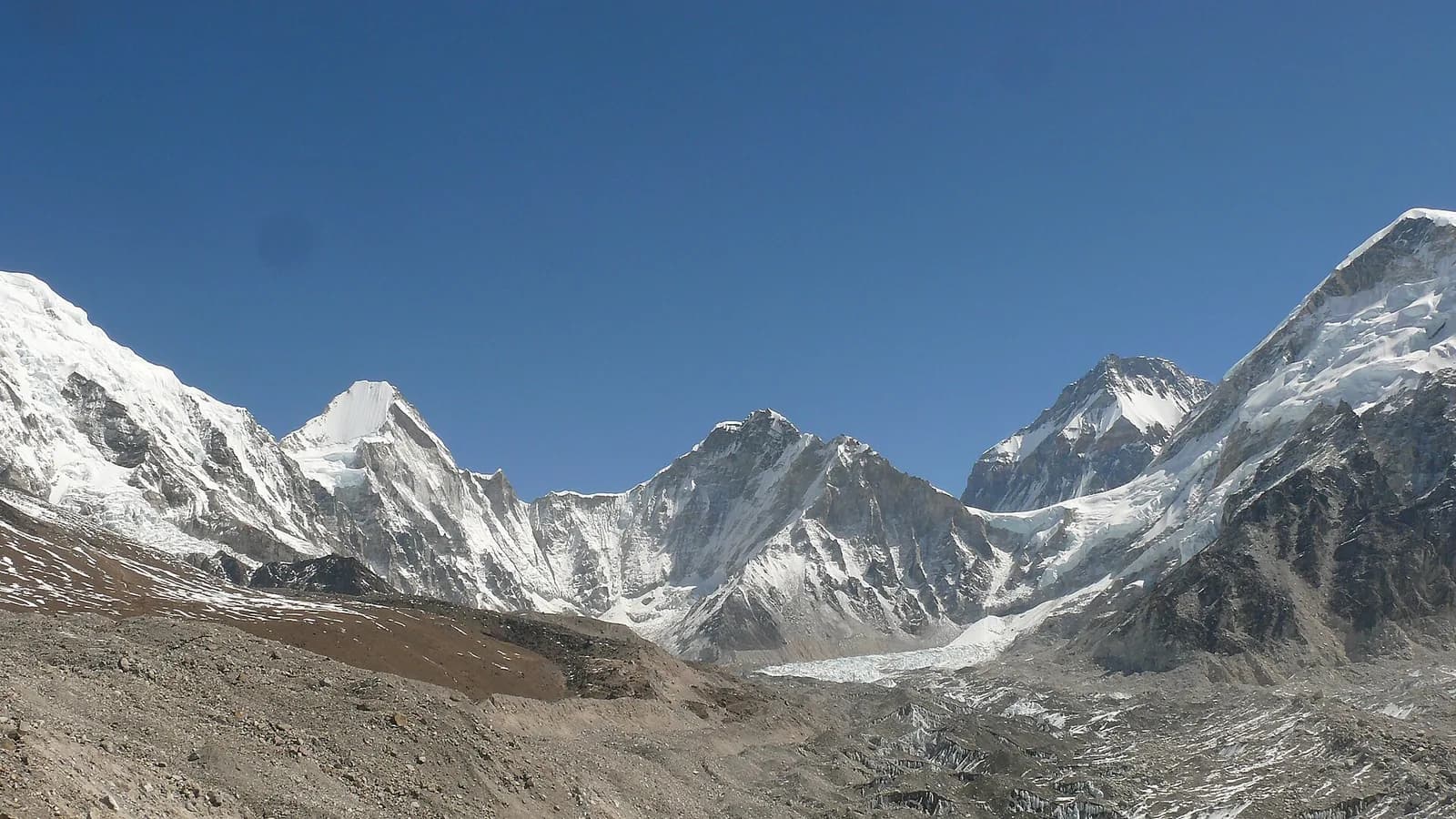
The Himalaya are sometimes called the "Third Pole," and the name is earned: outside the Arctic and Antarctic, no place on earth holds more ice. That frozen store feeds the great rivers of Asia and sustains around a quarter of humanity. It is also melting — faster than scientists once expected, and fast enough that the consequences are no longer a distant worry but an unfolding reality. This guide explains what is driving Himalayan glacier melt, how quickly the ice is going, and what it means for the people, rivers, and landscapes below.
It is the close companion to our broader look at Nepal climate change; here the lens narrows to the ice itself — the glaciers, the lakes they leave behind, and the water they release.
Key takeaways
- The Himalaya hold the largest store of ice outside the poles — the "Third Pole" — and it sustains around a quarter of the world's people.
- Glaciers across the Hindu Kush Himalaya melted 65% faster in 2011–2020 than the previous decade, according to ICIMOD.
- On current emissions, the region could lose up to 80% of glacier volume by 2100; even at 1.5–2°C of warming, a third to a half would still be lost.
- Around 240 million mountain residents and 1.65 billion downstream depend on water from this ice and snow.
- Roughly 200 glacial lakes are rated dangerous, raising the threat of glacial lake outburst floods (GLOFs).
- Meltwater is expected to peak around mid-century, then decline — meaning more floods now and water shortages later.
What's driving the melt
The core cause is straightforward: it is getting warmer, and ice melts when it warms. The Hindu Kush Himalaya region is heating at roughly twice the global average rate, and the highest elevations — where the glaciers live — are warming fastest of all, a pattern known as elevation-dependent warming. That puts the ice under sustained, accelerating pressure.
A second factor compounds the heat. Soot, dust, and black carbon from vehicles, wildfires, brick kilns, and the burning of fuel and crop waste settle onto the bright white surface of glaciers. Darkened ice absorbs more sunlight instead of reflecting it, which speeds melting further. So the same pollution that fouls the air in places like the Kathmandu Valley also helps darken and degrade the glaciers upstream — a double burden from a single problem.
How fast it's happening
For years, the hope was that the Himalaya's sheer scale would slow the impact of warming. The data has dispelled that hope. ICIMOD's landmark 2023 HI-WISE assessment found that glaciers across the Hindu Kush Himalaya disappeared 65% faster from 2011 to 2020 than during the preceding decade — a steep acceleration captured by satellite observation.
The projections that follow are sobering, and they hinge on how much the planet warms:
| Warming scenario | Projected glacier-volume loss by 2100 | |---|---| | Current emissions path (high warming) | Up to ~80% | | Warming held to 1.5–2°C | About one-third to one-half |
In other words, even the optimistic case — meeting the more ambitious goals of the Paris Agreement — still costs the Himalaya a third to a half of their ice. The difference between scenarios is not whether glaciers shrink dramatically, but how catastrophic the loss becomes.
A vanishing snow buffer, too
Glaciers are only part of the frozen picture. Seasonal snow, which melts each spring to recharge the rivers, is also in steep decline. ICIMOD's 2025 Snow Update recorded snow persistence 23.6% below normal across the region — the lowest in 23 years and the third consecutive below-normal year. Since snowmelt supplies roughly 23% of the annual flow in the region's major river basins, a shrinking snowpack stacks a second water problem on top of the glacier loss.
Why it matters: the water tower of Asia
The reason Himalayan glacier melt commands global attention is what sits downstream. The region is often called the "water tower of Asia," and the phrase is literal — its ice and snow feed a dozen major river systems that water a huge share of the continent.
According to ICIMOD's assessment, around 240 million people live in the mountains of the Hindu Kush Himalaya, and roughly 1.65 billion more live in the river valleys below — together about a quarter of the world's population. These rivers supply drinking water, irrigation for the farms that feed South and East Asia, hydropower, and the everyday flow of life across many countries.
Glaciers act as a slow-release reservoir, doling out meltwater through the dry months when rain and snowmelt are scarce. Lose that buffer, and the timing of water — not just the total amount — is thrown off, with consequences for everyone who depends on a predictable river.
The peak-and-decline problem
The cruelest twist is the shape of the change. As glaciers melt faster, they actually release more water for a while — which can mean more flooding in the near term. Scientists broadly expect this meltwater contribution to peak around mid-century and then decline as the glaciers themselves run down. The long-term threat is therefore the opposite of too much water: reduced dry-season river flow, water stress, and the prospect of prolonged shortages for the billions downstream once the ice can no longer top the rivers up.
The immediate danger: glacial lake outburst floods
While the river-flow question plays out over decades, glacier melt poses a sharper, more sudden hazard right now. As glaciers retreat, their meltwater collects into lakes held back by unstable natural dams of loose rock and ice. When such a dam gives way, the lake empties in minutes, sending a destructive surge of water, mud, and debris down the valley. This is a glacial lake outburst flood, or GLOF.
ICIMOD's research identifies roughly 200 glacial lakes across the Hindu Kush Himalaya as dangerous, and the number and risk are expected to grow as warming creates more meltwater lakes. For Nepal, the stakes are high: villages, trails, bridges, and hydropower projects all line the river valleys that a GLOF would tear through. Reducing this risk — through monitoring, early-warning systems, and in some cases artificially lowering lake levels — has become a central part of the country's adaptation effort.
Seeing the change on a trek
For travelers, the Himalaya offer a rare chance to witness these changes in person. The great glaciers remain vast and reachable on foot. The Khumbu Glacier, which trekkers walk alongside on the classic route to Everest Base Camp, is among the most famous ice rivers on earth, tumbling down from the highest mountain on the planet. The glacial valleys of the Gokyo Lakes and the high crossings of the Three Passes trek put you among ice and meltwater lakes for days at a time, much of it inside Sagarmatha National Park.
Increasingly, local guides narrate the retreat as they walk — pointing to bare rock where ice reached within living memory, or to meltwater pools that did not exist a generation ago. It turns a trek into a firsthand encounter with climate change, and a reminder of why low-impact, eco-conscious trekking matters in a landscape this fragile.
What can be done
The science draws a clear line: the fate of Himalayan ice depends overwhelmingly on how much the world warms. Every fraction of a degree avoided preserves more glacier volume, which is why global emissions cuts are the single most important lever — the gap between the 80% and the one-third loss scenarios is decided by collective action far beyond the mountains.
Alongside that, adaptation is now unavoidable, because significant melt is already locked in. For Nepal and its neighbors, that means GLOF early-warning systems, smarter water storage and management for the leaner dry seasons ahead, and disaster preparedness for the floods and landslides that come with a more volatile mountain climate. Regional bodies like ICIMOD frame this as a shared challenge across the many countries the rivers cross — a problem no single nation can solve alone.
The bottom line
Himalayan glacier melt is one of the defining slow disasters of our time: the planet's largest non-polar ice store, shrinking 65% faster than it used to, with up to 80% potentially gone by 2100 and roughly a quarter of humanity downstream. The near-term danger is sudden floods; the long-term danger is too little water once the ice that feeds the rivers is gone. The outcome is still ours to influence — and for anyone walking beneath these peaks, the retreating ice is a powerful, firsthand reason to care. For the wider view of how this fits Nepal's changing climate, read our guide to Nepal climate change.
Sources
- Landmark report on impacts of disappearing snow and ice in the Hindu Kush Himalaya — ICIMOD (2023, HI-WISE)
- Landmark study: Two-degree temperature rise could melt half of glaciers in Hindu Kush Himalaya — ICIMOD
- Himalayan glaciers melting 65 percent faster than previous decade: study — France 24 / AFP (2023)
- Risk of water shortages builds up as Hindu Kush Himalaya faces 23-year-record-low snow persistence — ICIMOD (2025)
- Himalayan glaciers may lose 75 percent of ice by 2100: Report — Al Jazeera (2023)
Frequently asked questions
- Why are Himalayan glaciers melting?
- Rising temperatures from human-caused climate change are the main driver. The Hindu Kush Himalaya is warming at about twice the global average, and deposits of soot and dust on the ice can speed melting by absorbing more heat.
- How fast are Himalayan glaciers melting?
- Faster than before. ICIMOD found that glaciers across the Hindu Kush Himalaya disappeared 65% faster in 2011–2020 than in the previous decade — a sharp acceleration documented by satellite data.
- How much Himalayan ice could be lost by 2100?
- On the current emissions path, the region could lose up to 80% of its glacier volume by 2100. Even if warming is held to 1.5–2 degrees Celsius, glaciers are projected to lose a third to a half of their ice.
- How many people depend on Himalayan glaciers?
- Around 240 million people live in the mountains themselves, and roughly 1.65 billion more live in the river valleys below — together about a quarter of humanity relies on water from this region's ice and snow.
- What is a glacial lake outburst flood?
- It's a sudden flood released when a natural dam holding back a glacial meltwater lake collapses. About 200 glacial lakes across the Hindu Kush Himalaya are rated dangerous, and the risk grows as glaciers melt.
- Will the rivers dry up as glaciers melt?
- Not right away. Meltwater is expected to increase for a time, peaking around mid-century, then decline as the glaciers shrink — meaning more floods now and reduced dry-season flow later.
- Can I still see Himalayan glaciers when trekking?
- Yes. Glaciers like the Khumbu on the Everest route remain vast and accessible to trekkers. Many guides now point out how far the ice has retreated, making a trek a firsthand look at the changes.
Related posts
Nepal Climate Change: Impacts on the Himalaya & People
Nepal climate change explained — how warming reshapes the Himalaya, water, farming, floods, and travel, with the latest science from ICIMOD.
Read postAnnapurna Helicopter Tour: Cost & 2026 Guide
Annapurna helicopter tour from Pokhara to Annapurna Base Camp — cost, flight time, the landing, weight limits, best season and how it compares to trekking.
Read postAnnapurna: A Traveler's Guide to Nepal's Famous Massif
What Annapurna means, the peaks in the massif, the treks around it, and the permits you need. A plain-English guide to Nepal's most famous mountain range.
Read post