Nepal Climate Change: Impacts on the Himalaya & People
Nepal climate change explained — how warming reshapes the Himalaya, water, farming, floods, and travel, with the latest science from ICIMOD.
Nepal did little to cause climate change, yet sits on its front line — warming faster than the global average and watching its ice, water, and weather shift in real time.
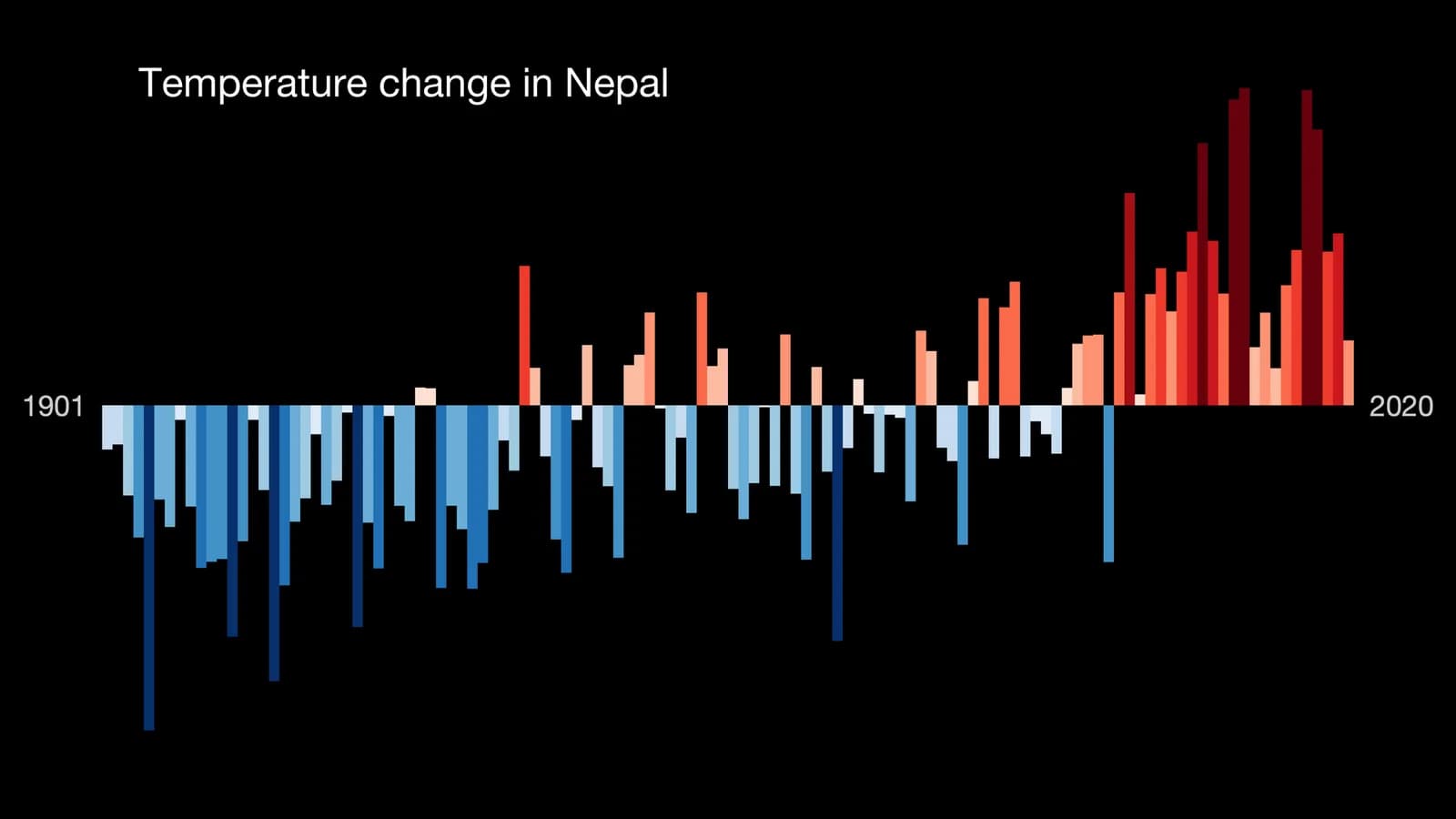
Nepal contributes a tiny fraction of the world's greenhouse-gas emissions, yet it sits squarely on the front line of climate change. The country straddles the central Himalaya — the "Third Pole," holding more ice than anywhere outside the Arctic and Antarctic — and that ice, along with Nepal's snow, water, farms, and weather, is changing faster than almost anywhere on the planet. Understanding Nepal's climate change story matters whether you live in the region, plan to travel there, or simply want to grasp how warming reshapes a mountain nation.
This guide pulls together the latest science — much of it from the Kathmandu-based International Centre for Integrated Mountain Development (ICIMOD) — to explain what is actually happening, who it affects, and what it means on the ground.
Key takeaways
- The Hindu Kush Himalaya region, including Nepal, is warming at roughly twice the global average rate, with the highest elevations warming fastest.
- Nepal's glaciers and snow are in retreat: regional snow persistence hit a 23-year low in 2025, 23.6% below normal, for the third year running.
- Mountain springs and streams are drying up — surveys report large shares of households seeing springs and rivulets decline or vanish.
- Extreme rainfall is intensifying: a September 2024 flood disaster killed 244 people, and attribution science links its severity to human-caused warming.
- Around 200 glacial lakes across the region are rated dangerous, raising the risk of glacial lake outburst floods.
- The impacts fall hardest on water, farming, and mountain communities — and increasingly shape the experience of travel in Nepal.
Why Nepal warms faster than the world
The single most important fact about Nepal's climate is that it is heating up faster than the global average. The wider Hindu Kush Himalaya region is warming at about twice the global rate, and within it, the highest places are warming the fastest — a phenomenon scientists call elevation-dependent warming. Studies summarized by ICIMOD and others report a maximum-temperature increase of roughly 2.2 degrees Celsius over the past four decades, around 0.56 degrees per decade.
That acceleration matters because so much of Nepal's water and weather is governed by ice and snow that respond directly to temperature. A degree of warming that would be modest in a lowland country has outsized effects in a place where the difference between frozen and liquid water defines the landscape. The consequences ripple outward into five connected areas: ice, snow, water, weather, and people.
The ice: glaciers in retreat
Nepal's glaciers are shrinking, and the pace is quickening. Across the Hindu Kush Himalaya, glaciers disappeared 65% faster in 2011–2020 than in the previous decade, according to ICIMOD's landmark 2023 HI-WISE assessment. On the current emissions path, the region's glaciers could lose up to 80% of their volume by 2100 — and even if warming is held to 1.5–2°C, they are still projected to lose a third to a half of their ice.
This is not an abstract loss. The ice acts as a frozen reservoir, releasing meltwater through the dry season when rivers would otherwise run low. As it retreats, that buffer weakens. We cover the mechanics and the downstream stakes in detail in our companion guide to Himalayan glacier melt.
Glacial lakes and the GLOF threat
As glaciers melt, the water often pools into lakes held back by fragile natural dams of rock and ice. When one of those dams fails, the result is a glacial lake outburst flood (GLOF) — a sudden torrent that can devastate valleys far downstream. ICIMOD's assessment flags roughly 200 glacial lakes across the region as dangerous, and the risk is expected to rise as warming continues. For Nepal, where settlements and trekking routes follow the river valleys, this is one of the more immediate hazards of a warming climate.
The snow: a vanishing seasonal store
Less visible than glaciers, but just as consequential, is seasonal snow. Snow that falls in winter and melts in spring feeds the rivers early in the year — and that supply is faltering. ICIMOD's 2025 Snow Update found that snow persistence across the Hindu Kush Himalaya was 23.6% below normal, the lowest in 23 years of records, and the third straight year of below-normal snow.
The implications for water security are stark. Snowmelt contributes roughly 23% of the annual flow in the region's major river basins, which sustain nearly two billion people. When the snow does not come, the shortfall shows up downstream months later. As ICIMOD's director general put it, carbon emissions have already "locked in" recurrent snow anomalies for the region — meaning this is a trend, not a one-off bad year.
The water: springs drying, rivers shifting
Climate change is rewriting Nepal's water map from the top down, and rural communities are feeling it first. Surveys reported by Nepal's National Statistics Office and covered in the Kathmandu Post paint a worrying picture of the mid-hills:
- Around 38% of households observed springs drying up completely.
- About 43% saw streams run completely dry.
- More than 78% reported a decline in rivulets and streams.
Springs and stone spouts that communities have relied on for generations are weakening or disappearing, driven by erratic rainfall, longer dry spells, and rising temperatures. Because so many hill villages depend on spring water rather than piped supply, this hits daily life directly — and it sharpens existing questions about whether the water is safe to drink for residents and visitors alike.
For rivers, the longer arc is a "peak and decline" pattern: as glaciers and snow melt faster, flows may rise for a time before falling as the ice that feeds them runs down. Scientists broadly expect that meltwater contribution to peak around mid-century, then diminish.
The weather: floods, landslides, and an erratic monsoon
Warming does not just shrink ice — it loads the atmosphere with more moisture and makes extreme weather more likely. Nepal's monsoon, the lifeblood of its farming, is becoming more erratic and more violent.
The clearest recent example came in late September 2024, when an unprecedented downpour hit Nepal — some areas recording their heaviest rainfall in more than 50 years — triggering floods and landslides that claimed 244 lives. A rapid attribution study found that human-caused climate change made the event nearly 70% more likely and about 10% more intense. The summer before, in July 2024, western Nepal logged its highest-ever 24-hour rainfall of 624 mm, causing millions of dollars in damage to infrastructure and irrigation.
ICIMOD has warned that hotter, wetter monsoons are becoming the pattern for mountain Asia, raising the baseline risk of floods and landslides each summer. For a country crisscrossed by steep slopes and river valleys, that is a serious and growing hazard — and one reason the monsoon months shape so much travel planning, as our month-by-month weather guide explains.
The people: agriculture and mountain livelihoods
All of this lands on people, and in Nepal it lands hardest on farmers and mountain communities. Agriculture employs a large share of the population and depends on a predictable monsoon and reliable water — both of which climate change is unsettling.
- Shifting crops. With rainfall less dependable and droughts more frequent, farmers are changing what and when they plant, switching crops when they expect a poor or dry season.
- Moving zones. Elevation-dependent warming is nudging the viable range for some crops uphill; certain high-altitude areas may even see short-term gains for rice and maize, while lower zones face more stress.
- Compounding shocks. Floods, landslides, and drought destroy harvests, irrigation, and roads, deepening rural hardship in a country with limited resources to absorb the damage.
Mountain communities — including those along popular trekking routes still rebuilding from past disasters, like the Langtang Valley — sit at the sharp end of these changes, facing both slow shifts and sudden catastrophes.
What it means for travelers
Climate change rarely cancels a trip to Nepal, but it increasingly shapes one. A few practical implications stand out:
- Time it carefully. An erratic monsoon and longer fire seasons make seasonal timing more important than ever — see our best time to visit Nepal guide.
- Build in flexibility. Floods and landslides can close roads and trails at short notice, especially in the monsoon. Loose itineraries and good travel insurance matter.
- Tread lightly. Choosing eco-conscious trekking operators, cutting plastic, and respecting fragile high-altitude environments all help reduce your footprint in a region already under strain.
- See it with context. Nepal's lakes, national parks, and peaks are extraordinary — and understanding the pressures on them deepens, rather than diminishes, the experience.
Nepal's response — and the bigger picture
Nepal frames its situation as a profound injustice: a country responsible for a negligible share of global emissions bearing some of the heaviest consequences. Diplomatically, it presses wealthy nations for climate finance and stronger emissions cuts, and it has adopted national net-zero and adaptation goals. On the ground, the practical priorities are early-warning systems for floods and GLOFs, better water management, and disaster preparedness for the communities most exposed.
The hard truth running through the science is that some change is now locked in. The realistic task is adaptation — managing the floods, droughts, and shifting water that are already arriving — alongside the global effort to limit how severe the future becomes.
The bottom line
Nepal's climate change story is the world's story in miniature, sped up and intensified: a region warming at twice the global rate, with shrinking glaciers, record-low snow, drying springs, and fiercer floods. The impacts are already reshaping water, farming, and mountain life, and they increasingly touch travel too. None of it makes Nepal any less worth visiting — if anything, the Himalaya are a place to witness, understand, and help protect while there is still time to limit the damage.
Sources
- Landmark report on impacts of disappearing snow and ice in the Hindu Kush Himalaya — ICIMOD (2023, HI-WISE)
- Risk of water shortages builds up as Hindu Kush Himalaya faces 23-year-record-low snow persistence — ICIMOD (2025)
- Climate Change Amplified the Effects of Extreme Rainfall in Nepal — Eos / AGU (2024)
- Nepal's agriculture, water resources under climate threat — The Kathmandu Post (2024)
- Brace for high-hazard summer as a hotter, wetter monsoon is forecast for mountain Asia — ICIMOD
- Climate change in Nepal — Wikipedia (overview and citations)
Frequently asked questions
- How is climate change affecting Nepal?
- Nepal is warming faster than the global average, melting its glaciers, shrinking snow cover, drying mountain springs, and intensifying floods and erratic monsoons. The effects hit water supply, farming, and mountain communities hardest.
- Is Nepal warming faster than the rest of the world?
- Yes. The wider Hindu Kush Himalaya region is warming at roughly twice the global average rate, and high-elevation areas warm fastest — a pattern scientists call elevation-dependent warming.
- How much has Nepal's temperature risen?
- Studies cited by ICIMOD and others report a maximum-temperature rise of about 2.2 degrees Celsius over the last four decades, around 0.56 degrees per decade — well above the global average for the same period.
- What are glacial lake outburst floods (GLOFs)?
- GLOFs are sudden, destructive floods that occur when a natural dam holding back a glacial lake fails, releasing a wall of water downstream. Roughly 200 glacial lakes across the Hindu Kush Himalaya are considered dangerous.
- Does climate change affect travel to Nepal?
- Increasingly, yes — through more erratic monsoons, flood and landslide risk, dust and haze, and changing conditions on high routes. It rarely stops a trip, but it makes timing, insurance, and flexibility more important.
- What is Nepal doing about climate change?
- Nepal has set net-zero and adaptation targets and argues internationally that it suffers outsized harm despite minimal emissions. On the ground, the focus is on early-warning systems, water management, and disaster preparedness.
- Will climate change make Nepal's rivers dry up?
- Not immediately, but the long-term trend is concerning. Glacier and snowmelt feed major rivers; scientists expect flows to peak mid-century and then decline as the ice that sustains them shrinks.
Related posts
Himalayan Glacier Melt: Causes and What It Means
Himalayan glacier melt explained — why the ice is vanishing 65% faster, what 80% loss by 2100 would mean for 2 billion people, and the risks downstream.
Read postAnnapurna: A Traveler's Guide to Nepal's Famous Massif
What Annapurna means, the peaks in the massif, the treks around it, and the permits you need. A plain-English guide to Nepal's most famous mountain range.
Read postEverest Base Camp Tour: How to Choose in 2026
An Everest Base Camp tour can mean a two-week trek, a luxury trip or a half-day helicopter flight. How to pick the right style and what it costs.
Read post