Annapurna: A Traveler's Guide to Nepal's Famous Massif
What Annapurna means, the peaks in the massif, the treks around it, and the permits you need. A plain-English guide to Nepal's most famous mountain range.
The tenth-highest mountain on Earth, and one of the friendliest regions in Nepal to walk through.
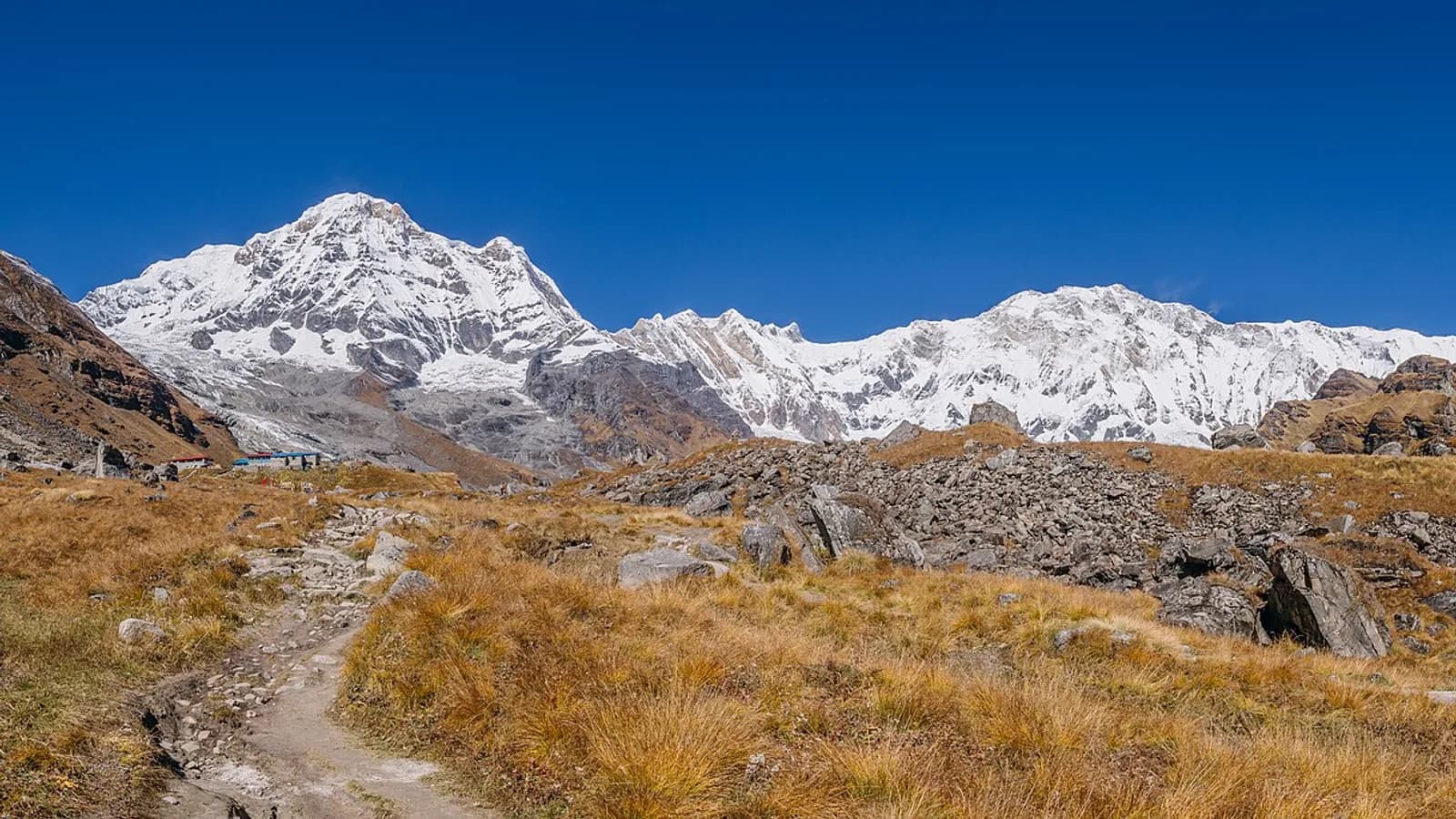
Say "Nepal trekking" to almost anyone and two names come up: Everest and Annapurna. But Annapurna is not a single mountain — it is a whole massif of peaks, glaciers and valleys in north-central Nepal, wrapped in a protected conservation area and laced with some of the most popular walking trails on the planet. This guide explains what Annapurna actually is, the peaks that make up the range, the treks that circle it, and the practical permits and seasons you need to know before you go.
Key takeaways
- Annapurna I is 8,091 metres (26,545 ft) — the tenth-highest mountain in the world and the first peak above 8,000 metres ever climbed, summited on 3 June 1950.
- The name means "full of food" in Sanskrit and refers to a Hindu goddess of nourishment, a daughter of the mountain king Himavat.
- The massif has several major peaks, including Annapurna I through IV, Annapurna South and Gangapurna — plus the iconic sacred Fishtail, Machhapuchhre, nearby.
- The trails are very different from the summit. Climbing Annapurna I is among the deadliest mountaineering feats on Earth; trekking the valleys below is accessible to fit, non-expert walkers.
- You need an ACAP permit (NPR 3,000 for foreigners, as of 2025) to enter the Annapurna Conservation Area.
- Pokhara is the gateway. Most treks start and end near this lakeside city in Gandaki Province.
What "Annapurna" actually refers to
The word covers three overlapping things, and travelers often blur them together.
The goddess. Annapurna (Sanskrit: अन्नपूर्णा) is a Hindu goddess of food and nourishment, a manifestation of Parvati. The name joins anna (food, grain) with purna (full, complete). In Hindu tradition she is one of the daughters of Himavat, the personified king of the Himalaya — a fitting namesake for a mountain that feeds the valleys below with its meltwater.
The mountain. Annapurna I, the highest summit in the group, stands at 8,091 metres (26,545 ft). That makes it the tenth-highest mountain on Earth and one of only fourteen peaks above 8,000 metres.
The region. In everyday travel language, "the Annapurnas" or "the Annapurna region" means the whole massif and the network of valleys, villages and trekking routes around it — most of which sit inside the Annapurna Conservation Area, Nepal's largest protected area.
The peaks of the massif
Annapurna is not one mountain but a cluster. The massif is usually described as a chain of summits running east to west, with Annapurna I anchoring the western end.
| Peak | Approx. height | Note | |---|---|---| | Annapurna I | 8,091 m | Highest in the massif; 10th-highest in the world | | Annapurna II | ~7,937 m | Eastern end of the chain | | Annapurna III | ~7,555 m | Central group | | Annapurna IV | ~7,525 m | Near Annapurna II | | Gangapurna | ~7,455 m | Rises above Manang | | Annapurna South | ~7,219 m | Prominent on the Base Camp trek |
Heights are widely cited approximate figures; sources vary slightly.
Machhapuchhre, the mountain you cannot climb
Just south of the main chain stands one of Nepal's most photographed peaks: Machhapuchhre, the "Fishtail," at roughly 6,993 metres (22,943 ft). Its twin-pointed summit dominates the skyline above Pokhara and the Annapurna Base Camp trail.
It is also officially unclimbed. A 1957 British expedition led by Wilfrid Noyce came close but is said to have stopped short of the very top out of respect for local beliefs. Since then the Nepali government has kept the peak closed to climbing, because it is held sacred. For trekkers, that means Machhapuchhre is something to admire rather than summit — and arguably the most beautiful single sight in the whole region.
The trails: trekking the Annapurna region
This is where most visitors meet Annapurna. The region offers everything from gentle multi-day walks to a serious high-altitude circuit, and the trails are famous for tea-house hospitality, terraced farmland, and changing scenery. If you are weighing two of the big classics against each other, our Annapurna Circuit vs Base Camp comparison breaks down which suits which traveler.
Annapurna Base Camp (ABC)
The Annapurna Base Camp trek climbs into a glacial amphitheater — the Annapurna Sanctuary — ringed by a wall of giants including Annapurna I, Annapurna South and Machhapuchhre. Base Camp itself sits at about 4,130 metres. It is an out-and-back route, with no high pass, and is a strong choice for trekkers who want concentrated mountain scenery without crossing a 5,000-metre col. For budgeting it, see our breakdown of the Annapurna Base Camp trek cost.
Annapurna Circuit
The Annapurna Circuit is the long, classic loop. Over roughly two weeks it passes through five climate zones — from subtropical farmland to stark high-desert reminiscent of Tibet — and crosses Thorong La pass at 5,416 metres, the highest point of the route. Along the way it touches the sacred Muktinath temple and the deep Kali Gandaki gorge. A popular side trip is the high-altitude Tilicho Lake, one of the highest lakes in the world.
Shorter and quieter options
You do not need two weeks to taste the Annapurnas:
- Poon Hill (Ghorepani): a short route topping out around 3,210 metres, famous for its sunrise panorama. The gateway village of Ghandruk is a highlight in its own right.
- Mardi Himal: a quieter ridge walk with close-up Fishtail views — see our Mardi Himal hidden-gem guide.
- Khopra Ridge: a less-crowded alternative with big views and fewer trekkers.
How the main treks compare
| Trek | Typical length | Max altitude | High pass? | |---|---|---|---| | Poon Hill | 3–5 days | ~3,210 m | No | | Annapurna Base Camp | 7–12 days | ~4,130 m | No | | Annapurna Circuit | 12–18 days | 5,416 m (Thorong La) | Yes | | Mardi Himal | 4–6 days | ~4,500 m | No |
Permits and rules
The Annapurna region is a managed conservation area, so you cannot simply walk in. The core requirement is the Annapurna Conservation Area Project (ACAP) entry permit.
| Item | Fee (as of 2025) | Notes | |---|---|---| | ACAP permit (foreign nationals) | NPR 3,000 | Paid in Nepalese rupees only | | ACAP permit (SAARC nationals) | NPR 1,000 | Reduced regional rate | | Children under 10 | No ACAP permit required | Confirm at the permit office |
The TIMS card picture is less clear. Several 2025 sources report that TIMS is no longer enforced for Annapurna treks, while others still mention it. Because Nepal's trekking rules change from season to season, confirm the current requirement with an official permit office or a licensed agency before you set out, and budget a little extra cash just in case. Permits are normally issued in Pokhara or Kathmandu and paid for in rupees.
For a wider view of where permits apply across the country, see our overview of Nepal's national parks.
Why the summit is so deadly — and why the trails are not
It is worth separating two very different activities that share the name "Annapurna."
Climbing Annapurna I is one of the most dangerous things in mountaineering. Despite being only the tenth-highest peak, it has historically carried the highest fatality rate of any 8,000-metre mountain. One widely cited figure (via Guinness World Records) puts it at roughly 13% — about 75 deaths against 559 ascents — and historical ratios were far grimmer before modern forecasting and equipment. The danger comes from avalanche-prone slopes, unpredictable weather, and famously steep, committing routes such as the enormous south face.
The first ascent itself, by Maurice Herzog and Louis Lachenal of a French expedition on 3 June 1950, was historic — the first 8,000-metre peak ever climbed — but came at a brutal cost, with severe frostbite leading to amputations during the descent.
Trekking the Annapurna region is a completely different proposition. The trails stay well below the death zone, follow established tea-house routes, and are walked by tens of thousands of ordinary travelers every year. The real risk on the trails is altitude sickness, not the technical danger of the summit — so acclimatize sensibly, and read up on altitude sickness before a high route like the Circuit.
When to go and how to get there
Best seasons. Spring (roughly March to May) and autumn (roughly late September to November) are generally regarded as the best windows, with the most stable weather and clearest mountain views. Winter trekking is possible on lower routes but cold and snowy up high, and the summer monsoon brings rain, leeches and clouds that hide the peaks.
Gateway city. Almost every Annapurna trek begins near Pokhara, the lakeside provincial capital of Gandaki Province, about 25 km south of the main peaks. It is the natural base for the region, with trailheads, gear shops and a relaxed atmosphere to recover in afterward. Plan your time there with our guide to things to do in Pokhara.
A few words of Nepali go a long way on the trail — greetings, numbers for bargaining, and thank-yous open doors in tea-house villages. Our phrases every trekker should know is a good place to start.
A quick word on the name's spirit
There is something fitting about a mountain named for a goddess of nourishment. The Annapurna massif feeds the rivers and terraced fields of central Nepal, and the trails that wind beneath it have, for decades, fed something else — the appetite of travelers for high, quiet, astonishing places. You do not have to be a mountaineer to meet Annapurna. You just have to walk.
Sources
- Annapurna — Wikipedia
- Annapurna — Britannica
- Annapurna (goddess) — Wikipedia
- Machapuchare — Wikipedia
- Annapurna: Deadly Mountain — NASA Earth Observatory
- List of deaths on eight-thousanders — Wikipedia
- Annapurna Trek Permits (2025): TIMS & ACAP Explained — Shikhar Adventure
- Annapurna Circuit Trek Permits — Magical Nepal
- Annapurna Conservation Area — Nepal Hiking Adventure
Frequently asked questions
- How tall is Annapurna and where does it rank?
- Annapurna I is 8,091 metres (26,545 ft), making it the tenth-highest mountain in the world and one of the fourteen peaks above 8,000 metres.
- What does the name Annapurna mean?
- It comes from Sanskrit and roughly means 'full of food' or 'goddess of nourishment' — anna meaning grain or food, and purna meaning full or complete.
- Do I need a permit to trek in the Annapurna region?
- Yes. Trekkers need an Annapurna Conservation Area Project (ACAP) entry permit, which costs NPR 3,000 for foreign nationals and NPR 1,000 for SAARC nationals (as of 2025).
- Is the TIMS card still required for Annapurna treks?
- Reporting is mixed and rules change, so confirm before you go; several 2025 sources say the TIMS card is no longer enforced for Annapurna, while ACAP remains mandatory.
- What is the easiest trek in the Annapurna region?
- The short Poon Hill (Ghorepani) route is the gentlest popular option, topping out around 3,210 metres with famous sunrise mountain views and no high pass.
- Is Annapurna dangerous to climb?
- Reaching the summit of Annapurna I is extremely dangerous and only for elite mountaineers; it has historically had the highest fatality rate of any 8,000-metre peak. Trekking the trails below is a completely different and far safer activity.
- Why can you not climb Machhapuchhre, the Fishtail peak?
- Machhapuchhre is considered sacred and is closed to climbing by the Nepali government, so no official ascent to its summit is permitted.
- When is the best time to trek around Annapurna?
- Spring (roughly March to May) and autumn (roughly late September to November) generally offer the most stable weather and clearest mountain views.
Related posts
ABC Trek: A Plain-English Guide to Annapurna Base Camp
The ABC trek (Annapurna Base Camp) explained — the route, how many days it takes, difficulty, the best seasons, and what daily trail life is really like.
Read postEverest Base Camp Tour: How to Choose in 2026
An Everest Base Camp tour can mean a two-week trek, a luxury trip or a half-day helicopter flight. How to pick the right style and what it costs.
Read postEverest: A Traveller's Guide to the World's Highest Peak
A plain-language Everest guide for travellers: the height, names, first ascent, 2025 climbing rules and fees, plus how trekkers can see it without climbing.
Read post