Senior Trekking Nepal: Easier Treks for Older Travellers
Senior trekking in Nepal: the easiest low-altitude treks for older walkers, from Poon Hill to the Everest View route, plus pacing and porter tips.
A trek in Nepal does not have to mean thin air and ten-hour days — the best routes for older walkers swap altitude for villages, stone steps and a sunrise worth getting up for.
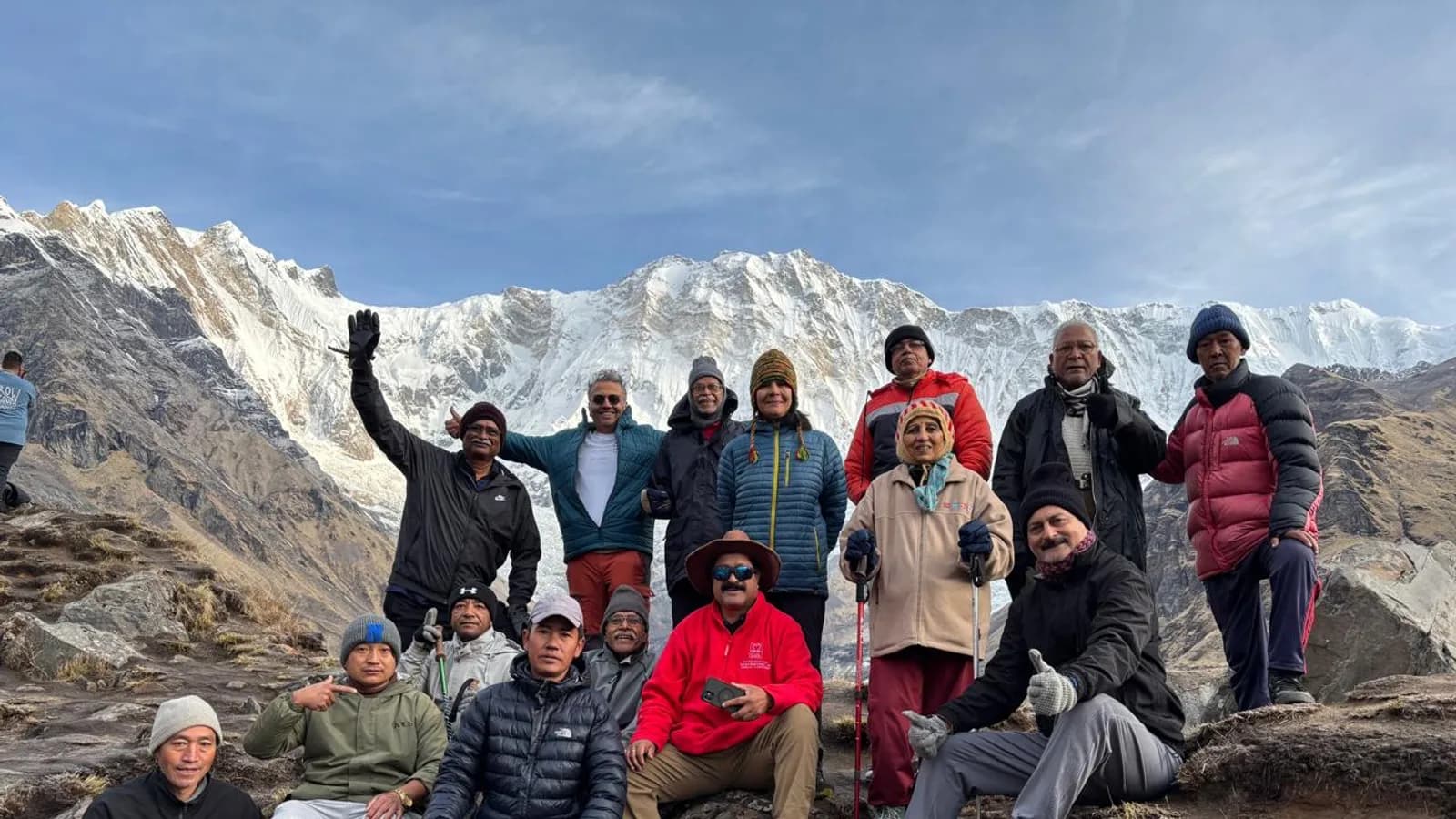
Senior trekking in Nepal is far more achievable than the country's fearsome reputation suggests. The images that sell Nepal — gasping trekkers at 5,000 metres, snow and suffering — describe only the hardest routes. Alongside them runs a quieter network of gentle, low-altitude trails built around villages, forests and sunrise viewpoints, where the walking is measured in pleasant hours rather than punishing days. On these routes, older walkers do beautifully.
This guide is for trekkers in their 60s, 70s and beyond who want to walk in the Himalaya, not just look at it. It covers the easiest treks, how to pace them, why a porter changes everything, and the altitude and safety basics that matter more as we age. If you would rather skip multi-day walking entirely, our companion Nepal for retirees guide covers the trek-free ways to enjoy the mountains. All details below come from recent trekking and official health sources, linked at the end — and none of it is medical advice, so confirm your own fitness and health with a doctor first.
Key takeaways
- You do not need altitude to trek well. The best senior routes stay low, swapping thin air for villages, forest trails and stone-step viewpoints.
- Ghorepani Poon Hill is the classic easy trek — a few gentle days ending at a famous sunrise around 3,210 metres.
- The Everest View trek reaches the high Khumbu's atmosphere without the grind to Base Camp, topping out near the Hotel Everest View at about 3,880 metres.
- Hire a porter and a guide. Carrying only a daypack, walking shorter days and ascending slowly is what makes trekking sustainable later in life.
- Trek in autumn (late Sep–Nov) or spring (Mar–May) for the mildest weather and clearest views.
- Train before you go, read up on altitude, and build rest days into any higher route.
What makes a trek senior-friendly
Three things separate a gentle Nepal trek from a hard one, and altitude is only one of them.
The first is maximum elevation. Acute mountain sickness is uncommon below about 2,500 metres and the risk rises as you climb higher, so routes that stay low — or gain height very gradually — are inherently kinder. The second is daily walking hours and terrain: an easy trek means roughly three to five hours a day, with breaks, rather than long days on relentless climbs. Nepal's trails are famously built of stone steps, so it is the up-and-down, not the distance, that tires legs. The third is support: a porter to carry your pack and a guide to manage pacing, teahouses and any problems transforms a route from daunting to doable.
Get those three right — modest altitude, short days, good support — and a remarkable range of the Himalaya opens up to older walkers.
The best easy treks in Nepal for seniors
Ghorepani Poon Hill — the classic choice
If you do one senior trek in Nepal, make it Ghorepani Poon Hill. This short Annapurna-region loop is the most popular easy trek in the country for good reason: it threads through Gurung villages and rhododendron forest to a celebrated sunrise viewpoint at about 3,210 metres, with the Annapurna and Dhaulagiri ranges glowing at dawn. It typically runs 3 to 5 days, with around three to six hours of walking a day on a well-marked, teahouse-lined trail.
The one honest warning is the staircase: the climb from Tikhedhunga up to Ulleri is a long, steep run of stone steps that many trekkers find the hardest single stretch. Taken slowly, with a porter carrying your pack, it is manageable for fit older walkers, and the reward at the top is one of the great Himalayan sunrises. The nearby Gurung village of Ghandruk makes a lovely, even gentler addition or alternative.
Everest View trek — the Khumbu without the grind
For walkers who want the atmosphere of the high Everest region without the long, demanding push to Base Camp, the Everest View trek is ideal. After the flight to Lukla, the route climbs through the famous Sherpa hub of Namche Bazaar and up to the Hotel Everest View at around 3,880 metres — recognised by Guinness World Records as one of the highest-placed hotels on earth — for a direct view of Everest, Lhotse and Ama Dablam. It is shorter and gentler than the full Base Camp trek, but it does reach genuine altitude, so a slow, well-acclimatised pace and an honest read of our altitude sickness Nepal trekking guide are essential.
Nagarkot to Dhulikhel — gentle and close to Kathmandu
For a softer introduction with little altitude and easy access, the rim of the Kathmandu Valley is hard to beat. The walk from Nagarkot toward Dhulikhel, often extended to the Buddhist pilgrimage site of Namobuddha, is a relaxed cultural ramble through villages and terraced fields with Himalayan views on clear days. It involves only modest height gain, takes just a short drive to reach, and suits trekkers who want a real trail without committing to a remote, high route.
A note on Mardi Himal and Khopra Ridge
Two slightly more ambitious routes deserve a mention for fitter seniors with trekking experience. Mardi Himal is a quieter ridge trek with spectacular close-up Annapurna views, and the Khopra Ridge trek offers high panoramas off the main trail. Both climb higher and ask more of you than Poon Hill, so treat them as a step up rather than a first trek, and budget extra rest days for acclimatisation.
How the treks compare
| Trek | Typical days | Approx. max altitude | Best for | |---|---|---|---| | Nagarkot–Dhulikhel | 2–3 | Under ~2,200 m | Gentle first trek, little altitude | | Ghorepani Poon Hill | 3–5 | ~3,210 m | The classic easy sunrise trek | | Everest View | 7–10 | ~3,880 m | Everest scenery without Base Camp | | Mardi Himal / Khopra | 4–7 | Higher | Fitter, experienced senior walkers |
Altitudes are approximate and depend on the exact itinerary; always confirm the day-by-day profile with your operator.
Pacing, porters and preparation
The difference between a hard trek and a happy one, for an older walker, usually comes down to preparation and support.
- Train before you go. A few weeks of regular walking, ideally with some hills and stairs, prepares your legs for Nepal's endless steps. Build up gradually in the month or two before departure.
- Hire a porter. Carrying only a light daypack while a porter handles your main bag dramatically reduces fatigue and joint strain. It is affordable and supports local livelihoods — see our guide to tipping trekking guides and porters.
- Walk shorter days. With a private guide you can split stages, add rest days, and start early to walk in the cool, clear morning. There is no prize for rushing.
- Choose teahouse routes. Every trek above is a teahouse trek, meaning warm meals and a bed in village lodges each night — no camping required.
- Pack smart. Good boots, layers and trekking poles (which save knees on descents) matter most. Our Nepal trekking packing list covers the essentials.
A reputable agency makes all of this easy to arrange; our guide to choosing the best trekking agency in Nepal explains what to look for.
Altitude and health for older trekkers
Altitude deserves respect but not fear. On the lowest routes it is barely a factor; on higher ones, the rules are simple and effective.
- Ascend slowly. Most acute mountain sickness comes from climbing too high too fast. Gradual height gain and rest days are the best prevention, and matter more on the Everest View route than on Poon Hill.
- Know the symptoms. Headache, nausea, dizziness and poor sleep are warning signs. If they appear, stop ascending; if they worsen, descend. Read our altitude sickness Nepal trekking guide before any higher trek.
- Insure properly. Comprehensive travel insurance with medical and helicopter-evacuation cover is non-negotiable on the trail. Our Nepal trekking insurance and helicopter evacuation guide explains what to check.
- Mind the basics. Drink treated or bottled water (see is the water safe to drink in Nepal), discuss vaccinations with a travel clinic via our Nepal vaccinations 2026 guide, and protect against strong high-altitude sun.
None of this is medical advice. If you have heart, lung or other ongoing conditions, talk to your doctor about high-altitude travel specifically before you commit to a trek.
Best time to go
Season shapes how comfortable and safe a trek feels.
- Autumn (late Sep–Nov) is the prime trekking season: stable weather, clear skies and the best mountain views, ideal for older walkers.
- Spring (Mar–May) is the other strong window, warm and bright with rhododendrons in bloom across the Annapurna foothills.
- Monsoon (Jun–Aug) brings wet, slippery, leech-prone trails best avoided for trekking.
- Winter (Dec–Feb) is clear but cold, and higher routes can be snowbound; the lower valley-rim walks remain feasible with warm layers.
For the full breakdown, see our best time to visit Nepal and Nepal weather by month guides.
Senior trekking in Nepal is not a contradiction — it is one of the most rewarding ways to travel later in life. Pick a gentle, low-altitude route, hire a porter, walk shorter days, come in autumn or spring, and you can earn your Himalayan sunrise the proper way: on foot, at your own pace, with a hot meal and a mountain view waiting at the top.
Sources
- Mosaic Adventure — Easy Treks in Nepal with Low Altitude: https://mosaicadventure.com/easy-treks-in-nepal/
- Nepal Treks and Tour — Trekking in Nepal for Seniors: https://nepaltreksandtour.com/blog/trekking-in-nepal-for-seniors
- Hotel Everest View — official site (altitude and Guinness record): https://hoteleverestview.com/
- Cleveland Clinic — Altitude Sickness: https://my.clevelandclinic.org/health/diseases/15111-altitude-sickness
- NaTHNaC (TravelHealthPro) — Nepal: https://travelhealthpro.org.uk/country/159/nepal
- CDC Travelers' Health — Nepal: https://wwwnc.cdc.gov/travel/destinations/traveler/none/nepal
Frequently asked questions
- Can older travellers really go trekking in Nepal?
- Yes. Plenty of trekkers in their 60s and 70s complete gentle low-altitude routes every season. The key is choosing easier trails, walking shorter days, ascending slowly and using a porter so you carry only a daypack.
- Which is the best easy trek in Nepal for seniors?
- The Ghorepani Poon Hill trek is the classic choice — a few days of walking on a well-supported trail with comfortable teahouses, ending at a famous sunrise viewpoint at about 3,210 metres. The Everest View and Nagarkot–Dhulikhel routes are strong alternatives.
- How high do senior treks go, and is altitude a worry?
- Most senior-friendly treks top out between roughly 2,000 and 3,900 metres. Altitude sickness is uncommon below about 2,500 metres, and on higher routes a slow, well-spaced ascent keeps the risk low. Always read up on the symptoms before you go.
- Do I need to be very fit to trek as a senior in Nepal?
- You do not need to be an athlete, but you should be able to walk comfortably for three to five hours a day, often on uneven stone steps. A few weeks of regular walking and stair practice before the trip makes a noticeable difference.
- Should older trekkers hire a guide and a porter?
- For most seniors, yes to both. A porter means you carry only a light daypack, and a guide handles navigation, teahouses and pacing, and knows what to do if you feel unwell. It turns a demanding trip into a manageable one.
- What is the best time of year for senior trekking in Nepal?
- Autumn from late September to November and spring from March to May offer the mildest weather and clearest mountain views. These shoulder seasons avoid the wet monsoon trails and the coldest winter conditions at altitude.
- Can I do a teahouse trek rather than camping?
- Yes. The popular senior routes are all teahouse treks, meaning you sleep and eat in simple village lodges along the way. There is no camping involved, and a hot meal and a bed are waiting at the end of each day.
- What if I cannot manage a multi-day trek at all?
- You can still see the mountains from viewpoints, scenic flights and short day walks without any multi-day trekking. Our Nepal for retirees guide covers the gentlest, trek-free ways to enjoy the Himalaya.
Related posts
Easy Treks in Nepal: 6 Beginner Routes for 2026
The best easy treks in Nepal for beginners — Poon Hill, Everest View, Langtang and more, with altitudes, days, permits and the 2023 guide rule.
Read postEverest Base Camp vs Annapurna Base Camp: Which to Trek
Everest Base Camp vs Annapurna Base Camp compared — altitude, days, difficulty, cost, permits, scenery, and which Himalayan trek fits you best.
Read postEverest vs Annapurna Difficulty: An Honest Compare
Everest vs Annapurna difficulty compared by altitude, days, terrain and risk — across base camps, passes and easy treks, so you pick the right trail.
Read post