Musk Deer in Nepal: The Himalayas' Shy Tusked Ghost
A trekker's guide to the musk deer in Nepal: where it lives, why it has fangs, its endangered status, and how to spot one ethically in the high forests.
It has no antlers and the fangs of a vampire, it lives where the forest meets the snow, and almost no trekker ever sees it.
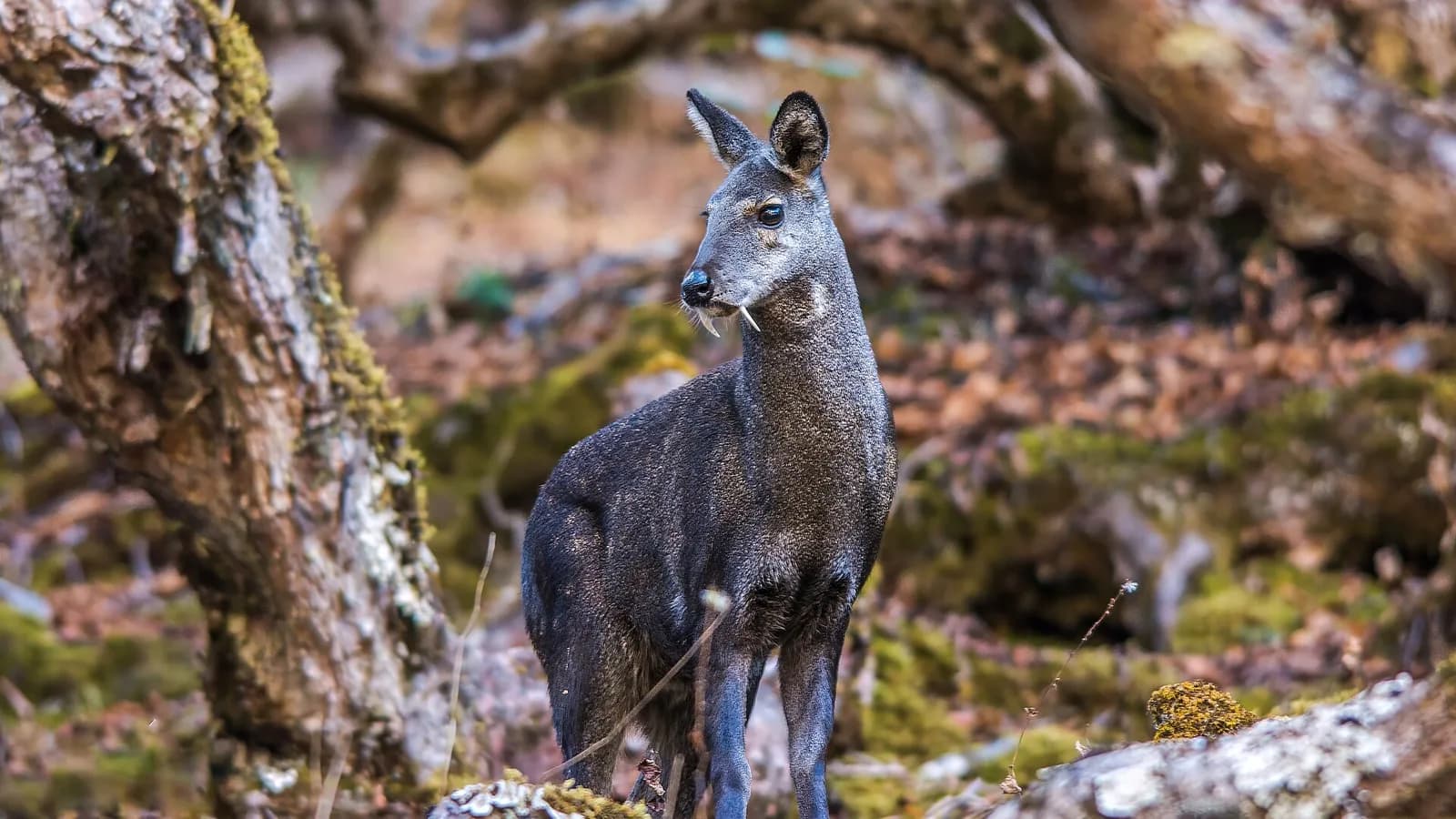
Nepal's wildlife reputation is built on big, visible animals: the one-horned rhino chewing through Terai grass, tigers, wild elephants, soaring vultures. The musk deer is none of those things. It is small, secretive, lives where the forest fades into rock and snow, and carries the strange combination of no antlers and a pair of curved fangs. For most travellers it is a creature of rumour rather than of photographs. This guide explains what the musk deer actually is, why it has tusks, where it lives in Nepal, why it is endangered, and the honest odds of seeing one on a trek.
Key takeaways
- The musk deer is not a true deer; it belongs to its own family, Moschidae, and has no antlers.
- Males grow long, fang-like canine teeth used for display and fighting, giving it the nickname sabre-toothed deer.
- It is a high-altitude animal, generally found in Nepal's alpine and subalpine forests above roughly 2,500 metres.
- The species is Endangered (IUCN) and protected under Nepal law and CITES Appendix I, mainly because of poaching for the valuable musk pod.
- The best, though still unlikely, places to spot one are the Annapurna Conservation Area and Langtang National Park, at dawn or dusk.
- Seeing a musk deer is a patience-and-luck experience, completely different from a lowland jeep safari.
What a musk deer actually is
The musk deer looks, at a glance, like a small, hunched deer about the size of a medium dog. Look closer and the differences pile up. It has no antlers at all. Its hind legs are noticeably longer than its front legs, giving it a rabbit-like, bounding gait over steep ground. And the adult males carry two long, downward-curving canine teeth that stick out past the lower jaw like tusks.
Biologists place musk deer in their own family, Moschidae, separate from the true deer family (Cervidae). They are sometimes described as primitive or ancient in form, keeping features that the antlered deer lost over evolutionary time. The genus name is Moschus, and several closely related species share the Himalayan slopes.
One animal, several species
Across Nepal and the wider Himalaya, more than one musk deer species is recognised, and telling them apart in the field is genuinely difficult. The commonly named forms in the region include the Himalayan musk deer (Moschus leucogaster), the Alpine musk deer (Moschus chrysogaster), the black musk deer (Moschus fuscus) and the Kashmir musk deer (Moschus cupreus), whose range has been confirmed by genetic work to extend into Nepal. All of them are classed as endangered by the IUCN. In Nepal, three species (Himalayan, Alpine and black) are strictly protected by law.
For a traveller, the practical point is simple: any musk deer you encounter on a Nepal trek is a protected, threatened animal, and a lucky sighting.
Why it has fangs
The fangs are the musk deer's most startling feature, and they belong almost entirely to the males. Both sexes have upper canine teeth, but the male's keep growing, reaching several centimetres in length, while the female's stay short.
These tusks are not for hunting; the musk deer is a plant-eater. Instead they are display and combat weapons. Because the animal has no antlers to lock and wrestle with, rival males during the breeding season settle disputes by slashing downward with their canines. Fights can turn aggressive, and animals sometimes carry the scars and deep cuts of these clashes. The tusks, in other words, do for the musk deer what antlers do for a stag.
That single adaptation, fangs instead of antlers, is why photographers and writers love to call it the vampire deer or sabre-toothed deer, despite it being one of the shyest and most harmless animals in the mountains.
Where musk deer live in Nepal
The musk deer is a high-mountain specialist. It is generally found in cool alpine and subalpine forest above about 2,500 metres, ranging up toward the treeline, with many records in the rough band of 3,000 to 4,300 metres. It favours dense forest with thick understorey cover and steep, shaded slopes where it can stay hidden, often a mix of conifer and broadleaf with rhododendron and birch.
Nepal holds a meaningful share of the world's musk deer habitat, scattered along the length of the high country. Recorded strongholds include several protected areas:
| Protected area | Region | Notes | | --- | --- | --- | | Sagarmatha (Everest) National Park | Khumbu, east | High forests below the famous peaks | | Langtang National Park | North of Kathmandu | One of the more accessible ranges | | Makalu Barun National Park | Far east | Remote, rich habitat | | Shey Phoksundo National Park | Dolpo, northwest | Large area of suitable high forest | | Khaptad National Park | Far west | Mid-mountain plateau forest | | Annapurna Conservation Area | Central north | Often cited for the best viewing odds | | Kanchenjunga Conservation Area | Far east | Pristine eastern habitat |
Despite this spread, research suggests only a modest fraction of Nepal is highly suitable musk deer country, and a large part of the potential habitat sits outside formally protected boundaries, which leaves the animal exposed to hunting and disturbance.
How it lives
Musk deer are mostly solitary and largely active in the low light of dusk, dawn and night, lying up in cover during the day. They are selective feeders, browsing leaves, grasses, mosses and especially lichens, which become a vital food in winter. They have even been recorded climbing leaning tree trunks to reach lichen growing well above the ground. Outside the breeding season, adults generally keep to small individual home ranges rather than gathering in herds, which is part of why they are so seldom seen.
Why the musk deer is endangered
The musk deer's troubles come down largely to one word: musk. Adult males produce a strong-smelling secretion in a gland, or pod, near the belly. For well over a thousand years this musk has been prized as a perfume fixative and as an ingredient in some traditional Asian medicines.
That demand makes the animal extraordinarily valuable dead. Researchers have reported deer musk changing hands at prices on the order of tens of thousands of US dollars per kilogram, ranking it among the most valuable animal products on earth. Because the musk is only reliably obtained by killing the male, decades of poaching have driven steep declines, with some assessments suggesting Himalayan musk deer numbers have fallen sharply from historic levels.
The pressures stack up:
- Poaching for the musk pod, often using indiscriminate snares that also kill females and young.
- Habitat loss and fragmentation from infrastructure, agriculture and grazing pressure pushing into high forest.
- Forest fire and livestock grazing degrading the dense understorey the deer depends on.
- Climate change, which over the long term shifts and shrinks the cold alpine forest belt the animal needs.
Protection on paper and on the ground
The musk deer is far from unprotected. It is listed as Endangered on the IUCN Red List, it sits on CITES Appendix I (banning international commercial trade), and in Nepal it is a protected species under the National Parks and Wildlife Conservation Act of 1973. Synthetic musk has also replaced the natural product in most of the modern perfume industry, removing some legal demand.
The gap, as with much wildlife law, is enforcement. Conservation researchers repeatedly highlight stronger anti-poaching effort, and bringing more of the deer's habitat under effective protection, as the key levers for the species' recovery. As a visitor, the most useful things you can do are never buy any product claiming to contain real musk, report snares or suspicious hunting to park staff, and support the community conservation and ecotourism models that give local people a stake in keeping the animal alive, the same logic that underpins efforts for the red panda in Nepal.
Can you actually see one on a trek?
Honestly: probably not, but it is not impossible, and that is part of the appeal. The musk deer is shy, cryptic and active mainly in poor light, so even in good habitat most trekkers walk straight past without knowing it is there.
If you want to give yourself a chance:
- Choose the right ground. The Annapurna Conservation Area and Langtang National Park are the most cited for realistic odds, with high subalpine forest near the treeline.
- Go at the right time of day. Early morning and late evening are when the animals move to feed; midday is hopeless.
- Move slowly and quietly. Patience and silence matter far more than distance covered. A local guide who knows the slopes is your biggest advantage.
- Look in the right structure. Dense forest understorey on steep, shaded slopes, often near water, rather than open meadow.
- Manage expectations. Treat any sighting as a gift. Far more common is to find only the deer's small, distinctive droppings or hear it crash away unseen.
Trails that pass through the right elevation band, such as the upper sections of the Langtang Valley trek and the high forests within the Annapurna Circuit, at least put you in the neighbourhood. So do the remote routes of the Upper Dolpo around Shey Phoksundo. Pair the walk with general Himalayan wildlife and birdwatching interest and the trek rewards you whether or not the deer appears.
Musk deer versus the deer you will actually see
It is worth clearing up a common confusion. The musk deer is not the kind of deer most tourists end up photographing in Nepal. On a lowland jeep safari in Chitwan or Bardia you will likely see spotted deer (chital), sambar and barking deer, true deer with antlers, living in hot Terai grassland and riverine forest. Those are easy, almost guaranteed sightings.
| Feature | Musk deer | Terai deer (chital, sambar) | | --- | --- | --- | | Family | Moschidae (its own family) | Cervidae (true deer) | | Antlers | None | Yes, on males | | Weapons | Long canine fangs (males) | Antlers | | Habitat | High alpine and subalpine forest | Lowland grassland and forest | | Where seen | High mountain treks | Terai national parks and safaris | | Odds of sighting | Very low, luck-based | High, often guaranteed |
So if your heart is set on watching deer in Nepal, the safari parks of the Terai are the sure thing. If instead you are drawn to the idea of a fanged, mist-loving mountain ghost that almost no one sees, the musk deer is one of the high Himalaya's great quiet prizes, best appreciated by knowing it is out there, sharing the forest with you, even when it stays hidden. For the wider context of where these animals live, the network of Nepal's national parks and conservation areas is the place to start, with Sagarmatha National Park among the high-altitude homes it shares with the deer.
Sources
- Predicting the current habitat refugia of Himalayan Musk deer across Nepal (Ecology and Evolution, 2024)
- Ecological correlates of Himalayan musk deer Moschus leucogaster (PMC)
- mtDNA analysis confirms the endangered Kashmir musk deer extends its range to Nepal (Scientific Reports)
- Moschus leucogaster (Himalayan musk deer), Animal Diversity Web
- Himalayan Musk Deer: The Sabre-toothed Super-smellers (RoundGlass Sustain)
- Musk deer | Size, Diet, Habitat, & Facts (Britannica)
- Alpine musk deer (Wikipedia)
- White-bellied (Himalayan) musk deer (Wikipedia)
- Himalayan Musk Deer, Sagarmatha National Park / Nepal (GRID-Arendal)
Frequently asked questions
- What is a musk deer?
- The musk deer is a small, primitive deer of the Himalaya and Central Asia that belongs to its own family, Moschidae, not the true deer family. It has no antlers; instead the males grow long, curved, fang-like canine teeth. It is famous for the musk gland that males carry, a substance long prized for perfume and traditional medicine, which is the main reason the animal is hunted and endangered.
- Are musk deer found in Nepal?
- Yes. Several musk deer species live along Nepal's high mountains, generally in alpine and subalpine forest above roughly 2,500 metres. They are recorded in protected areas including Sagarmatha (Everest), Langtang, Makalu Barun, Shey Phoksundo and Khaptad national parks, plus the Annapurna and Kanchenjunga conservation areas. They are widespread but shy, so sightings are rare even where the animal is present.
- Why do musk deer have fangs?
- The long upper canine teeth are a male feature used for display and fighting rather than for eating. Because musk deer have no antlers, rival males spar over territory and mates by slashing downward with these tusks, which can grow several centimetres long and sometimes inflict deep cuts. Females have much shorter canines. The fangs give the animal its nickname as a sabre-toothed or vampire deer, even though it is a harmless plant-eater.
- Are musk deer endangered?
- Yes. Himalayan musk deer are listed as Endangered on the IUCN Red List, and musk deer are protected under Nepal's National Parks and Wildlife Conservation Act of 1973. The genus is also on Appendix I of CITES, which bans international commercial trade. The main threats are poaching for the valuable musk pod, habitat loss and fragmentation, livestock grazing, forest fire and the long-term pressure of climate change on alpine forests.
- What is musk and why is it so valuable?
- Musk is a strong-smelling secretion produced in a gland, or pod, carried by adult male musk deer. For centuries it has been used as a fixative in perfume and as an ingredient in some traditional medicines across Asia. Researchers have reported deer musk fetching prices on the order of tens of thousands of US dollars per kilogram, which makes it one of the most valuable animal products in the world and drives illegal hunting. Most modern perfumes now use synthetic musk instead.
- Where can trekkers realistically see a musk deer?
- The best odds are in the Annapurna Conservation Area and Langtang National Park, usually in the early morning or late evening when the animals move to feed. Look in dense subalpine forest near the treeline, often on steep, shaded slopes. Even so, sightings are a matter of luck and patience; many guides who have walked these trails for years have only glimpsed the deer a handful of times. Quiet, slow walking at dawn gives you the best chance.
- What do musk deer eat and how do they behave?
- Musk deer are selective browsers that feed on leaves, grasses, mosses and especially lichens, which become important winter food. They have been seen climbing leaning tree trunks to reach lichen high off the ground. They are mostly solitary and largely active at dusk, dawn and night, hiding in cover during the day. Outside the breeding season adults usually keep to their own small home ranges rather than forming herds.
- Is the musk deer the same as a deer you would see in a Nepal safari park?
- No. The musk deer is a high-mountain, forest animal, completely different from the spotted deer, sambar and barking deer that tourists see on jeep safaris in lowland Terai parks like Chitwan and Bardia. Those are true deer with antlers, living in hot grassland and riverine forest. The musk deer lives far higher and colder, has fangs instead of antlers, and is far harder to find. Seeing one is a high-altitude experience, not a safari one.
Related posts
Himalayan Tahr: Nepal's Cliff-Dwelling Wild Goat
A trekker's guide to the Himalayan tahr in Nepal: where to see this wild goat, its alpine habitat, conservation status, and the Everest trail's most-spotted mammal.
Read postSnow Leopard in Nepal: Where the Ghost Cat Lives
A traveller's guide to the snow leopard in Nepal: the 397 national estimate, where they live, tracking treks in Dolpo and Kanchenjunga, and realistic sighting odds.
Read postThe Yak in Nepal: A Trekker's Guide to Himalayan Yaks
What every traveller should know about the yak in Nepal - where to see them, yak vs nak vs dzo, yak cheese, and trail safety in the Himalaya.
Read post