Lhotse Expedition: 2026 Guide to the 4th Highest Peak
A Lhotse expedition guide for 2026 — the 8,516m height, the Everest-shared route, the Reiss Couloir, permits, cost, difficulty and the best season.
Lhotse shares Everest's icefall, cwm and face — then peels off into a steep couloir all its own.
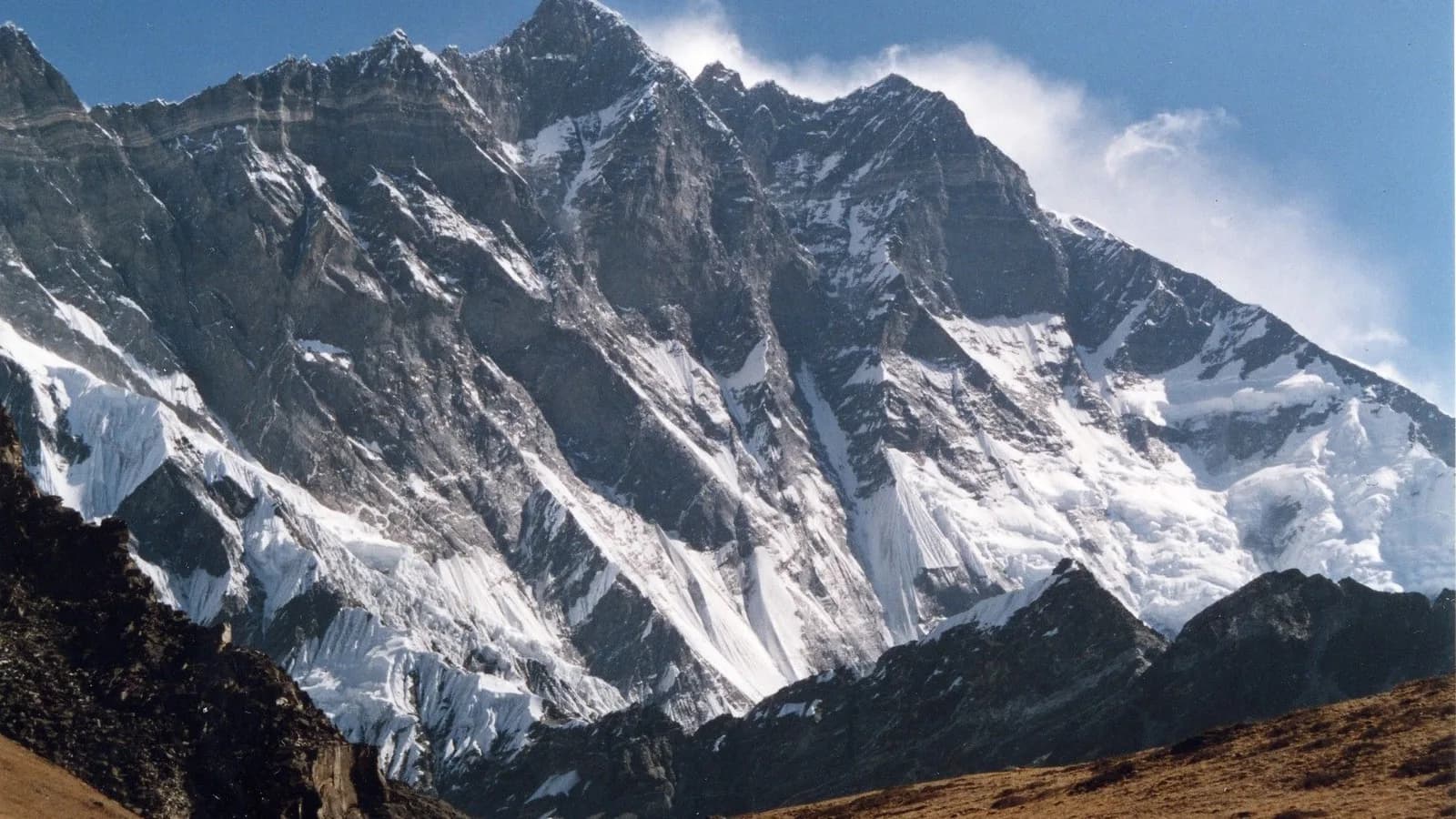
The Lhotse expedition is one of the great paradoxes of Himalayan climbing: you spend almost the entire route on Everest's doorstep, sharing the same icefall, the same valley and the same wall of ice, yet you finish on a separate summit with a far smaller crowd and a permit that costs a fraction of the price. Lhotse rises to 8,516 metres (27,940 feet) and is the fourth-highest mountain on Earth, standing directly south of Everest and joined to it by the South Col. This guide covers the height and geography, the route through the Khumbu Icefall and Lhotse Face, the camps, the steep Reiss Couloir near the top, the honest difficulty, the permits and cost, and the best season — all stamped to mid-2026.
If you are mapping out where Lhotse fits into a wider Khumbu plan, our Everest Base Camp trek itinerary traces the trail you will share on the walk in, our Ama Dablam climb guide covers the region's signature technical peak, and our pieces on Island Peak and Mera Peak cover the trekking peaks many climbers use to build experience first.
Key takeaways
- Lhotse is 8,516 metres (27,940 feet) high — the fourth-highest mountain in the world, on the Nepal–Tibet border just south of Everest.
- The standard route shares the Everest South Col line — Khumbu Icefall, Western Cwm and Lhotse Face — then diverges up the Reiss Couloir to the summit.
- It was first climbed on 18 May 1956 by Swiss climbers Fritz Luchsinger and Ernst Reiss.
- Nepal's climbing permit is USD 3,000 per foreign climber in spring under the rates effective 1 September 2025 (as of June 2026) — versus USD 15,000 for Everest.
- Expect a trip of about 50 to 60 days and full guided costs commonly in the USD 20,000–45,000+ range per person (as of June 2026).
Lhotse at a glance
Lhotse is the immediate neighbour of Everest, separated from it only by the South Col, the high saddle at around 7,900 metres. The two are so close that the Lhotse Face — the great wall of blue ice that climbers ascend — is the same face that every Everest South Col climber must also climb. In fact the usual Everest route starts up the northwest flank of Lhotse before cutting across to the higher peak, which is why a Lhotse summit shares so much of Everest's character.
The mountain is not a single point. Its main ridge carries several distinct summits: Lhotse Main (8,516 m), Lhotse Middle (8,414 m), Lhotse Central II (8,372 m) and Lhotse Shar (8,383 m). The name itself means roughly "south peak" in Tibetan, a reference to its position relative to Everest. Commercial expeditions almost always target Lhotse Main; Lhotse Middle in particular was one of the last named 8,000-metre-plus points on Earth to be summited, and the secondary tops remain rarely climbed and technically severe.
| Fact | Detail | | --- | --- | | Height | 8,516 m (27,940 ft) | | World rank | 4th highest | | Location | Nepal–Tibet (China) border, Khumbu region | | First ascent | 18 May 1956, Fritz Luchsinger & Ernst Reiss (Swiss) | | Other summits | Lhotse Middle 8,414 m, Central II 8,372 m, Shar 8,383 m | | Base camp | Shared with Everest (Khumbu side) |
The standard climbing route
Base camp to Camp 3
A Lhotse expedition uses the same Everest Base Camp on the Khumbu side, reached after roughly a two-week trek from Lukla through Namche Bazaar, Tengboche and Dingboche. From there the lower route is identical to the Everest South Col climb.
The first major obstacle is the Khumbu Icefall, a chaotic, constantly moving river of ice tumbling out of the Western Cwm. A team of Sherpa specialists known as the Icefall Doctors fixes and maintains a path through it each season using ropes and aluminium ladders. Above the icefall lies the broad, glittering Western Cwm, leading to Camp 2 (Advanced Base Camp) at roughly 6,400 metres.
From Camp 2 the route climbs the Lhotse Face, a wall of glacial blue ice described as around 1,125 metres (3,690 feet) high, rising at pitches of roughly 40 to 50 degrees with occasional steeper bulges. Camp 3 is cut into this face at about 7,300–7,500 metres. Up to here, Lhotse and Everest climbers move together on the same fixed lines.
The divergence and the Reiss Couloir
Above Camp 3 and the rocky Yellow Band, the Everest route traverses left towards the South Col while the Lhotse route continues more directly up the face. Many teams place a high Camp 4 around 7,800 metres before the summit push. The final section narrows into the Reiss Couloir (also tied to the wider Lhotse Couloir on the west face) — a steep gully only a few metres wide in places, where the slope steepens toward roughly 60 degrees and fixed ropes are essential. This couloir is the crux of the climb: it concentrates the route into a single line, so conditions and traffic can both create bottlenecks high on the mountain.
| Camp | Approx. altitude | Notes | | --- | --- | --- | | Base Camp | ~5,300 m | Shared with Everest, Khumbu side | | Camp 1 | ~5,900–6,000 m | Top of the Khumbu Icefall | | Camp 2 | ~6,400 m | Advanced Base Camp, Western Cwm | | Camp 3 | ~7,300–7,500 m | On the Lhotse Face | | Camp 4 | ~7,800 m | High camp before the couloir | | Summit | 8,516 m | Via the Reiss Couloir |
How hard is Lhotse?
Lhotse is a serious, high-risk 8,000-metre peak, and bottled oxygen, fixed ropes and Sherpa support are standard on commercial climbs. Because the route mirrors Everest's almost to the top, the objective dangers are largely the same: the unpredictable Khumbu Icefall, crevasses, avalanche-prone slopes, extreme cold and the thin air of the so-called death zone above 8,000 metres.
Where Lhotse differs is the finish. It avoids the long, exposed summit ridge and the Hillary Step that define Everest's final hours, which some climbers find marginally more contained. But the Reiss Couloir is genuinely steep and narrow, and being funnelled into it at extreme altitude carries its own hazards. Historically the mountain has seen a meaningful number of deaths relative to its summits — by the late 2000s, records counted hundreds of ascents against around twenty fatalities — so it should never be treated as an "easy" 8,000er. Solid prior experience on a peak such as Ama Dablam, Manaslu or another 8,000-metre mountain is the sensible foundation before attempting it.
Permits and red tape
Lhotse is administered by Nepal's Department of Tourism, and the climbing royalty rose sharply under the mountaineering regulation amendment that took effect 1 September 2025. As of June 2026, the headline figures are:
| Permit / fee | Amount (as of June 2026) | Notes | | --- | --- | --- | | Lhotse climbing permit (spring) | USD 3,000 per climber | Up from USD 1,800; covers 8,000 m peaks like Lhotse and Makalu | | Everest climbing permit (spring) | USD 15,000 per climber | For comparison, south/Nepal route | | Sagarmatha National Park entry | NPR 3,000 | Paid per person | | Khumbu Pasang Lhamu Rural Municipality | ~NPR 2,000 | Local area fee |
Permits are issued through a registered Nepali expedition operator, not to individuals directly, and applications are generally submitted well in advance with passport copies, climbing CVs, medical paperwork and high-altitude insurance. The same 2025 reforms also adjusted the permit validity window, so confirm current durations with your operator when you book. For the wider context on Everest-region paperwork, see our guide to Everest Base Camp permits for 2026 and the broader Nepal trekking permits overview.
What a Lhotse trip costs
The permit is only a small slice of the bill. A fully supported Lhotse expedition — with logistics, base-camp infrastructure, bottled oxygen, climbing Sherpas, food and the icefall fees — is commonly advertised in the region of USD 20,000 to USD 45,000 or more per person, depending heavily on operator reputation, group size, oxygen volume and how much one-to-one Sherpa support you buy (as of June 2026). That is still far below an Everest budget, largely because of the much smaller permit, which is one reason Lhotse appeals to climbers who want an 8,000-metre summit without Everest's price tag. For a sense of how the bigger neighbour's costs stack up, see our Everest expedition cost breakdown.
Best season and a realistic timeline
Spring (roughly April to May) is overwhelmingly the main Lhotse season. It piggybacks on the Everest spring rush: the Icefall Doctors establish the route, fixed ropes go in on the Lhotse Face, and teams share the same narrow weather windows for a summit push, typically clustered in May. Autumn climbs do happen but are uncommon and colder high on the face, while the monsoon and deep winter are generally avoided for commercial trips because of snow loading and avalanche risk.
A typical commercial Lhotse expedition lasts about 50 to 60 days. Roughly two weeks go to the trek in from Lukla and the walk back out; the remainder is spent acclimatising at base camp and doing two or more rotations up through the icefall to the higher camps before a final, weather-dependent summit bid. The long timeline is not padding — it is the acclimatisation that makes a summit at 8,516 metres survivable. If you are planning when to be in the region at all, our guide to the best season to trek in Nepal covers the wider weather picture.
A short history
The first ascent of Lhotse Main came on 18 May 1956, when Swiss climbers Fritz Luchsinger and Ernst Reiss reached the top — the gully high on the route, the Reiss Couloir, carries Reiss's name. The peak holds a notable place in mountaineering history for another reason: it was the final 8,000-metre summit in Reinhold Messner's completion of all fourteen 8,000ers in 1986. The first winter ascent was made by Krzysztof Wielicki at the very end of 1988. The harder secondary summits, especially Lhotse Middle, resisted climbers for decades longer and remain among the most demanding objectives in the range.
Is Lhotse right for you?
If you are an experienced high-altitude mountaineer who wants a true 8,000-metre summit but balks at Everest's permit and crowds, Lhotse is one of the most logical choices in Nepal. You get the full Everest-route experience — the icefall, the cwm, the great blue face — at a far lower headline cost, with the Reiss Couloir as a distinctive finish. It is emphatically not a beginner objective, and it demands the same respect, fitness and contingency planning as any extreme-altitude climb. For most travellers, the realistic Khumbu dream is the trail below, not the summit above: our Everest Base Camp trek guide is the place to start, with Lhotse looming overhead as the prize for a later, far more committing season.
Sources
Frequently asked questions
- How tall is Lhotse?
- Lhotse stands at 8,516 metres (27,940 feet), making it the fourth-highest mountain on Earth after Everest, K2 and Kangchenjunga. Its main summit sits on the border between Nepal's Khumbu region and the Tibet Autonomous Region of China, immediately south of Everest and connected to it by the South Col.
- What route do Lhotse expeditions follow?
- The standard Lhotse route shares almost the entire Everest South Col line — the Khumbu Icefall, the Western Cwm and the lower Lhotse Face up to around Camp 3. From there Lhotse climbers carry on up the face and finish through a steep, narrow gully known as the Reiss Couloir to the main summit, rather than traversing left to the South Col and Everest.
- How much does it cost to climb Lhotse?
- Nepal's climbing permit for Lhotse is USD 3,000 per foreign climber in the spring season under the royalty rates effective 1 September 2025 (as of June 2026). Full guided expeditions are far more, commonly cited from roughly USD 20,000 to USD 45,000 or more per person depending on operator, oxygen, Sherpa support and service level.
- Do you need a permit to climb Lhotse?
- Yes. Lhotse is an 8,000-metre expedition peak administered by Nepal's Department of Tourism, so you need a climbing permit (USD 3,000 in spring as of June 2026), arranged through a registered Nepali operator. You also pay the Sagarmatha National Park entry fee and the local Khumbu Pasang Lhamu Rural Municipality fee, and you must carry liaison-officer and rescue insurance arrangements.
- How long does a Lhotse expedition take?
- Most commercial Lhotse expeditions run roughly 50 to 60 days door to door. That includes the trek in from Lukla, a long acclimatisation period at base camp, two or more rotations up to the higher camps, a weather-dependent summit window and the journey back out. Roughly two weeks of that is simply getting to and from base camp.
- Is Lhotse harder than Everest?
- On the standard routes the two share most of the difficulty up to Camp 3, so they feel similar at altitude, and the permit is far cheaper for Lhotse. The Reiss Couloir near the top is steep and narrow, which can create bottlenecks, but Lhotse avoids the highest, most exposed terrain of Everest's summit ridge. Lhotse is still a serious, high-risk 8,000-metre peak.
- When is the best time to climb Lhotse?
- Spring, roughly April to May, is the main Lhotse season, sharing the same fixed ropes and weather windows as Everest. Autumn is occasionally attempted but is far less common and colder high on the face. The monsoon and deep winter are generally avoided for commercial climbs because of snow loading, cold and avalanche risk.
- Can you climb Lhotse and Everest together?
- Yes, and some climbers do, because the routes overlap so closely. It is even possible in principle to link the two summits within a short window, but in practice a combined Everest and Lhotse trip means two summit pushes, two permits and a great deal of extra time, oxygen and risk at extreme altitude. It is only for very strong, experienced mountaineers.
Related posts
Ama Dablam Climb: 2026 Expedition Guide (6,812m)
An Ama Dablam climb and expedition guide for 2026 — height, the Southwest Ridge route, camps, fixed ropes, difficulty, permits, cost and the best seasons.
Read postCho Oyu Expedition: 8,188m Guide for 2026
A Cho Oyu expedition guide for 2026 — height, the Tibet normal route, why it's the easiest 8000m peak, CTMA rules, permits, seasons and how hard it really is.
Read postEverest Expedition Cost 2026: A Buyer's Guide to the Quote
Everest expedition cost in 2026 — how to read an operator quote, what drives the price, season and route differences, deposits, and what's excluded.
Read post