Cho Oyu Expedition: 8,188m Guide for 2026
A Cho Oyu expedition guide for 2026 — height, the Tibet normal route, why it's the easiest 8000m peak, CTMA rules, permits, seasons and how hard it really is.
At 8,188 metres, Cho Oyu is the gentlest of the eight-thousanders — but a gentle 8,000-metre peak is still a serious mountain.
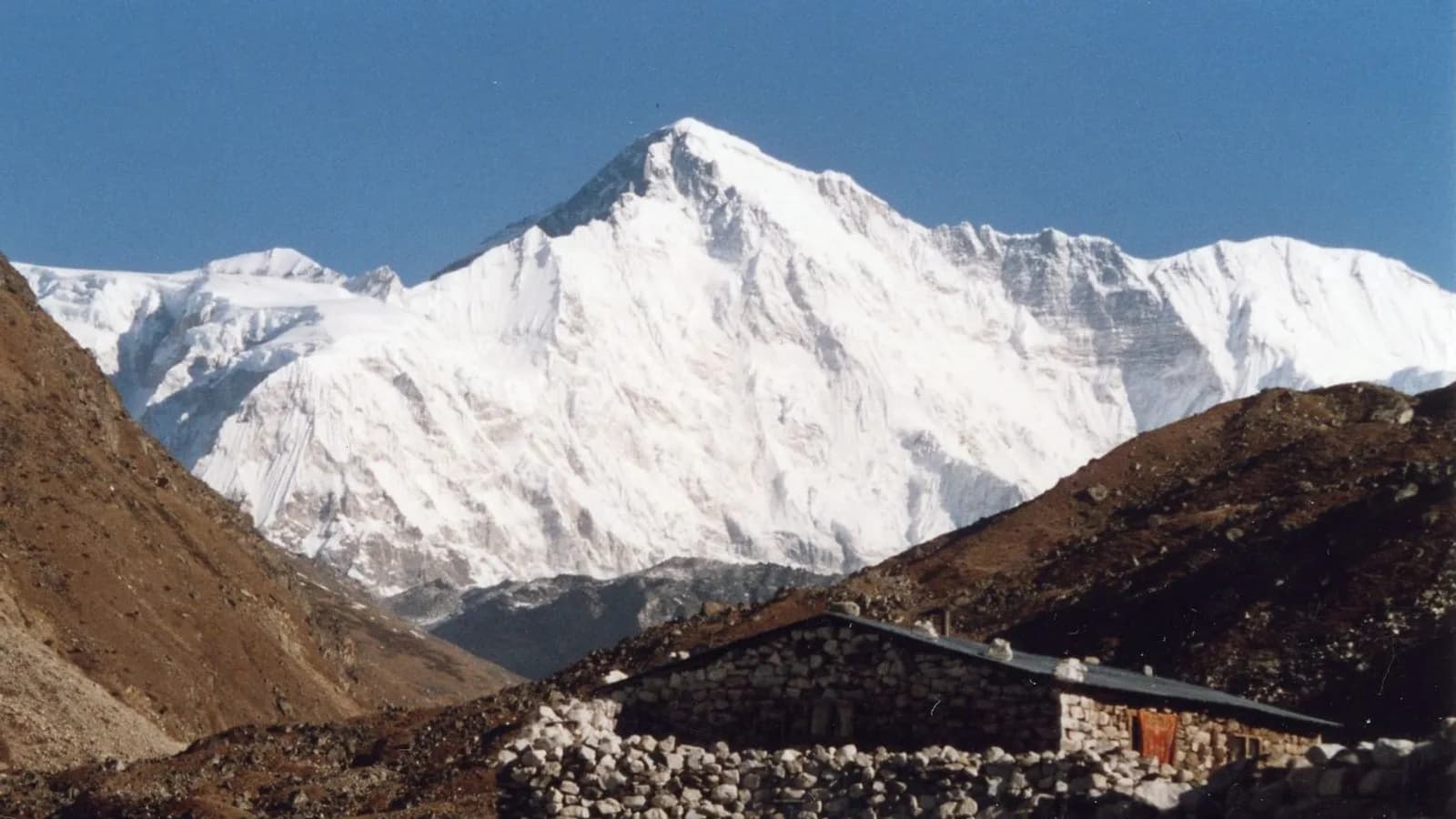
The Cho Oyu expedition is, for many climbers, the front door to the world of 8,000-metre peaks. At 8,188 metres (26,864 feet) Cho Oyu is the sixth-highest mountain on Earth, sitting on the China-Nepal border barely 20 kilometres west of Everest — and it is the only one of the fourteen eight-thousanders that is regularly described as "the easiest." That reputation is earned, but it is also easy to misread. A gentle slope at 8,000 metres is still a place where weather, avalanche and thin air can end a trip, or worse. This guide covers the real height, the Tibet normal route, the rules that now govern the climb, the honest difficulty, and how a Cho Oyu attempt fits alongside Nepal's other big objectives, stamped to mid-2026.
If you are still mapping out where Cho Oyu fits in a Himalayan progression, our guides to Mera Peak and Island Peak cover the trekking peaks many climbers use as stepping stones, while the Ama Dablam climb is the classic technical step before an eight-thousander.
Key takeaways
- Cho Oyu is 8,188 metres (26,864 feet) — the sixth-highest mountain in the world — on the China-Nepal border about 20 km west of Everest.
- You will see two heights quoted: the 1996 survey figure of 8,188 m and an older 1984 figure of 8,201 m.
- It is widely called the most achievable eight-thousander, with the lowest death-to-summit ratio of the fourteen, thanks to the moderate northwest ridge from Tibet.
- Almost all commercial climbs go from the Tibet (China) side; the Nepal side is steep, dangerous and climbed only rarely.
- The China Tibet Mountaineering Association (CTMA) now sets strict rules — a vetted climbing resume, a professional guide, and oxygen above 7,000 m — and access has been on-and-off in recent seasons.
- It is still a serious high-altitude expedition: avalanche and altitude sickness have killed climbers here, and "easiest" never means safe.
The mountain: what makes Cho Oyu special
Cho Oyu rises in the Mahalangur Himalaya, the same great cluster of peaks that holds Everest, Lhotse and Makalu. Its name comes from Tibetan and is usually translated as "Turquoise Goddess" — a nod to the colour the broad summit can take in certain light. The mountain straddles the frontier between the Tibet Autonomous Region of China and Nepal's Koshi Province, and its proximity to Everest means that on a clear day from the summit plateau you look straight across at the highest mountain on the planet.
What sets Cho Oyu apart from its neighbours is its shape. Where Everest, Lhotse and Makalu throw up steep walls and knife ridges, Cho Oyu's standard side is comparatively broad and rounded, with a flat summit plateau rather than a sharp peak. That gentler architecture, combined with its position near an old trans-Himalayan trading pass (the Nangpa La), is the single biggest reason it has become the eight-thousander most people attempt first.
Two heights, one mountain
It is worth clearing up the height confusion early. A 1984 estimate put Cho Oyu at 8,201 metres (26,906 feet), and that number still appears in plenty of references — including some encyclopaedias. But a more rigorous survey in 1996, by Nepal's Survey Department and the Finnish Meteorological Institute, measured it at 8,188 metres (26,864 feet), very close to the figure Edmund Hillary used back in the 1950s. The 8,188 m value is the one most modern sources treat as definitive, but seeing both is normal and neither changes the mountain's sixth-place ranking.
A short history of Cho Oyu
Cho Oyu was first climbed on 19 October 1954 by an Austrian party: Herbert Tichy, Joseph (Sepp) Jöchler and the Sherpa Pasang Dawa Lama, via the northwest ridge from the north. It was a remarkable, lightweight effort for its era, and for a time it held a notable distinction — until Everest was climbed without bottled oxygen in 1978, Cho Oyu's 1954 first ascent was the highest summit ever reached without supplementary oxygen.
The mountain has been central to oxygen-free climbing history ever since. Reinhold Messner reached the top in 1983, on his fourth attempt, together with Hans Kammerlander and Michael Dacher. Its moderate slopes have made it a favoured testing ground for high-altitude climbers ever since, both with and without oxygen.
That history also has a sombre side. In 1959, four members of an international women's expedition were killed in an avalanche on Cho Oyu — an early and stark reminder that the mountain's gentle reputation does not remove its hazards.
How hard is a Cho Oyu expedition?
This is the question that matters most, because the word "easiest" does so much damage. Cho Oyu is the least technical of the eight-thousanders on its normal route, and it has the lowest death-to-summit ratio of the fourteen. But "least technical 8,000-metre peak" is still an enormous undertaking.
On the Tibet-side northwest ridge, the climbing is mostly snow-plodding on moderate slopes, with one notable obstacle: a rocky step often called the Yellow Band high on the route, which is short but can be awkward and is usually fixed with rope. There are few of the deep crevasses, tottering seracs and steep ice that define harder peaks like Manaslu. What you are really fighting is altitude and weather — the long, grinding effort of moving above 7,000 and then 8,000 metres, where the air holds barely a third of the oxygen at sea level.
Tibet normal route vs the Nepal side
The two sides of Cho Oyu could hardly be more different, and it is important to understand which one a commercial "Cho Oyu expedition" actually means.
| Aspect | Tibet (China) side — normal route | Nepal side | |---|---|---| | Route character | Moderate northwest ridge, broad slopes | Steep faces, mixed rock and ice | | Technical difficulty | Low for an eight-thousander | High and serious | | Objective hazards | Fewer seracs and crevasses; main risks are altitude, weather, the Yellow Band | Avalanche-prone, rockfall, very steep walls | | Who climbs it | Almost all commercial expeditions | Very rare; gaps of a decade or more between ascents | | Access | Drive-in base camp via Tibet | Reached through the Gokyo valley and Ngozumba Glacier |
The takeaway is simple: commercial Cho Oyu means the Tibet normal route. The Nepal-side faces, with their long, avalanche-swept walls, have seen only a handful of successful ascents over the decades and are firmly the province of elite alpinists. If you walk the Gokyo Lakes trek, you are looking at the foot of that hard side, but the trekking trails and the climbing routes are entirely different worlds.
The CTMA rules you must plan around
Because the standard route is in Tibet, a Cho Oyu expedition is governed by the China Tibet Mountaineering Association (CTMA), and its rules have tightened in recent years. As of mid-2026, climbers on CTMA-permitted eight-thousanders have generally faced requirements including:
- A complete medical file and a climbing resume with proof of previous ascents.
- A previous high point that is not more than about 1,000 metres lower than the target peak — so Cho Oyu effectively asks for prior 7,000-metre-class experience.
- Being accompanied by a professional mountain guide.
- Supplementary oxygen used throughout above 7,000 metres.
The CTMA has also shown it will close a peak outright after a tragedy. After two avalanches killed climbers and guides on a neighbouring Tibetan eight-thousander, the association shut that mountain for the rest of the season — part of a broader pattern of cautious, sometimes unpredictable access decisions.
Is the Tibet side actually open?
Access has been genuinely on-and-off. The CTMA reopened Cho Oyu permits for autumn 2023, then kept the peak closed in spring 2024 and again in spring 2025, while issuing permits for the autumn 2024 season (as of mid-2026). No detailed official explanation has accompanied the spring closures. The practical message for anyone planning: do not assume a given season is open. Confirm the current status with a licensed operator before you book flights or commit money, and build in flexibility.
Costs, seasons and logistics
What it costs
Cho Oyu is not a cheap objective. Because everything runs through the China side, you are paying for the China permit, cross-border logistics, Sherpa support and bottled oxygen on top of guiding. Guided Tibet-side expeditions are commonly advertised in the rough range of USD 18,000 to USD 30,000 or more per person, depending on operator, group size and service level (as of June 2026). Prices vary widely, so scrutinise exactly what each quote includes — permits, oxygen, high-altitude Sherpas and rescue arrangements can make or break a budget.
For context on how the big peaks compare on price, our Everest expedition cost guide breaks down where the money goes on Nepal's flagship climb; Cho Oyu typically sits below Everest but well above the trekking peaks.
When to go
In recent seasons the permitted window on the Tibet side has been autumn (roughly September into early October), with the post-monsoon weather settling and the China side opening then rather than in spring. Spring access has frequently not been granted. So unlike many Nepal climbs, your season is dictated as much by CTMA policy as by weather — another reason to keep plans flexible.
A realistic timetable
A Cho Oyu trip is shorter than an Everest expedition but still measured in weeks, not days. Most itineraries run on the order of four to six weeks door to door, covering travel into Tibet, a drive-in to base camp, several acclimatisation rotations between camps, and a patient wait for a settled summit window. Rushing acclimatisation is the classic mistake; the mountain rewards climbers who give their bodies time to adapt to the altitude.
Is Cho Oyu right for you?
Cho Oyu makes most sense as a first eight-thousander for a climber who already has a solid Himalayan base — comfort on fixed ropes, crampons and an ice axe, good decision-making at altitude, and ideally a 6,000 or 7,000-metre summit already behind them. It is a logical step up from peaks like Mera Peak, Island Peak and the more technical Ama Dablam.
It is not a good idea as a first big mountain, and the "easiest 8,000er" label should never be read as "safe." Avalanche, altitude sickness and weather have all taken lives here. Treated with respect, thorough preparation and a reputable operator, a Cho Oyu expedition is one of the most rewarding ways to step into the rarefied world above 8,000 metres. If you are weighing Tibet against staying on the Nepal side of the range, our Nepal vs Tibet comparison covers the wider trade-offs in access, permits and experience.
Sources
- Cho Oyu — Wikipedia
- Cho Oyu | Map, Height, & Facts — Britannica
- First ascent of Cho Oyu — Guinness World Records
- A Look at China's Strict 8,000m Rules — ExplorersWeb
- The Hard Side: A History of Climbing Cho Oyu From Nepal — ExplorersWeb
- China closes Mt Everest, Cho-Oyu, Shishapangma from climbing this autumn — The Himalayan Times
- No Shisha Pangma, No Cho Oyu This Spring — ExplorersWeb
- Adventure Consultants — Cho Oyu
Frequently asked questions
- How tall is Cho Oyu?
- Cho Oyu is 8,188 metres (26,864 feet) according to a 1996 survey by Nepal's Survey Department and the Finnish Meteorological Institute. An earlier 1984 figure of 8,201 metres is still widely quoted, which is why you will see both numbers. Either way it is the sixth-highest mountain on Earth, on the China-Nepal border about 20 kilometres west of Everest.
- Is Cho Oyu the easiest 8000m peak?
- It is widely regarded as the most achievable of the fourteen eight-thousanders, mainly because the standard northwest ridge from Tibet has moderate slopes, few technical sections and the lowest death-to-summit ratio of the group. Easiest is relative, though — it is still a high-altitude expedition with real avalanche and altitude risk, not a walk-up.
- What is the normal route up Cho Oyu?
- Almost all commercial climbs use the northwest ridge from the Tibet (China) side, the line of the 1954 first ascent. It runs from a drive-in base camp up through a series of high camps to a broad summit plateau, with a short rock band (the Yellow Band) as the main technical obstacle. The Nepal side is far steeper and is climbed only rarely.
- Can you climb Cho Oyu from Nepal?
- You can, but very few people do. The Nepal-side faces are steep, avalanche-prone and technically demanding, with successful ascents separated by gaps of more than a decade. Trekkers can reach the Gokyo valley and the Ngozumba Glacier below the mountain, but the climbing routes themselves are serious mountaineering terrain.
- Do you need supplementary oxygen on Cho Oyu?
- On the Tibet normal route the China Tibet Mountaineering Association currently requires supplementary oxygen above 7,000 metres on its eight-thousanders. Historically Cho Oyu has been a popular peak for oxygen-free attempts, and it was first climbed without oxygen in 1954, but climbers on permitted Tibet-side expeditions today should plan around the CTMA rule.
- Is the Tibet side of Cho Oyu open?
- Access has been on-and-off. The China Tibet Mountaineering Association reopened Cho Oyu permits for autumn 2023, kept the peak closed in spring 2024 and spring 2025, and issued autumn permits in 2024 (as of mid-2026). Always confirm the current season's status with a licensed operator before booking, because policy can change year to year.
- How much does a Cho Oyu expedition cost?
- Guided Tibet-side expeditions are commonly advertised in the rough range of USD 18,000 to USD 30,000 or more per person depending on operator, group size and service level (as of June 2026). That typically bundles the China permit, logistics, Sherpa support and oxygen, but always check exactly what is and is not included before you commit.
- When is the best time to climb Cho Oyu?
- Autumn (roughly September to early October) has been the main permitted window on the Tibet side in recent years, with the post-monsoon weather settling and the China side typically opening then rather than in spring. Spring climbs have often not been permitted, so the season is largely dictated by CTMA access as well as weather.
Related posts
Ama Dablam Climb: 2026 Expedition Guide (6,812m)
An Ama Dablam climb and expedition guide for 2026 — height, the Southwest Ridge route, camps, fixed ropes, difficulty, permits, cost and the best seasons.
Read postEverest Expedition Cost 2026: A Buyer's Guide to the Quote
Everest expedition cost in 2026 — how to read an operator quote, what drives the price, season and route differences, deposits, and what's excluded.
Read postHow Long to Climb Everest: The Real Timeline
How long to climb Everest from arrival to summit: roughly two months, broken into the trek-in, acclimatization rotations, the weather wait, and summit day.
Read post