Indra Chowk: Kathmandu's Bead and Bazaar Square Guide
A traveler's guide to Indra Chowk in old Kathmandu — the Akash Bhairab temple, the famous pote bead market, history, and how to visit.
Six lanes meet at one square, and every one of them sells something.
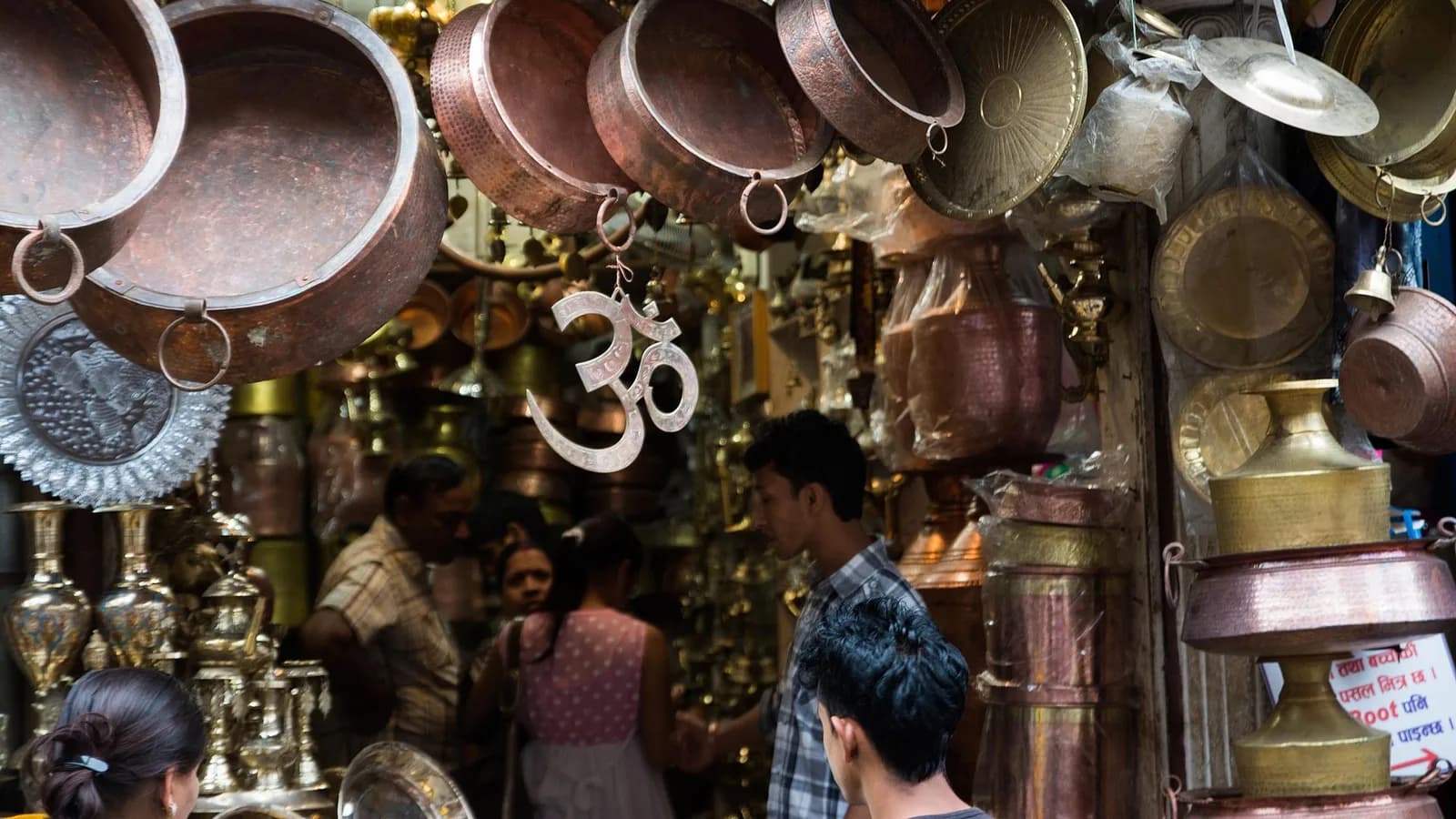
Indra Chowk is one of the busiest and most atmospheric market squares in old Kathmandu — a six-way junction where temple bells, motorbike horns, and bead sellers all compete for the same narrow strip of pavement. For travelers staying in Thamel or visiting Kathmandu Durbar Square, Indra Chowk is the kind of place you stumble into without planning to, and then remember more clearly than the monuments you actually paid to see.
This guide covers what Indra Chowk is, the temple at its center, the centuries-old bead bazaar it is famous for, and the practical details of getting there and visiting respectfully.
Key takeaways
- Indra Chowk is a historic commercial and ceremonial square in the heart of old Kathmandu, sitting on the former India–Tibet trade route.
- Its centerpiece is the Akash Bhairab temple, a Newari pagoda-style shrine dedicated to a sky-god form of Bhairab.
- The square is best known for its pote (glass bead) market, parts of which are said to be several centuries old.
- It is free to walk through, a short stroll from Kathmandu Durbar Square and roughly 10–15 minutes on foot from Thamel.
- During the Indra Jatra festival in September, the square becomes a focal point, with the Akash Bhairab mask displayed publicly.
Where is Indra Chowk?
Indra Chowk lies in the dense historic core of central Kathmandu, in Bagmati Province. It functions as a junction linking several of the old city's most important market streets and squares, including Maru, Makhan, Asan (Ason), and the route toward Kathmandu Durbar Square.
For orientation, the square is a short walk northeast of Kathmandu Durbar Square, and the wide road called Shukra Path (Sukrapath) runs south from near here down toward New Road, Kathmandu's main modern shopping street. The lane heading northeast leads on to Asan, another famous bazaar square.
Getting there
From most tourist bases, Indra Chowk is easiest reached on foot, because the surrounding lanes are narrow and frequently choked with pedestrians, porters, and motorbikes.
| From | Rough approach | Notes | |------|----------------|-------| | Thamel | About 10–15 minutes walk southeast | Head toward Durbar Square, then follow the market lanes | | Kathmandu Durbar Square | A few minutes on foot northeast | Follow the Makhan street toward the bead stalls | | Asan (Ason) | A few minutes walk southwest | Connected by one of the busiest old-city lanes |
If you take a taxi, expect to be dropped at the edge of the old-city core rather than at the square itself, since vehicle access into the tightest lanes is limited. For a wider look at moving around the capital, see our guide to getting around Kathmandu.
The Akash Bhairab temple
The visual anchor of Indra Chowk is a large rectangular, multi-story building on the square that houses the Akash Bhairab shrine (sometimes referred to in connection with Indra). "Akash Bhairab" translates roughly as "Sky Bhairab," a fierce sky-god form within the broader Bhairab tradition.
The building follows traditional Newari design, rising in stories with carved wooden detailing typical of Kathmandu Valley temple architecture. Historical accounts associate the development of the shrine and square with the Malla period, and in particular with King Pratap Malla in the 17th century, who is credited in several accounts with significant temple construction in this part of the city.
The mask and Indra Jatra
For most of the year, the principal mask of Akash Bhairab is kept inside the temple. Its most public moment comes during Indra Jatra, Kathmandu's major late-monsoon festival. During the festival, the large mask is brought out from the temple and placed on a decorated platform in the square, where it is honored with rituals and offerings — including, by tradition, offerings of local rice beer.
This makes Indra Chowk one of the key nodes of the wider Indra Jatra celebration, which centers on Kathmandu Durbar Square. If your trip overlaps with the festival, read our full guide to Indra Jatra in Kathmandu before you go, as the old-city lanes around here get extremely crowded.
The famous pote bead bazaar
If Indra Chowk has one signature, it is pote — strands of small, brightly colored glass beads. Walk into the lanes branching off the square and you find narrow stalls hung with hundreds of bead strands, where sellers thread and join beads into necklaces, often right in front of the customer.
What pote is
Pote (pronounced potay) is a traditional necklace of glass beads, frequently dominated by red. It carries strong cultural meaning: pote is associated with married women in Nepali tradition, and a strand is part of the symbolism of marriage. Because of this, the bead market here is closely tied to weddings, and the square fills with shoppers preparing for ceremonies. Travelers curious about the wider customs can read about a Nepali wedding.
According to local reporting and travel accounts, parts of this bead market are said to be on the order of several centuries old, with bead-selling traditions in the area going back to the medieval period. The craft of stringing pote has been passed down through generations, though some accounts note that fewer young people are taking up the trade today.
Buying beads and other goods
Beyond pote, the lanes around Indra Chowk are a working market for everyday and ceremonial goods:
| What you'll find | Where it tends to be | |------------------|----------------------| | Pote (glass bead strands) and bead jewelry | The bead lanes branching off the square | | Cloth, textiles, and shawls | Shopfronts on the connecting streets | | Blankets and woolens | Around the square, especially in cooler months | | Wedding and ritual items | Near the bead stalls |
This is a genuine local bazaar rather than a tourist craft market, so prices are not always fixed. Polite bargaining is normal; for tactics and the numbers you'll hear, see our notes on Nepali numbers for bargaining. Bead jewelry and textiles also make popular keepsakes — our roundup of the best things to buy in Nepal puts them in context with other souvenirs.
A quick currency note: this is a cash-leaning market, and small stalls may not take cards, so carry some Nepali rupees in small denominations.
What it's like to visit
Indra Chowk is not a quiet, roped-off heritage site. It is a living intersection, and the experience is part street market, part temple square, part traffic bottleneck. That intensity is exactly why it is worth seeing.
Atmosphere and timing
- Mornings are generally calmer, with softer light and fewer crowds — better for photographs and for actually moving through the lanes.
- Late afternoon is the liveliest, when shopping peaks and the square hums.
- Evenings, by tradition, groups gather near the temple to sing devotional songs and hymns, especially around festival times.
Because the square is compact, many visitors fold it into a half-day walk through the old city, combining it with Durbar Square, Asan, and the surrounding lanes. See our broader Kathmandu sightseeing guide for a route that links them.
Etiquette and practical tips
- Treat the temple and any active worship with respect: don't climb on shrine platforms, and ask before photographing people closely.
- Watch for motorbikes threading through the same narrow lanes you're walking in.
- Keep bags zipped and to the front in the densest crowds, as you would in any busy market.
- Step out of the flow of foot traffic when you stop to look or shoot, since the lanes are genuinely narrow.
Is Indra Chowk worth visiting?
For travelers who enjoy markets, street life, and living heritage rather than ticketed monuments, Indra Chowk is one of the most rewarding stops in central Kathmandu — and it costs nothing to walk through. The combination of a working temple, a centuries-old bead trade, and the constant churn of old-city commerce gives it a character that the more polished tourist sites can't replicate.
If your itinerary already includes Kathmandu Durbar Square and Asan, Indra Chowk sits naturally between them, and skipping it would mean missing one of the most photogenic and authentically local corners of the capital.
Sources
- Indra Chowk — Wikipedia
- Indra Chowk Kathmandu: Historic Market & Temples Guide — The Longest Way Home
- Indra Chowk: A Cultural and Commercial Hub in Kathmandu — Nepal Traveller
- The beloved beads of Kathmandu's Indra Chowk — Inside Himalayas
- The glitter of 'Pote Market' endures for centuries — The Rising Nepal
- Aakash Bhairabh during Indra Jatra — Ask Me About Nepal
- Indra Jatra — Nepal Tourism Board
Frequently asked questions
- What is Indra Chowk known for?
- Indra Chowk is a historic market square in old Kathmandu known for its Akash Bhairab temple and its long-running pote (glass bead) bazaar, plus cloth, blankets and wedding goods.
- Where is Indra Chowk located?
- It sits in the historic core of central Kathmandu, a short walk northeast of Kathmandu Durbar Square and roughly 10 to 15 minutes on foot from the Thamel tourist area.
- Is there an entry fee for Indra Chowk?
- No. Indra Chowk is a public street square, so walking through it is free; the surrounding Durbar Square monument zone does charge foreigners a separate ticket.
- What is pote and why is it sold here?
- Pote (pronounced potay) is a strand of small coloured glass beads, often red, traditionally worn by married Nepali women, and Indra Chowk has sold it for centuries.
- When is the best time to visit Indra Chowk?
- Mornings tend to be calmer and good for photos, while late afternoon is liveliest; during Indra Jatra in September the square becomes a major festival focal point.
- Can I see the Akash Bhairab mask?
- The large mask is normally kept inside the temple, but it is brought out and displayed on a platform in the square during the Indra Jatra festival each year.
- Is Indra Chowk safe for tourists?
- It is generally fine to walk during the day; the main things to manage are heavy crowds, narrow lanes shared with motorbikes, and ordinary pickpocket awareness.
Related posts
Asan Bazaar Kathmandu: Old Town Market Guide
A visitor guide to Asan bazaar, Kathmandu's oldest market — its six-road square, Annapurna Temple, what to buy, when to go, and how to get there.
Read postBalen Shah: A Traveler's Guide to Nepal's Mayor-PM
Who is Balen Shah? A neutral, fact-checked profile of the rapper-turned-engineer who led Kathmandu and became Nepal's prime minister, for curious visitors.
Read postBoudhanath Stupa: Architecture & Symbolism Guide
How to read the Boudhanath stupa — its mandala shape, the Buddha eyes, the 13 golden steps, and the meaning behind the clockwise kora walk.
Read post