Asan Bazaar Kathmandu: Old Town Market Guide
A visitor guide to Asan bazaar, Kathmandu's oldest market — its six-road square, Annapurna Temple, what to buy, when to go, and how to get there.
Six lanes pour into one square, and every one of them is carrying spices, marigolds, brass and a thousand years of trade.
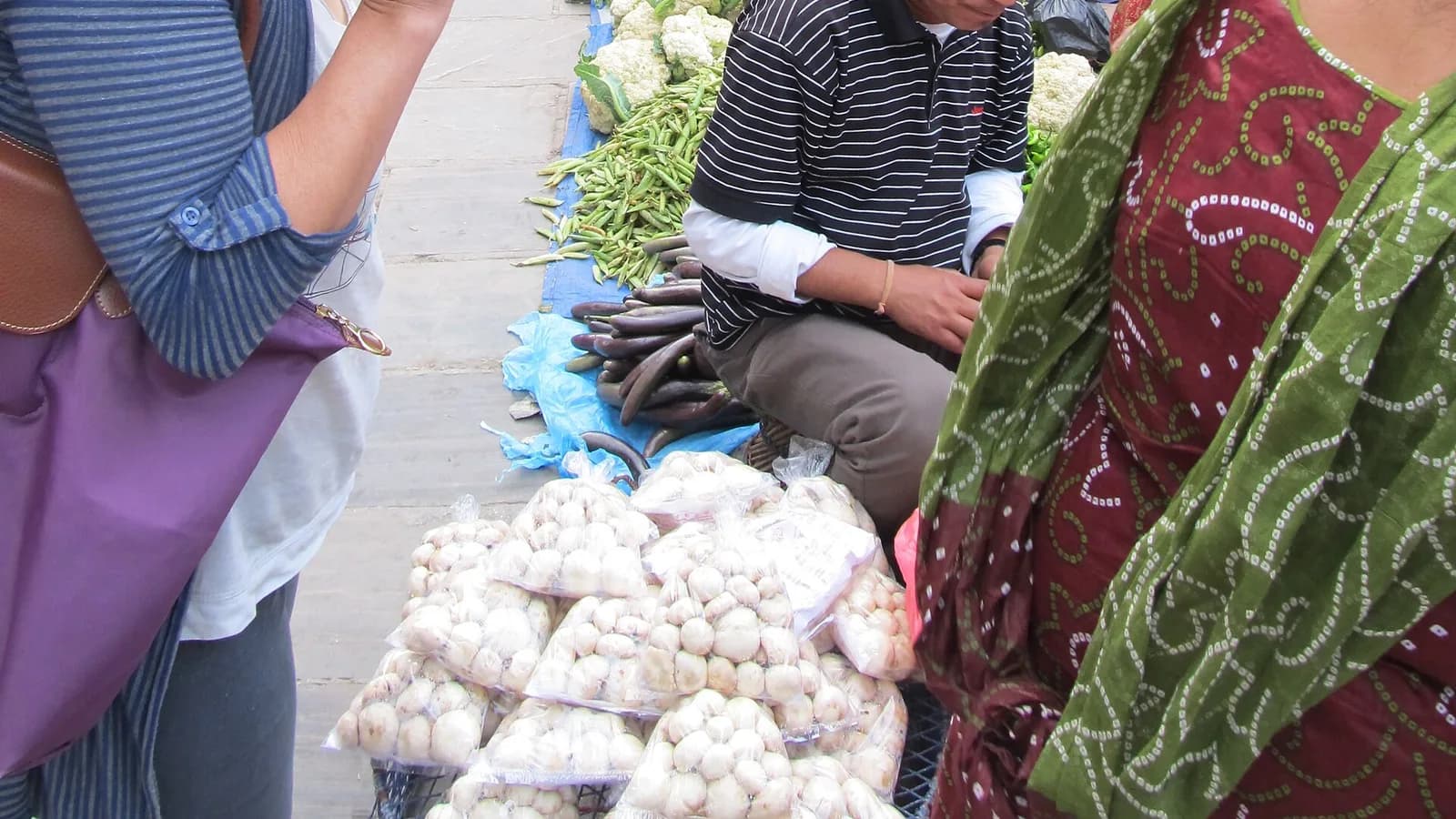
Asan bazaar is the oldest and most frenetic traditional market in Kathmandu — a tight knot of old-town lanes funnelling into a single square where six streets meet. For centuries this was a key junction on the trade route between India and Tibet, and that trading energy never left. Today Asan (also written Ason or Asan Tole) is where ordinary Kathmandu still does its shopping: spices by the sackful, marigold garlands, lentils, brassware, bolts of cloth and trays of sweets, all sold under the eaves of temples that are hundreds of years old. For a visitor, it is one of the most rewarding and atmospheric corners of the capital.
This guide explains what Asan is, how to reach it, when to go, what to look for, and the temples and festivals that give the square its character. It is a working market rather than a tourist attraction, which is exactly what makes it worth your time.
Key takeaways
- Asan is Kathmandu's oldest traditional market, a ceremonial and commercial square where six streets converge in the old town.
- It grew up on the historic India–Tibet trade route and has been a trading hub since the era of the Malla kings, with roots traced back much earlier.
- It is the old city's open-air grocery and spice market: foodstuffs, tea, textiles, brass and copper, and ritual items.
- The square holds the Annapurna Temple, dedicated to the goddess of grain and abundance, plus smaller Ganesh and Bhairab shrines.
- It sits between Thamel and Kathmandu Durbar Square, an easy 15 to 20 minute walk from either, and is best explored on foot.
- Asan lies on the route of the Seto Machhindranath chariot festival, one of the valley's great old-town processions.
What and where is Asan?
Asan is a ceremonial, market and residential square in central Kathmandu. Its defining feature is geography: six streets pour into the square from different directions, which is why it has a perpetual, churning bustle that few other places in the city can match. That convergence made it a natural meeting point and marketplace, and it has stayed one ever since.
The name itself hints at its role. "Asan" is commonly linked to the Sanskrit word asana, meaning a seat or place, fitting for a square that has long been the seat of trade and ritual for this part of the old town. Around the square stand traditional Newari buildings, temple platforms and courtyards, with the commercial life spilling out of every ground-floor shopfront and into the lanes.
Asan sits squarely inside the old city. To its north is the tourist district of Thamel; to its south, through more bazaar lanes and Indra Chowk, lies Kathmandu Durbar Square. That makes it a natural waypoint on any walking route through central Kathmandu rather than a detour.
A quick orientation
| Detail | What to expect | | --- | --- | | Type | Working market square in the old town | | Layout | Six streets meeting at one central square | | Setting | Between Thamel (north) and Durbar Square (south) | | Main temple | Annapurna Temple (goddess of abundance) | | Access | On foot through pedestrian old-town lanes | | Typical visit | 30 to 60 minutes, longer if you shop |
A short history of the square
Asan's story is the story of Kathmandu's trade. The square developed as a commercial hub during the Malla dynasty, and its origins are often traced back much further still, to the early centuries of the valley's recorded history. Whatever the exact starting point, it has been a marketplace for a very long time, which is why it is so often called the oldest market in the city.
Its importance came from its position. Asan was a significant stop on the ancient trade route linking India and Tibet, which threaded through the Kathmandu Valley. Merchants moving goods between the plains to the south and the Tibetan plateau to the north passed through here, exchanging spices, grain and other commodities. Over the centuries that trading junction grew into something more layered: a place that is simultaneously a market, a religious centre and a residential neighbourhood, knitted together around the same crowded square.
That history is not in a museum here — it is in the daily routine. The same kinds of goods that moved along the old route, grain and spices above all, are still piled in the shops today.
How to get to Asan
The simplest way to reach Asan is to walk. The old-town lanes are narrow, busy and mostly pedestrian, so walking is both the easiest and the most enjoyable approach.
- From Thamel: head south through the bazaar streets. It is roughly a 15 to 20 minute walk, depending on how often you stop. The lanes wind, so it helps to keep a general southward bearing or simply follow the flow of shoppers.
- From Kathmandu Durbar Square: walk north through Indra Chowk and the connecting market lanes; Asan is only a short stroll away, which is why the two pair so well on a single walk.
- By taxi: a taxi can bring you to the edge of the old-town core, but it cannot drive into the tightest lanes. Expect to walk the last stretch in.
Because Asan, Indra Chowk and Durbar Square are strung along the same old trade artery, the most rewarding plan is a continuous old-town walk that links all three on foot. For more on the surrounding districts, see our guides to Thamel and Kathmandu Durbar Square.
When to visit and what to expect
Asan runs on the rhythm of a real market, so timing changes the experience.
- Early morning is the traditional time. Fresh produce arrives, vendors lay out their stalls, and the market is at its most authentic. It can get going very early, from around 6am.
- Mid-morning to midday is the busiest, most photogenic window, when the square is packed and the energy is highest.
- Late afternoon stays lively but begins to wind down compared with the morning rush.
Whatever time you come, expect crowds. The square's six-road geometry means people, porters carrying loads, hand-carts and the occasional motorbike all converge in the same space. It is part of the appeal, but it rewards patience. Keep moving with the crowd rather than against it, watch your footing on uneven stones, and stay aware of bikes nosing through.
Photography and etiquette
Asan is wonderful for street photography, but it is also someone's workplace and a living religious space. A few simple courtesies go a long way: ask before photographing people up close, be respectful around the temples and anyone at worship, and avoid blocking narrow lanes for a shot. Treating the market as a community space rather than a backdrop is appreciated by the people who work there every day.
What to buy in Asan
Asan functions like an open-air supermarket for the old city. The variety is genuinely large, and even if you are not buying, browsing it is half the experience. Among the things the market is known for:
- Spices of every kind, often sold loose by weight.
- Lentils, grains and rice, the staples that gave the square its trading reason to exist.
- Local tea, oils, ghee (clarified butter) and molasses.
- Sweets and savoury snacks, plus a wide range of breads and breakfast items.
- Fresh vegetables and bright marigold garlands used for offerings.
- Dried fish and other foodstuffs.
- Textiles, woollens, footwear and clothing.
- Brassware and copperware, and religious and ritual items.
There are also bullion and electronics shops in and around the area, reflecting how the market has broadened well beyond food over time. If you are after souvenirs specifically, you will find handicrafts and ritual objects here, though dedicated souvenir shopping is often easier in Thamel; see our guide to Nepali souvenirs and what to buy for ideas.
A note on bargaining
Whether to haggle depends on the item. Everyday groceries and produce are frequently sold at fixed or near-fixed prices, and the quoted figure is usually fair. Souvenirs, textiles and handicrafts, on the other hand, are typically negotiable. The reliable approach is to ask the price first, stay friendly, and compare a couple of shops before committing. For more on numbers and haggling, our piece on Nepali numbers and bargaining is a useful companion.
The temples of Asan
Asan is not only a market; it is a religious square, and its shrines are woven into the commercial bustle rather than set apart from it.
Annapurna Temple
The centrepiece is the Annapurna Temple, a multi-storey temple dedicated to the goddess of grain and abundance — a fitting deity for a grain market. Unusually, the goddess here is represented not by a human figure but by a silver vessel, a purna kalasha or brimming bowl, symbolising plenty. It is an active local shrine: at most times, and especially on Sundays, you will see residents circle the temple, touch a coin to their forehead, make an offering and ring the bell above as they pass. Watching this quiet daily devotion in the middle of a heaving market is one of Asan's most memorable sights.
Other shrines
The square and its alleys hold several smaller shrines, including Ganesh and Bhairab shrines and the open temple platform known as the Asan Dabu. A small temple of Ganesh stands toward the northern side of the square. These shrines are part of the everyday spiritual texture of the old town; expect lamps, garlands and small offerings, and treat them with the usual care around active places of worship. For broader guidance, see our Nepal temple etiquette for tourists.
Festivals and the chariot procession
Asan comes most alive during the old city's festivals, and it sits on the route of one of the valley's grandest processions: the Seto Machhindranath chariot festival (also linked to the local celebration known as Yenya). During this multi-day event, a tall, intricately carved wooden chariot — rebuilt afresh each year — carries the white-faced deity through the core neighbourhoods of the old town. The procession passes through Asan, halting along the way, before continuing through Indra Chowk toward Kathmandu Durbar Square.
The chariot festival blends Hindu and Buddhist traditions in the way that is so characteristic of Kathmandu's old town, and it draws huge crowds and cultural performances. If your visit happens to coincide with it, the market square becomes the stage for a centuries-old spectacle. To plan around the festival calendar more broadly, browse our Nepal festivals overview and the wider Nepali culture guide.
Making the most of a visit
A short checklist to get the best out of Asan:
- Go on foot and fold it into a longer old-town walk linking Thamel, Asan, Indra Chowk and Durbar Square.
- Arrive earlier for the freshest produce and the most authentic market scene, or mid-morning for maximum buzz.
- Carry small cash. Markets here run on cash, and small notes make buying snacks and produce easier; see our guide to how much cash to bring to Nepal.
- Mind your bag in the densest crowds and stay alert for motorbikes in the lanes.
- Be temple-aware. Step around worshippers and shrines respectfully.
- Taste something. Local sweets, snacks and tea from the market are an easy, low-commitment way to experience it; our street food in Kathmandu guide has more.
Asan is not polished and it is not packaged, and that is precisely the point. It is the working heart of old Kathmandu, where a thousand-year trade junction still hums with spices, garlands and the ring of a temple bell. Give it an unhurried hour and it will tell you more about the city than almost any monument.
Sources
- Asan, Kathmandu — Wikipedia
- Asan — Nepal Tourism Board
- Asan Tole — Lonely Planet
- Annapurna Temple — Lonely Planet
- Fascinating Story of Kathmandu's Oldest Market — DCnepal
- Ason Chowk Kathmandu: Historic Market Square Guide — The Longest Way Home
- Seto Machindranath Rath Jatra — Rugged Trails Nepal
- Seto Machindranath — Wikipedia
Frequently asked questions
- What is Asan bazaar?
- Asan (also spelled Ason or Asan Tole) is a ceremonial market and residential square in the old town of central Kathmandu, where six streets meet. It is widely described as the city's oldest and busiest traditional market, selling spices, grains, textiles, religious items and household goods, and it is also home to the Annapurna Temple and several smaller shrines.
- Where is Asan and how do I get there?
- Asan sits in the old city between Thamel and Kathmandu Durbar Square. It is roughly a 15 to 20 minute walk south from Thamel through the bazaar lanes, and a short walk north of Durbar Square. The old-town alleys are narrow and largely pedestrian, so most visitors simply walk in; a taxi can drop you at the edge of the area.
- What is the best time to visit Asan bazaar?
- Early morning is the classic time, when fresh produce arrives and vendors set up, often from around 6am. Mid-morning to midday is busiest and best for atmosphere and photography. Avoid being in a hurry at peak hours, as the square and lanes get extremely crowded with shoppers, porters and the occasional motorbike.
- What can you buy in Asan?
- Asan is known for spices, lentils and grains, local tea, dried fish, oils and ghee, sweets and savoury snacks, fresh vegetables and marigold garlands, plus textiles, woollens, footwear, brass and copperware, and religious and ritual items. It functions like an open-air supermarket for the old city, with some bullion and electronics shops nearby too.
- Is bargaining expected in Asan bazaar?
- It depends on the item. Many produce and household stalls have effectively fixed or near-fixed prices, while souvenirs, textiles and handicrafts are usually negotiable. Ask the price first, stay friendly, and compare a couple of shops before buying. For everyday groceries the marked or quoted price is often fair.
- What is the Annapurna Temple at Asan?
- The Annapurna Temple in Asan is a multi-storey temple dedicated to the goddess of grain and abundance, who is represented by a silver vessel rather than a human figure. It is an active local shrine; you will often see residents circle it, ring the bell and make small offerings, especially in the mornings and on Sundays.
- Is Asan bazaar safe for tourists?
- Asan is a busy, normal working market and is generally fine to visit during the day. The main things to watch are crowds, pickpocketing risk in tight spaces, and motorbikes squeezing through the lanes. Keep valuables secure and zipped, stay aware of your bag in the densest spots, and you can explore comfortably.
- Does any festival procession pass through Asan?
- Yes. Asan lies on the route of the Seto Machhindranath chariot festival, one of the old city's major processions, when a tall wooden chariot is pulled through the core neighbourhoods including Asan over several days. The square and surrounding shrines are also part of wider old-town festival and ritual life through the year.
- How long should I spend at Asan?
- Many visitors spend 30 to 60 minutes wandering the square and the lanes that radiate from it. It pairs naturally with a longer old-town walk linking Thamel, Indra Chowk and Kathmandu Durbar Square, so you can fold Asan into a half-day exploring central Kathmandu on foot.
Related posts
Indra Chowk: Kathmandu's Bead and Bazaar Square Guide
A traveler's guide to Indra Chowk in old Kathmandu — the Akash Bhairab temple, the famous pote bead market, history, and how to visit.
Read postBalen Shah: A Traveler's Guide to Nepal's Mayor-PM
Who is Balen Shah? A neutral, fact-checked profile of the rapper-turned-engineer who led Kathmandu and became Nepal's prime minister, for curious visitors.
Read postBest Things to Buy in Nepal: A Smart Shopper's Guide
The best things to buy in Nepal and how to buy them well — fair-trade artisans, value-for-luggage picks, a shopping-day plan, and tips that respect makers.
Read post