Tilicho Lake Trek: One of the World's Highest Lakes
A 2026 Tilicho Lake trek guide — the 4,919 m turquoise lake in the Annapurna range, with itinerary, permits, costs, difficulty and the landslide section.
A frozen turquoise eye at 4,919 metres, ringed by ice and the dust of one of the most exposed trails in the Annapurnas.
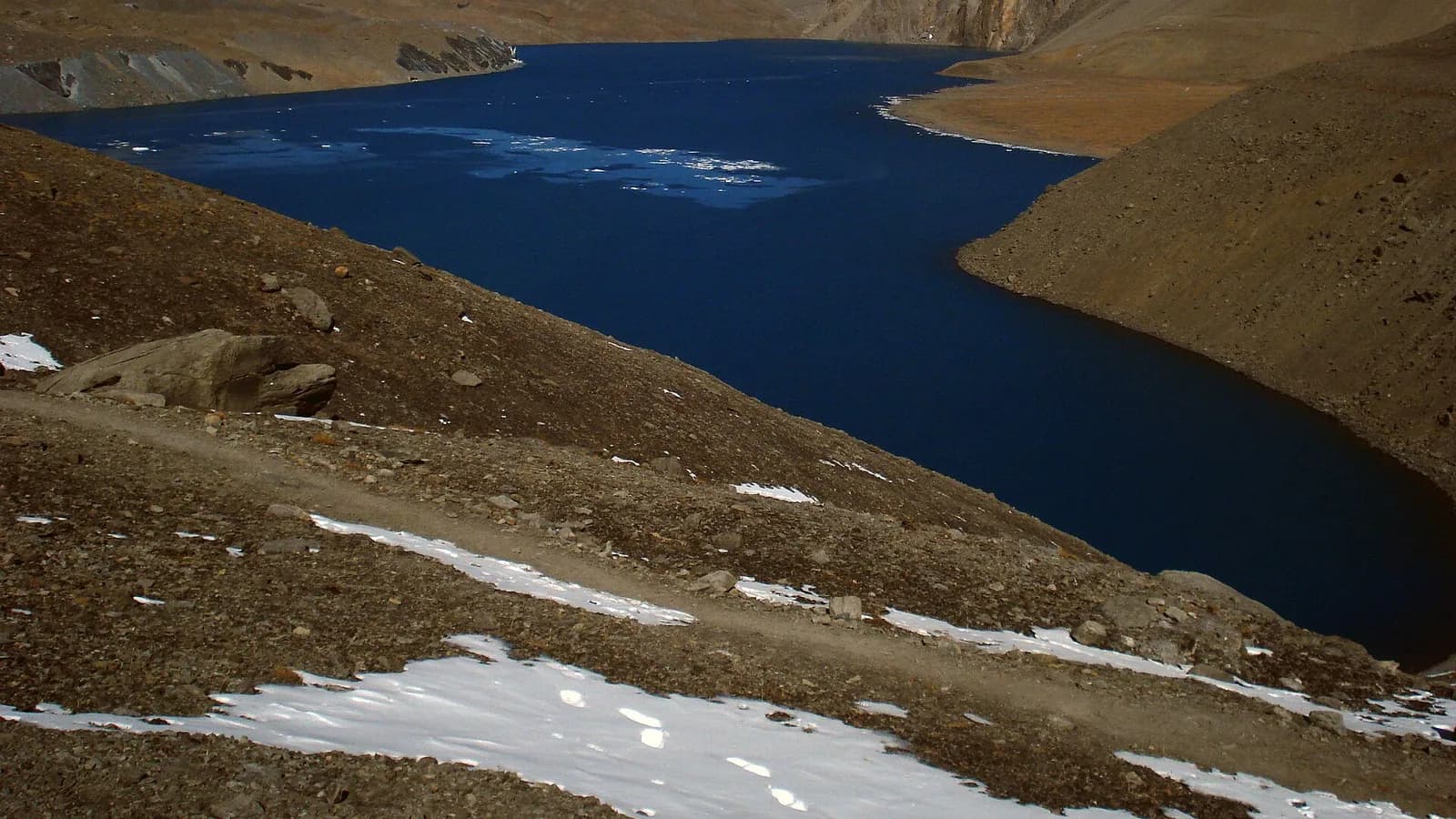
The Tilicho Lake trek leads to one of the most improbable sights in the Nepal Himalaya: a vast, frozen, turquoise lake cupped at about 4,919 metres in the heart of the Annapurna range, widely described as one of the highest lakes of its size anywhere in the world. Getting there means leaving the well-trodden Annapurna Circuit, climbing into a stark high valley above the village of Manang, and crossing one of the most exposed and loose stretches of trail in the region. The reward is a place that feels genuinely remote, set against a wall of ice and rock, far quieter than the famous base-camp trails. This guide covers the route, the permits, the realistic costs and the difficulty, stamped to mid-2026.
If you are still choosing between the big Annapurna options, our comparison of the Annapurna Circuit versus Annapurna Base Camp is a useful companion, because Tilicho works either as a standalone out-and-back or as a spectacular detour woven into the circuit.
Key takeaways
- Tilicho Lake sits at about 4,919 metres (16,138 feet) in the Manang district, in the Annapurna range — a glacial lake roughly 4 km long.
- A standalone out-and-back trek usually takes 10 to 14 days; adding the Thorong La pass to complete the Annapurna Circuit extends it to 14 to 18 days.
- The signature hazard is the landslide-prone scree section between Khangsar and Tilicho Base Camp — start early and go carefully.
- You need the Annapurna Conservation Area Permit (ACAP) at NPR 3,000 for foreigners (as of June 2026); a TIMS card (around NPR 2,000) is still officially listed.
- Best seasons are spring (March–May) and autumn (September–November); the monsoon makes the base-camp trail dangerous.
- This is a serious high-altitude trek — higher and more exposed than Annapurna Base Camp, and a licensed guide is both required and genuinely useful.
What makes Tilicho special
Most high lakes in Nepal are small tarns. Tilicho is different: a broad sheet of glacial meltwater around four kilometres long, fed by the glaciers spilling off the north face of the Annapurnas and the Grand Barrier, the huge ridge that walls off the valley to the south. For much of the year its surface is frozen or part-frozen, and the water that does show glows an intense milky turquoise from suspended glacial silt. Standing on the moraine above it, with peaks rising sheer on almost every side, is one of those rare trekking moments that genuinely stops conversation.
The lake also has a small place in record books. In 2000, a Russian team carried out what was reported as the highest-altitude scuba dive ever attempted in its frigid water — a reminder of just how high and how cold this place is. You will not be swimming, but you will feel the altitude in every step of the final climb.
Because Tilicho branches off the main Annapurna Circuit, it sees far fewer trekkers than the circuit's honeypot villages. That quiet is part of the appeal, but it also means thinner infrastructure and a trail that demands more self-reliance.
The route, stage by stage
The classic approach follows the Annapurna Circuit as far as Manang, then peels south-west into the Tilicho valley. Many trekkers now drive the dusty lower section to save days, commonly starting the walk at Chame. Here is the shape of a typical plan.
| Day(s) | Stage | Approx. altitude | Notes | |---|---|---|---| | 1 | Drive to Chame | ~2,710 m | Road through Besisahar | | 2 | Chame to Upper Pisang | ~3,300 m | Take the scenic high route | | 3 | Pisang to Manang | ~3,540 m | Main acclimatisation hub | | 4 | Acclimatisation day at Manang | — | Hike to Ice Lake or Gangapurna | | 5 | Manang to Shree Kharka | ~4,050 m | Branch off via Khangsar | | 6 | Shree Kharka to Tilicho Base Camp | ~4,500 m | The landslide section | | 7 | Tilicho Lake day trip and back | ~4,919 m | The big day | | 8+ | Descend, or cross Thorong La | varies | Circuit continuation option |
Round-trip distances vary widely with your start and end points, but the trek commonly works out somewhere in the region of 100 to 150 kilometres of walking once you account for the drive-in.
The landslide section
The reason Tilicho earns its reputation is the trail between Khangsar and Tilicho Base Camp. It crosses a long, steep slope of loose scree and shifting rock that is genuinely prone to landslides and rockfall, particularly during and just after the monsoon when the ground is saturated. The standard precautions matter here more than almost anywhere else in the Annapurnas: cross early in the morning while the slope is cold and stable, move steadily without lingering in the most exposed gullies, and listen to a guide who knows the current state of the path. In a good season and with sensible timing it is manageable for fit trekkers, but it deserves respect rather than a casual stroll.
Acclimatisation is non-negotiable
Tilicho Lake is high — higher than Annapurna Base Camp and only a few hundred metres below the Thorong La pass. The route builds in a natural rest at Manang, the region's main acclimatisation town, and you should use it. A full day there with a climb to a higher viewpoint such as the Ice Lake, returning to sleep low, pays off enormously on the final push. Before you go, read our altitude sickness guide for Nepal treks and treat any worsening symptoms as a signal to descend, not to push on.
Permits and the guide rule
Tilicho lies inside the Annapurna Conservation Area, so the permit picture is the standard Annapurna one rather than anything bespoke.
| Permit | Fee (as of June 2026) | Notes | |---|---|---| | Annapurna Conservation Area Permit (ACAP) | NPR 3,000 for foreigners | Buy in Kathmandu or Pokhara | | TIMS card | ~NPR 2,000 | Still officially listed; enforcement varies |
The ACAP is the document that matters most and is checked at entry posts along the trail. The TIMS card remains part of the official framework even though reports suggest it is loosely enforced in the Annapurna region; carrying both removes any uncertainty at a checkpoint. Since 2023, Nepal has also required foreign trekkers to walk with a licensed guide hired through a registered agency, so factor a guide into your budget and plans. On the question of whether guiding is worth it in tougher terrain, our guide-or-no-guide breakdown is written for the Everest region but the logic carries over to an exposed trail like this one.
What the Tilicho Lake trek costs
Costs depend heavily on how you book, how much you drive versus walk, and whether you extend over the Thorong La. The structure, though, is predictable, and the Annapurna region is generally cheaper to trek than the Everest region because there is no expensive mountain flight to pay for.
| Tier | Typical total | What it covers | |---|---|---| | Budget, careful spending | lower end | Permits, guide, basic teahouses, shared rooms | | Standard guided package | higher end | Logistics, guide, transport, set lodging |
Rather than quote a single figure, treat the ACAP fee above as the one fixed cost and plan the rest around your style. On the trail, the familiar rules apply: rooms are cheap if you eat where you sleep, dal bhat is the best value because refills are usually free, and the price of food, charging, hot showers and wifi climbs steadily with altitude. For a sense of how Annapurna trekking budgets break down in practice, our Annapurna Base Camp cost guide is a helpful reference point, even though Tilicho is a different and higher route.
Whatever you spend on the trek itself, do not economise on travel insurance. At nearly 5,000 metres, on an exposed and remote trail, a helicopter evacuation can be the difference between a scare and a tragedy — our guide to trekking insurance with helicopter evacuation explains exactly what to check for in a policy.
When to go
Tilicho follows the same two prime windows as the rest of the Annapurna region.
- Spring (roughly March to May): warming days, rhododendron on the lower trail and generally stable weather, with the lake often still partly frozen.
- Autumn (roughly September to November): famous for crisp, clear post-monsoon skies and the most reliable mountain views, which is why it is the busiest season.
Avoid the June to August monsoon. Beyond the cloud and rain that hide the peaks, this is precisely when the landslide section above Khangsar is at its most dangerous. Deep winter is possible for very experienced, well-equipped parties, but heavy snow can close the high trail and the final climb to the lake entirely. For a fuller country-wide picture, see our guide to the best time to visit Nepal.
Tilicho as a detour on the Annapurna Circuit
One of the best things about Tilicho is that you do not have to choose between it and the classic circuit. After visiting the lake you can return to the main trail at Manang and continue over the Thorong La pass at about 5,416 metres, dropping to the temple town of Muktinath and on toward Jomsom — completing the full Annapurna Circuit with its single greatest viewpoint thrown in. This is a wonderful way to do it, but be honest about the load: you are stacking a near-5,000-metre lake and a 5,400-metre pass into the same trip, which demands genuine fitness and careful acclimatisation. If you are weighing the difficulty of Nepal's big circuits against one another, our comparison of the Manaslu Circuit versus Annapurna difficulty gives useful context on what a long, high circuit really asks of you.
Practical tips for a smoother trek
- Start the base-camp section early. Cross the landslide slope in the cold morning hours when rockfall risk is lowest.
- Bank your acclimatisation at Manang. A real rest day with a high hike is the best insurance against altitude sickness higher up.
- Carry cash from the city. Draw your trail rupees in Kathmandu or Pokhara, as mountain ATMs are scarce and unreliable in this valley.
- Pack for serious cold. Nights near base camp and at the lake can drop well below freezing even in the good seasons.
- Treat your water. A filter or tablets save money and cut plastic versus buying bottled water at altitude.
- Learn a few words. A handful of Nepali phrases every trekker should know goes a long way in the teahouses.
Getting to the trailhead
Most trekkers reach the Annapurna region overland from Kathmandu or Pokhara via Besisahar, then up the rough Marsyangdi valley road. Improved roads now let many parties drive as far as Chame, trimming a couple of the dustier lower walking days. If you are travelling between the two cities to start or finish, our guide to the Kathmandu to Pokhara tourist bus covers the comfortable overland option. For trekkers who finish over the Thorong La, a short flight from Jomsom or the long scenic drive back to Pokhara are the usual ways out.
Is it right for you?
Choose the Tilicho Lake trek if you want a genuinely high, wild and quiet objective, you are comfortable with exposure and loose ground, and you have the fitness and patience for proper acclimatisation. It is more demanding and more remote than gentler Annapurna options, and the landslide section means it is not the trek to cut your high-altitude teeth on. But for those ready for it, Tilicho delivers one of the most singular sights in the entire Himalaya — a frozen turquoise lake at the roof of the Annapurnas, with hardly anyone else there to share it. If a comparable high-desert detour appeals, the Upper Mustang permit guide describes another of the region's standout add-ons.
Sources
Frequently asked questions
- How high is Tilicho Lake?
- Tilicho Lake sits at about 4,919 metres (16,138 feet) in the Manang district of Nepal's Annapurna range. It is widely described as one of the highest lakes in the world of its size. Tilicho Base Camp, where most trekkers sleep before the final push, is lower at roughly 4,500 metres.
- How many days is the Tilicho Lake trek?
- An out-and-back trek to Tilicho Lake from the Annapurna Circuit trail usually takes around 10 to 14 days including acclimatisation, depending on where you start driving from and where you finish. Adding the Thorong La pass to continue the full Annapurna Circuit pushes it to roughly 14 to 18 days.
- Is the Tilicho Lake trek dangerous?
- The main hazard is the exposed, loose section between Khangsar and Tilicho Base Camp, which crosses unstable scree and is prone to rockfall and landslides, especially in or just after the monsoon. With a careful pace, an early start and good acclimatisation it is manageable for fit trekkers, but it is not a casual walk.
- Do I need permits for the Tilicho Lake trek?
- Yes. You need the Annapurna Conservation Area Permit (ACAP), which costs NPR 3,000 for foreigners (as of June 2026). A TIMS card (around NPR 2,000) is still listed in official rules, though enforcement in the Annapurna region has been inconsistent. Carry both to be safe and buy them in Kathmandu or Pokhara.
- What is the best time for the Tilicho Lake trek?
- Spring (roughly March to May) and autumn (roughly September to November) are the prime windows, with stable weather and clear views. Autumn is especially popular for crisp post-monsoon skies. Avoid the June to August monsoon, when the landslide-prone base camp trail is at its most dangerous and clouds hide the peaks.
- Is Tilicho Lake harder than Annapurna Base Camp?
- In most respects yes. Tilicho reaches a higher altitude than Annapurna Base Camp, the trail to the lake is more exposed and loose, and the days at altitude are longer. Annapurna Base Camp is a gentler, lower and more sheltered trek, which makes Tilicho the more serious undertaking of the two.
- Can you combine Tilicho Lake with the Annapurna Circuit?
- Yes, and many trekkers do. After visiting the lake you return to the main trail and continue over the Thorong La pass at about 5,416 metres, completing the classic Annapurna Circuit. This is one of the most rewarding ways to do it, but it adds several high-altitude days and demands solid fitness.
- Do I need a guide for the Tilicho Lake trek?
- Since 2023 Nepal has required foreign trekkers to use a licensed guide arranged through a registered agency on its trekking routes. Beyond the rule, a guide is genuinely valuable here for judging the landslide section, pacing your acclimatisation and managing the long day to the lake and back.
Related posts
ABC Trek: A Plain-English Guide to Annapurna Base Camp
The ABC trek (Annapurna Base Camp) explained — the route, how many days it takes, difficulty, the best seasons, and what daily trail life is really like.
Read postAnnapurna Base Camp Helicopter Tour: Which Option?
An Annapurna Base Camp helicopter tour can be a seat-in landing flight, a private charter, or a trek-up fly-down combo. Here is how to pick the right one.
Read postAnnapurna Base Camp Trek Cost: The Honest 2026 Breakdown
What the Annapurna Base Camp trek cost really comes to in 2026 — permits, guide and porter fees, daily teahouse spend, and the line items quotes skip.
Read post