Newari Khaja Set: A Guide to the Brass-Platter Feast
What is a Newari khaja set? A traveller's guide to Samay Baji — the beaten-rice platter, what each item is, and how to eat it in Kathmandu.
One brass plate, a dozen small flavours, and centuries of Kathmandu Valley history.
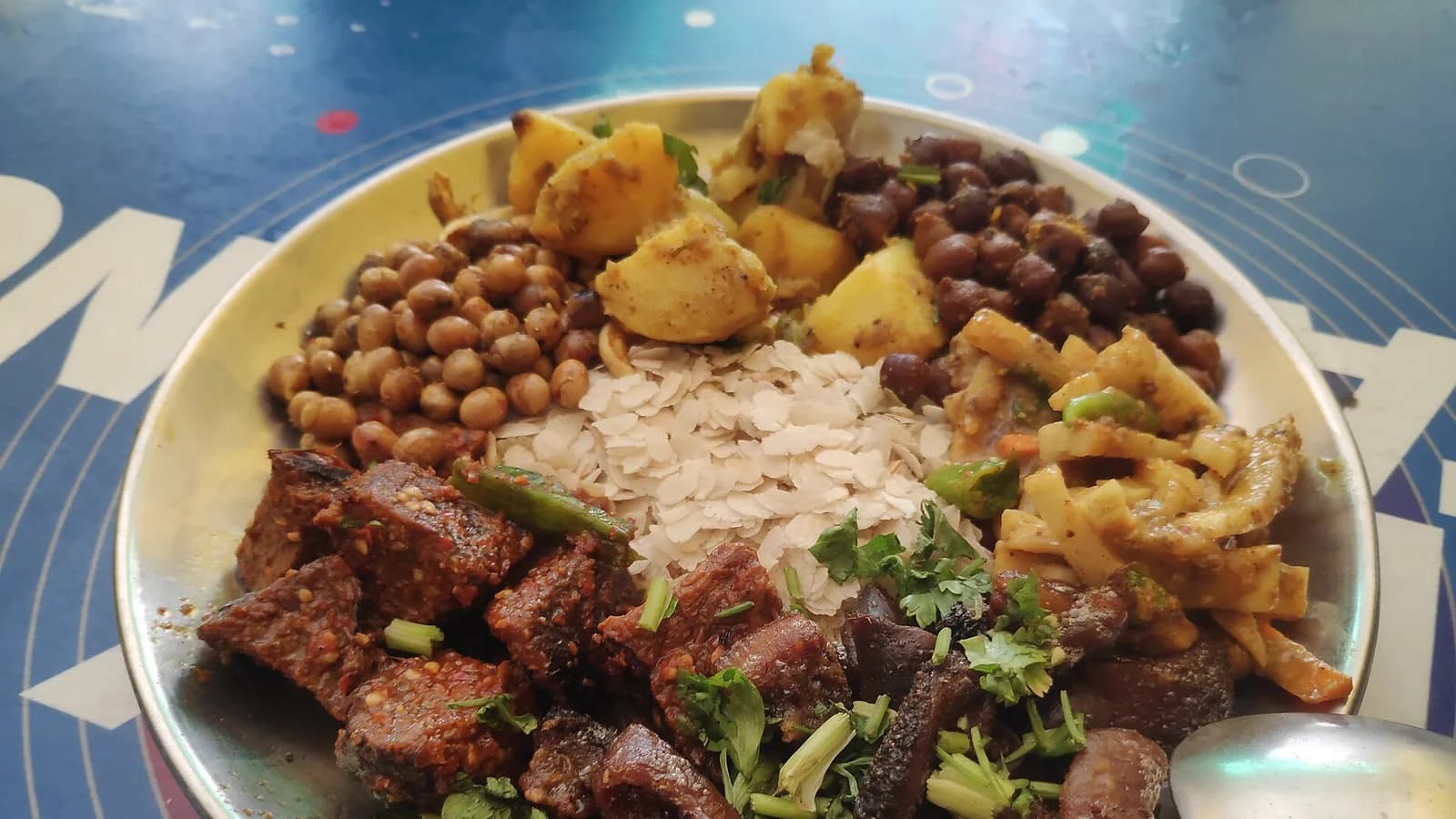
If you have eaten your way through Thamel and want the food that actually belongs to the Kathmandu Valley, order a Newari khaja set. It is a single brass platter built around beaten rice, ringed by a dozen or more small, intense side dishes — spiced buffalo, lentil pancakes, soybeans, pickles, egg and more. It is the everyday face of Samay Baji, the ceremonial plate of the Newars, the valley's indigenous people, and it is one of the most rewarding meals a traveller can find in Kathmandu.
This guide explains what a Newari khaja set is, what each item on the plate actually is, how to eat it, and where to look for a good one. For a wider tour of the cuisine, pair this with our Newari food in Kathmandu guide and our background piece on the Newar people.
Key takeaways
- A Newari khaja set is a brass platter centred on chiura (beaten rice) with many small accompaniments — typically 12 to 14 items, sometimes 20 or more.
- It is essentially the everyday version of Samay Baji, the Newars' ceremonial feast plate.
- "Khaja" means snack, but here it means a generous spread meant to honour the eater — not a light bite.
- The default meat is buffalo, served as choila; vegetarian-leaning versions are easy to request.
- You eat with your right hand, layering small portions of each side onto a base of beaten rice.
- It traces back to the Malla-era Kathmandu Valley and still anchors Newar festivals like Indra Jatra.
What "Newari khaja set" actually means
The word khaja is plain Nepali for "snack." But among the Newars a khaja is closer to a small feast: a way of saying a guest matters, served with abundance. So a Newari khaja set is not a single dish — it is an assembled platter of many separately prepared items, brought together around a base of beaten rice.
In practice, restaurant menus use "Newari khaja set" and "Samay Baji" almost interchangeably. The difference is one of register: Samay Baji is the ritual, ceremonial plate offered to deities and shared at festivals, while khaja set is the everyday, order-it-for-lunch version of the same spread. The components overlap heavily, so for a traveller they amount to the same experience.
The tradition grew out of the Kathmandu Valley's unusually fertile soil and was refined over centuries by Newar merchant and artisan families in Patan, Bhaktapur and old Kathmandu. Many sources trace its roots to the Malla period, when the valley was split into the three kingdoms of Kathmandu, Bhaktapur and Lalitpur.
What's on the plate
The platter is traditionally a round brass tray, sometimes called a chukey, divided into small sections — one per item. Chiura sits in the centre and everything else is arranged around it in neat little mounds. A standard set runs to roughly a dozen items; a generous festival spread can carry far more. Here is what you are most likely to meet.
| Item | Nepal Bhasa / local name | What it is | | --- | --- | --- | | Beaten rice | Baji / chiura | Flattened, dried rice eaten cold — the carbohydrate base | | Spiced buffalo | Choila / chhwela | Grilled or boiled buffalo with mustard oil, ginger, garlic, chilli | | Lentil pancake | Bara / wo / woh | Crisp-edged patty of ground black lentil, shallow-fried | | Rice crepe | Chatamari | Thin rice-flour crepe, sometimes topped with meat or egg | | Fried soybeans | Bhatmas | Black soybeans, often as bhatmas sadeko (spiced salad) | | Ginger & garlic | Palu | Finely cut raw ginger and garlic, a sharp digestive side | | Boiled/fried egg | Khen | A halved or whole egg | | Dried fish | Sanyaa | Small fried or dried fish | | Potato salad | Aalu-wala | Spiced boiled-potato salad | | Pickled beans | Bodi ko achar | Tangy black-eyed bean pickle | | Greens | Saag | Sauteed seasonal leafy greens | | Rice liquor | Aila / ayla | Clear, strong home-distilled Newar spirit |
The headline items
Choila is the star for most first-timers — buffalo cut small and tossed with mustard oil, garlic, ginger and dried chilli. The smoky, charcoal-grilled black version is haku choila. Buffalo is the traditional red meat across Newari cooking; its flavour is darker and richer than beef, and it is widely eaten even where cows are protected.
Bara (also spelled wo or woh) is a thick, savoury pancake of ground black lentil, shallow-fried until the edges crisp. It is one of the most iconic items on the plate and is delicious with a spicy tomato pickle.
Chiura is the quiet anchor. Light, dry and eaten cold, it is meant to be mixed in small pinches with everything else rather than eaten on its own. Treat it as the canvas; the side dishes are the paint.
The meaning behind the plate
For the Newars this is far more than lunch. The ceremonial Samay Baji is widely read as a representation of the Pancha Tattva — the five classical elements said to make up the universe: earth, water, fire, air and sky. In one common reading the beaten rice stands for the earth beneath our feet, while the black soybeans represent air.
In its Buddhist Newar context, individual items are also linked to specific deities — the beaten rice associated with Vairochana, the lentil bara with Amitabha, and ginger-with-aila with Ratnasambhava, among others. You do not need to track any of this to enjoy the meal, but it explains why the plate appears at almost every ritual moment in Newar life — pujas, weddings, festivals and even death-anniversary rites.
Regional and seasonal notes
The khaja set is a Kathmandu Valley tradition, and the three old cities each have their own touch.
Where the styles differ
- Patan (Lalitpur) is famous for its choila and for multi-generational khaja houses near Patan Durbar Square, where you sit on a low stool and eat with your hands.
- Bhaktapur leans traditional and ritual-quality, with small community-run eateries around its Durbar Square; the city is also celebrated for juju dhau, the "king of curds."
- Kathmandu's old city — Asan and Indra Chowk — is the place for casual bara, chatamari and snack-sized portions between sightseeing.
When it appears
There is no single season for Samay Baji; it shows up year-round at family gatherings. But it is especially tied to major Newar festivals — Indra Jatra in late summer, plus Dashain and Tihar. If you are in the valley during one of these, you may see the platter laid out at home shrines and community feasts.
How to eat a Newari khaja set
The ritual is simple once you relax into it.
- Use your right hand. As across Nepal, the left hand is not used for eating. See our note on ordering food in Nepali for the wider etiquette.
- Build small bites. Take a pinch of chiura and add a little choila, a bit of bara, some soybeans — layering textures rather than eating each item alone.
- Use palu as a reset. The raw ginger-and-garlic is there to sharpen the palate between richer mouthfuls.
- Pace the aila. The rice liquor is strong; sip it slowly. It is optional, and many vegetarian or "dry" Newari shops do not serve alcohol at all.
- Mind the chilli. Choila and the pickles can be genuinely hot. If you are sensitive, ask for kam piro — "less spicy."
A few practical notes: traditional seating is often on the floor or on low stools, so be ready to fold your knees. Many authentic places take cash only. And if you do not eat buffalo, ask whether chicken or a vegetarian set is available before you order.
Newari khaja set vs other Nepali plates
Travellers often compare the khaja set to the two dishes they already know. Here is how it sits alongside them.
| Plate | What it is | Best for | | --- | --- | --- | | Newari khaja set | Cold beaten rice with many small Newar sides | Variety, texture, valley culture | | Dal bhat | Hot rice, lentil soup, curry and pickle | A filling, warming everyday staple | | Momos | Steamed or fried dumplings | A quick, familiar snack |
If dal bhat is the warm, comforting national plate and momos are the universal snack, the khaja set is the specialist's choice — cooler, sharper, more fragmented, and rooted specifically in the Kathmandu Valley rather than the country at large. For a broader survey of options, see what to eat in Nepal.
Finding a good one
You will not usually find an authentic khaja set on a generic tourist menu. Look instead toward the old Newar neighbourhoods. Patan's khaja houses around the Durbar Square are the classic introduction; Bhaktapur's small eateries near its squares serve ritual-grade plates; and Asan in central Kathmandu is dotted with shops doing bara and chatamari. For a curated list of dining spots across the city, our best restaurants in Kathmandu guide is a useful companion.
A simple way to order, blending a greeting with the request, is "Namaste — ek Newari khaja set." If you want to go further with the language before you travel, start with our Nepali greetings phrasebook.
Pricing varies widely by venue, from humble local shops to upscale heritage restaurants, so confirm the cost when you sit down rather than assuming. Whatever you pay, a Newari khaja set buys you something most visitors never taste: the layered, centuries-old flavour of the valley itself.
Sources
- Samay baji — Wikipedia
- Newar cuisine — Wikipedia
- Samay Baji: The Newari Khaja Set — Swotah Travel
- Samaya Baji: The Newari Khaja Set — Nepal Traveller
- Samay Baji: Facts, Origin, Ingredients, Where to Eat — Altitude Himalaya
- A Beginner's Guide to Samay Baji — Jhi Newa: Magazine
- Newari Khaja Set (Kathmandu Valley Brass-Platter Snack Feast) — Nepali Taste
- A feast fit for the gods — The Kathmandu Post
- Best Newari Restaurants in Kathmandu Valley — Altitude Himalaya
Frequently asked questions
- What is a Newari khaja set?
- It is a single brass platter built around chiura (beaten rice) with a dozen or more small side dishes — spiced meat, lentil pancakes, soybeans, pickles and more — eaten as a Newar snack-feast.
- Is the Newari khaja set the same as Samay Baji?
- Largely yes. Samay Baji is the ceremonial Newar platter; menus across Kathmandu sell almost the same spread under the everyday name 'Newari khaja set'.
- Is the Newari khaja set vegetarian-friendly?
- Many items are meat-based (buffalo choila, dried fish), but you can ask for a veg version with soybeans, pancakes, egg, potato salad and pickles instead.
- What does khaja mean?
- Khaja simply means 'snack' in Nepali, but a Newari khaja is a full, generous spread rather than a light bite — a way of honouring guests.
- What meat is used in a Newari khaja set?
- Buffalo is the traditional default, served as choila (spiced grilled or boiled buffalo); some places offer chicken or goat instead if you prefer.
- How do you eat a Newari khaja set?
- With your right hand, mixing a pinch of chiura with small portions of each side so the textures and flavours layer together; aila is the traditional drink.
- How spicy is the food?
- It can be genuinely hot, especially the choila and pickles; ask for 'kam piro' (less spicy) if you are sensitive to chilli.
- When is Samay Baji traditionally served?
- At Newar festivals and rituals such as Indra Jatra, Dashain and Tihar, plus weddings, pujas and family gatherings throughout the year.
Related posts
Newari Food: A Beginner's Guide to the Newar Feast
Newari food explained for travellers — samay baji, choila, chatamari, yomari and juju dhau, plus the festivals and feasts that the dishes belong to.
Read postStreet Food Kathmandu: A Tourist's Guide to What to Eat
A traveler's guide to street food in Kathmandu — momo, chatamari, sekuwa, sel roti and where to eat them safely in Asan, Indra Chowk and Thamel.
Read postNewari Food in Kathmandu — Samay Baji, Chatamari, Yomari Explained
The food of the indigenous Kathmandu Valley people — distinct from mainstream Nepali cuisine, deeper, stranger, and worth seeking out.
Read post