Nepal vs Bhutan: Which Himalayan Country to Visit
Nepal vs Bhutan compared on cost, visas, trekking, and culture — an even-handed guide to which Himalayan country fits your trip and budget.
Nepal lets you wander on a backpacker's budget; Bhutan asks you to book a curated, all-in experience — and charges a daily fee for the privilege.
If you are weighing Nepal vs Bhutan, you are really choosing between two completely different ways to experience the Himalaya. Nepal is open, busy, and cheap — you can land with a visa on arrival, sleep in a five-dollar guesthouse, and trek for two weeks on a backpacker's budget. Bhutan is the opposite: a small, tightly managed kingdom that charges a daily fee, expects you to travel with a guide, and trades volume for exclusivity.
Neither is "better." They suit different travellers, different budgets, and different reasons for going. This guide compares them honestly on the things that actually decide a trip — cost, access, trekking, culture, and timing — so you can match the country to the trip you want. Every fee here is stamped with currency and date, because these numbers move; confirm the latest figures before you book.
Key takeaways
- Cost is the biggest divider. Bhutan levies a Sustainable Development Fee of US$100 per person per night for most international visitors (as of June 2026); Nepal has no daily fee and is one of Asia's best-value destinations.
- Access is easier in Nepal. Nepal grants a tourist visa on arrival; Bhutan requires an advance visa (US$40, as of June 2026) and, in practice, a guide for travel beyond Paro and Thimphu.
- Trekking style differs. Nepal is teahouse trekking — beds and hot food every night. Bhutan is camping-based wilderness, quieter but more demanding and pricier.
- Both deliver world-class culture, but Nepal offers a busy Hindu-Buddhist mosaic while Bhutan offers a curated, slow-paced Buddhist kingdom.
- You can combine them: direct Kathmandu–Paro flights make a Nepal-plus-Bhutan trip realistic if the budget allows.
The 30-second decision
Choose Nepal if you want freedom, low cost, world-famous trekking, and the ability to travel independently and change plans on the fly. It is the natural pick for backpackers, first-time Himalayan trekkers, long-stay travellers, and anyone on a budget.
Choose Bhutan if you want an exclusive, low-stress, all-arranged experience in a place that has deliberately kept mass tourism out — and you have the budget for a daily fee on top of normal travel costs. It suits travellers who value culture and calm over cost, and who would rather have everything organised than organise it themselves.
Cost: the headline difference
This is where the two countries separate most sharply.
Bhutan runs a "High Value, Low Volume" tourism policy built around the Sustainable Development Fee (SDF). As of June 2026 the SDF is US$100 per person per night for international tourists, with a concessionary rate for Indian nationals of roughly INR 1,200 per night. Children aged 6 to 12 pay 50 percent and those aged 5 and under are exempt. That rate is fixed through 31 August 2027. On top of the SDF you pay a one-time visa fee of US$40, plus your actual accommodation, meals, transport, and guide. From January 2026 a 5 percent Goods and Services Tax applies to tourism services (though not to the SDF itself). In practice, even a fairly modest Bhutan trip tends to land well into the hundreds of US dollars per day once everything is added up.
Nepal has no equivalent daily charge. Your costs are the visa, your day-to-day spending, trekking permits if you trek, and any flights. On the ground, prices are famously low: simple guesthouses, cheap local food, and inexpensive transport. For a sense of realistic totals, see our Nepal travel budget and the line-by-line Nepal trip cost breakdown — the headline is that a careful traveller can spend in a week in Nepal what a single day in Bhutan might cost once the SDF is included.
Cost at a glance
| Factor | Nepal | Bhutan | |---|---|---| | Daily government fee | None | SDF US$100/person/night (intl, as of June 2026) | | Tourist visa | On arrival, US$30 / 50 / 125 for 15 / 30 / 90 days | In advance, US$40 fee (as of June 2026) | | Typical on-the-ground budget | Backpacker to comfort, very wide range | All-inclusive, high by regional standards | | Independent travel | Yes | Guide required beyond Paro/Thimphu | | Best value for | Budget and flexibility | Exclusivity and low hassle |
The takeaway: if budget is the deciding factor, this comparison is essentially over — Nepal wins on cost by a wide margin. Bhutan's fee is the point, not an accident; it is how the country deliberately limits visitor numbers.
Visas and access
Nepal is one of the easiest countries in the region to enter. Most nationalities get a visa on arrival at Kathmandu airport and land borders, paid in cash, with tiers of US$30 (15 days), US$50 (30 days), and US$125 (90 days) as of 2026. The visa is multiple-entry, so you can pop over to India or Tibet and return. Full details are in our Nepal visa on arrival guide, and if you decide to stay longer, the visa extension guide covers that.
Bhutan requires planning ahead. You apply for a visa in advance — either through a licensed Bhutanese tour operator or via the official online portal — paying the US$40 visa fee plus the SDF for your whole stay. Indian, Bangladeshi, and Maldivian nationals follow a permit process rather than the standard visa. Critically, visitors who want to travel beyond Paro and Thimphu must be accompanied by an accredited guide. So while Bhutan is no longer the rigid "minimum daily package" system of years past, it remains, in practice, a guided destination for most itineraries.
The contrast is simple: Nepal lets you show up and figure it out; Bhutan wants the plan locked in before you arrive.
Trekking: teahouse comfort vs wilderness camping
Both countries sit in the Himalaya, but the trekking experience could hardly be more different.
Nepal is the trekking capital of the world, and its infrastructure shows it. On classic routes like Everest Base Camp or the Annapurna circuits you can walk for two weeks and sleep in a teahouse bed every single night, with cooked meals, marked trails, and dense lodge networks. That makes Nepal genuinely accessible to fit-but-inexperienced trekkers. The trade-off is crowds: popular trails get busy in peak season. For what a Nepal trek actually costs, see the Everest Base Camp trek cost and Annapurna Base Camp cost guides.
Bhutan offers far fewer trekkers and far more solitude — but its treks are camping-based wilderness expeditions. There is no teahouse network to lean on; routes like the Jomolhari trek (moderately challenging) or the legendary Snowman Trek (which has a notoriously low completion rate and is reserved for very experienced high-altitude trekkers) require a fully organised camp crew. Trails are less maintained, rescue options are thinner, and the whole undertaking costs more to support. What you get in return is genuine wilderness and almost nobody else on the path.
Trekking compared
| Factor | Nepal | Bhutan | |---|---|---| | Accommodation on trail | Teahouse lodges (beds + meals) | Tented camps, self-supported | | Crowds | Busy on popular routes | Very few trekkers | | Difficulty for beginners | Many accessible routes | Generally harder, expedition-style | | Cost to organise | Lower; can go independent | Higher; fully organised | | Best for | First Himalayan trek, budget | Solitude, seasoned trekkers |
If trekking is your main reason to come and you want it accessible and affordable, Nepal is the clear pick. If you have done it before, want emptiness, and the budget is there, Bhutan delivers a rare kind of quiet.
Culture and sights
Both countries are cultural heavyweights, but they feel different.
Nepal is a dense, living mosaic of Hindu and Buddhist heritage. The Kathmandu Valley alone packs in centuries of temples, palaces, and squares — from the medieval brick-and-wood Bhaktapur to the great Boudhanath stupa and the hilltop shrines around the valley. Festivals run nearly year-round, and the cultural texture is loud, colourful, and very much out in the open. Our best places to visit in Nepal roundup gives a fuller picture.
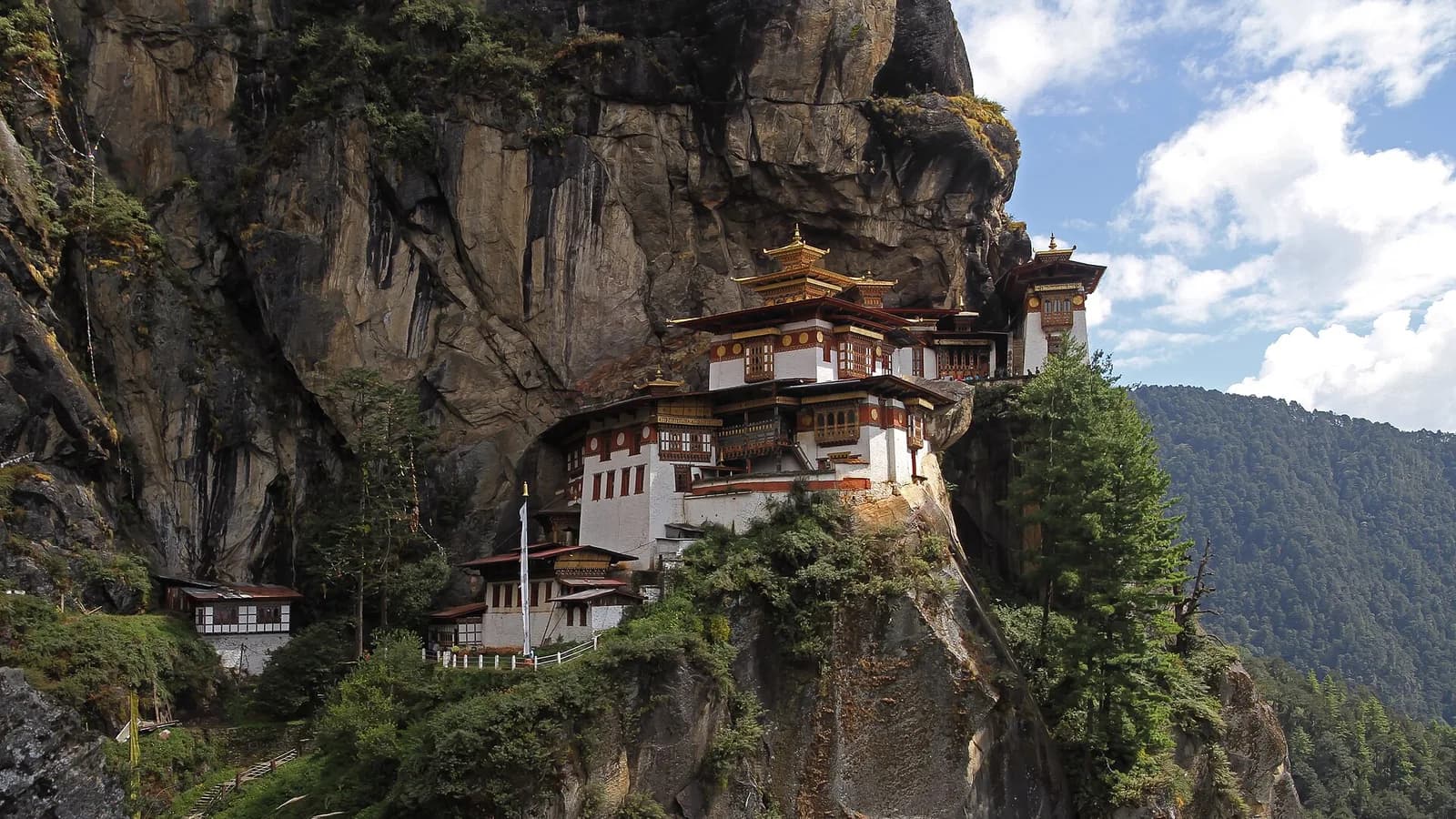
Bhutan is a living Vajrayana Buddhist kingdom that has consciously preserved its traditions — fortress-monasteries (dzongs), prayer-flag-draped passes, and the iconic Paro Taktsang ("Tiger's Nest") clinging to its cliff. National dress is still widely worn, architecture is regulated to stay traditional, and the whole experience is slower and more curated. You see Bhutan at the pace your itinerary sets, which many travellers find restful rather than restrictive.
In short: Nepal immerses you in a busy, accessible cultural sprawl; Bhutan offers a smaller, quieter, deliberately protected world.
Safety and ease of travel
Both destinations are generally safe for tourists. Bhutan's tightly managed model means very little hassle — low crime, organised logistics, and a guide handling the details. Nepal is also safe, but it is busier and more chaotic, with the ordinary big-city risks of pickpocketing in crowds and the occasional tourist-area scam in Kathmandu and Pokhara. Our is Nepal safe guide covers the practical precautions, and the Nepal tourist scams rundown flags the common ones. The honest summary: Bhutan is the lower-effort, lower-friction country to move around in; Nepal asks a bit more street sense in return for freedom and savings.
When to visit
The good news is that the ideal windows largely overlap. For both Nepal and Bhutan, spring (March to May) and autumn (late September to November) bring the clearest skies and most stable weather. Autumn is peak trekking season in Nepal — exceptional visibility after the monsoon, plus the big Dashain and Tihar festivals — and is also excellent in Bhutan. Spring adds rhododendron blooms across the hills of both countries. Summer monsoon (June to early September) is best avoided for mountain views in either place. For the full breakdown by activity, see our best time to visit Nepal guide.
Can you do both?
Yes — and it is a popular combination. Direct flights link Kathmandu and Paro, so a classic pairing is a week or two in Nepal (trekking, Kathmandu Valley, Pokhara) followed by a shorter, more expensive Bhutan add-on. The key budgeting point: keep Bhutan's daily SDF as a separate line item rather than blending it into your Nepal spending, because the two cost structures are nothing alike. If you are planning a longer regional trip, our two-week Nepal itinerary is a useful anchor for the Nepal portion.
Which should you choose?
Pick Nepal if you want freedom, low cost, the world's best teahouse trekking, easy on-arrival access, and a busy, colourful cultural immersion. It is the right call for most budget and first-time Himalayan travellers.
Pick Bhutan if you want an exclusive, low-hassle, fully arranged experience in a kingdom that has deliberately kept mass tourism at bay — and you are comfortable paying a daily fee for it.
For many travellers the smartest answer is Nepal first — it is cheaper, more flexible, and more forgiving of a learning curve — with Bhutan saved for a later trip when you want something quieter and are ready to pay for it. Whichever you choose, match the country to the trip you actually want, not the one the brochures sell.
Sources
- VisitBhutan.com — Sustainable Development Fee: https://www.visitbhutan.com/page.php?id=68
- Bhutan Department of Tourism — Visa: https://bhutan.travel/visa
- Odynovo Tours — Bhutan SDF 2026: https://www.odynovotours.com/bhutan/sustainable-development-fee.html
- U.S. State Department — Bhutan International Travel Information: https://travel.state.gov/content/travel/en/international-travel/International-Travel-Country-Information-Pages/Bhutan.html
- TibetTravel.org — Trekking Bhutan vs Nepal: https://www.tibettravel.org/bhutan-tour/trekking-bhutan-vs-nepal.html
- Nepal Department of Immigration — Tourist Visa: https://www.immigration.gov.np/en/page/tourist-visa
- Nepal Bhutan Trails — Nepal vs Bhutan travel costs 2025: https://www.nepalbhutantrails.com/complete-nepal-vs-bhutan-travel-costs-breakdown-2025/
Frequently asked questions
- Is Bhutan more expensive than Nepal?
- Yes, considerably. Bhutan charges a Sustainable Development Fee of US$100 per person per night for most international visitors (as of June 2026), on top of accommodation, food, transport and a guide. Nepal has no such daily fee, and on the ground it is one of the best-value destinations in Asia.
- Do I need a guide and a tour to visit Bhutan?
- In practice yes for most trips. Bhutan's visa is arranged through a licensed operator or its online system, and visitors travelling beyond Paro and Thimphu must be accompanied by an accredited guide. Nepal, by contrast, allows fully independent travel and grants tourist visas on arrival.
- Which is better for trekking, Nepal or Bhutan?
- Nepal is the easier and cheaper place to trek, with teahouse lodges, marked trails and routes for every level. Bhutan's treks are camping-based wilderness expeditions, less crowded but more demanding and more expensive to organise. Choose Nepal for accessibility, Bhutan for solitude.
- How much is the Bhutan Sustainable Development Fee?
- As of June 2026 the SDF is US$100 per person per night for international tourists, with a discounted rate for Indian nationals of around INR 1,200 per night. Children aged 6 to 12 pay half and those 5 and under are exempt. The rate is set through August 2027.
- Can I visit both Nepal and Bhutan on one trip?
- Yes, and many travellers do. There are direct flights between Kathmandu and Paro, so a common itinerary pairs a week or two in Nepal with a shorter, pricier Bhutan add-on. Just budget for Bhutan's daily fee separately from your Nepal spending.
- Is Bhutan safer than Nepal for tourists?
- Both are generally safe for visitors. Bhutan's tightly managed tourism and small visitor numbers make it feel very controlled and low-hassle. Nepal is also safe but busier, with the usual big-city pickpocketing and tourist-area scams to watch for in Kathmandu and Pokhara.
- Which has better culture and temples?
- Both are extraordinary but different. Nepal blends Hindu and Buddhist heritage across cities like Kathmandu and Bhaktapur, with countless temples and festivals. Bhutan is a living Vajrayana Buddhist kingdom of fortress-monasteries and preserved traditions, experienced at a slower, curated pace.
- When is the best time to visit Nepal and Bhutan?
- For both, spring (March to May) and autumn (late September to November) bring the clearest skies and most stable weather. Autumn is peak season in Nepal and also excellent in Bhutan, while spring adds rhododendron blooms across the hills of both countries.
Related posts
Nepal or Bhutan: Which Is Better for Your Trip?
Nepal or Bhutan, which is better? A quick decision guide by traveller type, budget, and trekking goal — plus how to pair both in one trip.
Read postNepal vs Peru Trekking: An Honest Comparison
Nepal vs Peru trekking compared on altitude, permits, cost, comfort and crowds — an even-handed guide to choosing the Himalaya or the Andes for your trek.
Read postNepal vs Tibet: Which Himalayan Trip to Choose
Nepal vs Tibet compared on cost, permits, trekking, altitude and culture — an even-handed guide to which side of the Himalaya suits your trip.
Read post