Mustang Mountain Biking: Routes, Permits & 2026 Guide
A practical Mustang mountain biking guide — Lower vs Upper Mustang routes, the new USD 50/day permit, difficulty, season and how to plan your ride.
A high-desert ride in the Annapurna rain shadow — jeep tracks, ochre canyons and a walled kingdom at the end of the trail.
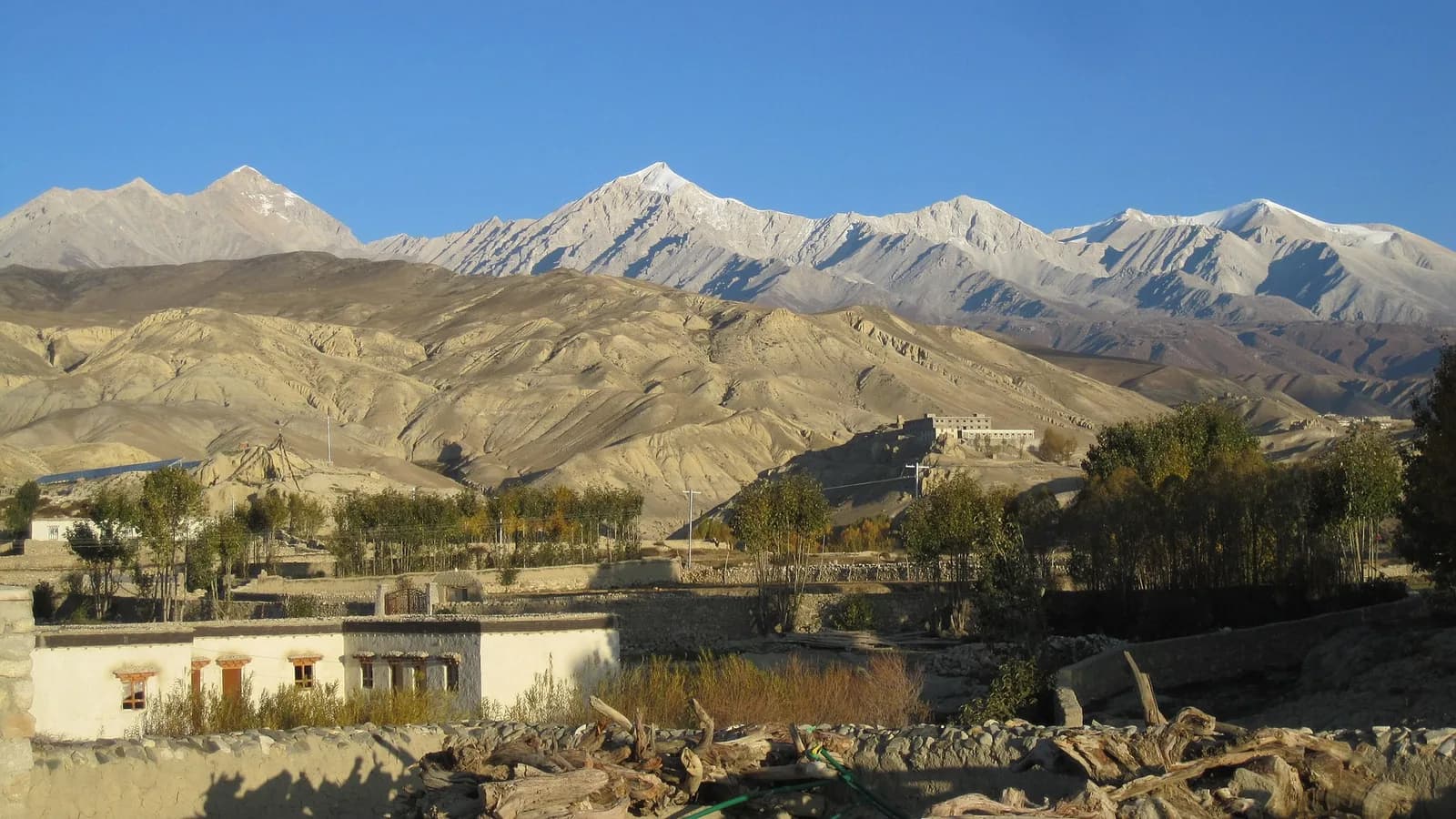
Mustang mountain biking is one of the most distinctive rides in Nepal: a high-desert journey up the Kali Gandaki — the world's deepest gorge — between the Annapurna and Dhaulagiri massifs, on rough jeep tracks and rocky trails that climb toward a medieval walled kingdom. It is dry, wind-blown and Tibetan in feel, far from the green terraced hills most people picture when they imagine Nepal. This guide covers the two main regions you can ride, the new 2026 permit system, realistic difficulty and altitude, the best season, and how a typical trip is put together.
If you want the wider planning picture for the region on foot, our Upper Mustang trek guide and the focused Upper Mustang permit guide pair well with this article.
Key takeaways
- Mustang splits into Lower Mustang (Kali Gandaki valley, ACAP only) and Upper Mustang (restricted, needs an extra permit and a guide).
- Since late 2025 the Upper Mustang Restricted Area Permit is USD 50 per person per day (as of June 2026), replacing the old flat USD 500 fee.
- You also need an Annapurna Conservation Area Permit (ACAP) of NPR 3,000 for foreign nationals on either route.
- The riding is mostly rough jeep track and rocky single-track at 2,700m to ~3,800m — best for confident intermediate riders with good fitness.
- Mustang sits in the Annapurna rain shadow, so it stays dry and rideable even in the monsoon, unlike most of Nepal.
- Most trips run as supported tours with hired hardtail bikes, a guide and a backup jeep, starting via Pokhara and Jomsom.
Where Mustang is and why bikers go
Mustang is a district in north-central Nepal, tucked behind the Himalayan crest along the upper Kali Gandaki river. Because the Annapurna and Dhaulagiri ranges block the monsoon clouds, the land beyond them is a parched, almost Tibetan plateau of ochre cliffs, eroded canyons and barley villages. The Kali Gandaki carves the deepest gorge on Earth here, running between two peaks above 8,000m.
For mountain bikers, that combination is rare. You get a long, rideable valley with an existing jeep road and a web of older trails, dramatic scenery, genuine Tibetan Buddhist culture, and — crucially — weather you can rely on when the rest of the country is under monsoon cloud. It is less about lift-served downhill and more about a multi-day point-to-point adventure through big, empty country.
Lower Mustang vs Upper Mustang
The single most important distinction for planning is which half of Mustang you ride, because it changes both the paperwork and the character of the trip.
| | Lower Mustang | Upper Mustang | |---|---|---| | Area | Kali Gandaki valley: Jomsom, Kagbeni, Muktinath | North of Kagbeni to Lo Manthang | | Permits | ACAP only | ACAP + Restricted Area Permit | | Guide required | No (recommended) | Yes, mandatory | | Feel | Valley villages, apple orchards, Muktinath pilgrimage | Remote desert kingdom, walled towns, sky caves | | Typical length | ~1 week with travel | ~2 weeks with travel | | Cost | Lower | Higher (daily permit + guide + vehicle) |
Lower Mustang is the easier, cheaper introduction; Upper Mustang is the remoter, more committing prize.
The classic riding routes
Lower Mustang: the Kali Gandaki loop
Most Lower Mustang rides begin in Jomsom (about 2,720m), reached by a short, scenic flight from Pokhara through the Kali Gandaki gorge, or by road. From Jomsom you roll along the rocky valley floor to Kagbeni, the medieval gateway village at the mouth of Upper Mustang — a mostly flat warm-up that nonetheless tests lungs unused to altitude.
The signature climb is Kagbeni up to Muktinath, a sacred temple complex revered by both Hindus and Buddhists at roughly 3,800m. It is a short distance but relentlessly uphill, and the thin air and steep grade mean it can take several hours. Many riders descend on rougher, more technical side trails — such as the Lupra valley single-track — that drop quickly back toward the main valley. It is a satisfying loop that samples the region without the restricted-area cost.
Upper Mustang: north to Lo Manthang
To continue past Kagbeni into Upper Mustang, you cross into restricted territory and the scenery turns starkly desert. The route shadows the Kali Gandaki and a network of trails north through villages like Chele, Syangboche and Ghami toward Lo Manthang, the walled former capital of the old Kingdom of Lo at roughly 3,800m. The terrain mixes long jeep-track climbs over high passes with fast, dusty descents, and the riding is genuinely remote.
Lo Manthang itself is the cultural climax: medieval city walls, centuries-old monasteries, a royal palace and cliff-carved sky caves nearby. Most itineraries build in a rest day here to explore on foot and acclimatise before turning back. Our Lo Manthang and Upper Mustang guide covers the town in more depth.
Permits and rules for 2026
Permits are the part of Mustang planning most likely to trip people up, and the rules changed significantly in late 2025.
The new USD 50/day Restricted Area Permit
For decades, Upper Mustang carried a flat USD 500 fee covering the first ten days, with extra charges beyond that. In November 2025 Nepal's government scrapped the flat fee and replaced it with a flexible USD 50 per person per day system, gazetted to take effect later that year. According to the Kathmandu Post, the change ended the long-standing ten-day minimum that had been in place for years.
The practical effect is that you now pay only for the days you actually spend inside the restricted area above Kagbeni. A ten-day visit still works out near USD 500, but a shorter ride costs proportionally less, which makes custom and shorter itineraries far more viable than before. Reporting and operators note the daily rate applies to everyone entering the zone — trekkers, jeep tours, motorbike riders and, by extension, mountain bikers alike. All figures here are as of June 2026; confirm current rates with a registered agency before you pay.
ACAP and what didn't change
On either route you also need the Annapurna Conservation Area Permit (ACAP), which costs NPR 3,000 (about USD 30, as of June 2026) for foreign nationals — see our ACAP permit guide for details. Importantly, the fee change did not lift the restricted-area status of Upper Mustang, the mandatory licensed-guide requirement, or the rule that permits are issued through registered Nepali agencies. So while the cost is more flexible, you still cannot ride Upper Mustang truly independently. For the bigger picture on Nepal's trekking paperwork, see our overview of Nepal trekking permits.
| Permit | Cost (foreign nationals, as of June 2026) | Where it applies | |---|---|---| | ACAP | NPR 3,000 | All of Mustang (lower + upper) | | Restricted Area Permit | USD 50 per person per day | Upper Mustang only (above Kagbeni) |
How hard is it? Difficulty and altitude
Mustang is best described as physically demanding but technically moderate. The trails are mostly rough jeep track, gravel and rocky single-track rather than steep, root-laced downhill, so you do not need expert descending skills. What you do need is endurance and the ability to ride at altitude: you are pedalling between roughly 2,700m and 3,800m, where the thin air noticeably cuts your power and recovery.
The hardest elements are the sustained climbs — Kagbeni to Muktinath in the lower valley, and the high passes north of Kagbeni in Upper Mustang — plus the strong afternoon winds that funnel up the Kali Gandaki and the ever-present dust. Some descents off passes are genuinely long and fast on loose surface, which is where intermediate bike-handling pays off.
Managing the altitude
Because Mustang stays below 4,000m for most of its route, serious altitude sickness is less common than on Everest or Manaslu trips, but it is not zero. Ascend gradually, drink plenty of water, and watch for headaches, nausea, dizziness or poor sleep. A rest day in Lo Manthang doubles as acclimatisation. If symptoms worsen, descend. Our altitude sickness guide for Nepal explains the warning signs and prevention in more detail, and it is worth reading before any high ride.
How a typical trip is put together
Most riders do Mustang as a supported tour rather than fully self-organised, simply because the logistics — permits, guide, bike, spares and a backup vehicle — are far smoother through an operator.
- Bikes: Operators generally provide hardtail mountain bikes suited to the rocky jeep tracks; some now offer e-bikes to help with the climbs, though village charging can be limited. You usually don't need to fly your own bike to Nepal.
- Support vehicle: A jeep typically follows the route carrying spares, luggage and any riders who want a break on the big climbs.
- Getting there: Trips usually start by reaching Pokhara from Kathmandu, then either flying Pokhara to Jomsom with bikes as cargo or driving up the Kali Gandaki road. See our Kathmandu to Pokhara flight guide for that first leg.
- Accommodation: Nights are spent in valley teahouses and simple village lodges, the same network that serves trekkers.
If a self-powered ride doesn't appeal, the same valley is a popular Nepal motorcycle tour route, and the region is equally rewarding on foot.
Best time to ride
The two prime windows are spring (roughly April to May) and autumn (September to October), when skies are clearest and temperatures mildest. Mustang's signature advantage is the monsoon: because it sits in the Annapurna rain shadow it stays largely dry from June to August, making it one of the few parts of Nepal you can ride comfortably in summer. Even then, the Pokhara–Jomsom flight can be delayed by cloud, so build a buffer day into your plans. For the national picture, see our best time to visit Nepal overview.
Winter (December to February) is rideable lower down but cold and exposed up high, with some passes snowbound and many lodges closed.
Riding around the Tiji festival
If you want a cultural highlight, time an Upper Mustang ride to Lo Manthang's Tiji festival, a three-day Tibetan Buddhist celebration of masked monk dances usually held in May (reported as around 13–16 May 2026, with exact dates set by the Tibetan calendar). Lodges fill fast in festival week, so book well ahead. Our Tiji festival guide covers what to expect.
Practical tips before you go
- Acclimatise and pace yourself. Treat the first valley days as easy spins, not race stages.
- Pack for sun, wind and dust. High-UV sun, gritty afternoon wind and dry air are constants; bring eye protection, a buff and strong sunscreen.
- Carry layers. Mornings and high passes are cold even in spring; afternoons in the valley can be warm.
- Confirm permits through a registered agency, and remember Upper Mustang requires a guide by law.
- Insure for the activity. Make sure your travel insurance covers mountain biking at altitude and, ideally, helicopter evacuation from remote terrain.
- Respect the culture. Mustang's monasteries, chortens and walled towns are living religious sites — ask before photographing people and walk clockwise around Buddhist monuments.
Ridden well, Mustang offers something few mountain-biking destinations can: a multi-day, high-desert ride through a landscape and culture that survived in near isolation for centuries — with weather dependable enough to plan around.
Sources
- Kathmandu Post — Nepal scraps $500 Upper Mustang trekking fee for foreigners, sets $50 daily
- Altitude Himalaya — Upper Mustang Mountain Biking Tour: Itinerary, Cost, Difficulty
- MTB Worldwide — Mountain Biking in Lower Mustang
- Nepal Mountain Bike — Lower Mustang Mountain Biking
- Nepal Vision Treks — Upper Mustang Restricted Area Permit 2026: Rules, Cost & Application
- Best Heritage Tour — Tiji Festival in Upper Mustang 2026: Exact Dates, Permits & Guide
Frequently asked questions
- Do I need a permit to mountain bike in Mustang?
- Yes. The lower section needs an Annapurna Conservation Area Permit (ACAP), which is NPR 3,000 for foreign nationals. To ride above Kagbeni into Upper Mustang you also need the Restricted Area Permit, which since late 2025 costs USD 50 per person per day (as of June 2026). Lower Mustang, below Kagbeni, only needs the ACAP.
- How fit do I need to be for Mustang mountain biking?
- You should be a confident intermediate rider with good general fitness. The terrain is mostly rough jeep track and rocky single-track rather than technical downhill, but you are pedalling at 2,700m to nearly 3,800m where thin air saps your power, and there are long sustained climbs such as Kagbeni up to Muktinath. Strong legs and patience matter more than expert bike-handling.
- Can you ride Upper Mustang without a guide?
- No. Upper Mustang is a restricted area, so a licensed guide arranged through a registered Nepali agency is mandatory, and most riders go as a supported group with a vehicle. Lower Mustang is not restricted, so independent riding there is allowed, though a guide and a backup jeep still make the logistics far easier.
- What is the best time of year for Mustang biking?
- Spring (roughly April to May) and autumn (September to October) give the most settled, mild conditions. Because Mustang sits in the Annapurna rain shadow it stays dry and rideable even through the June to August monsoon, which is its big advantage over most of Nepal, though Pokhara to Jomsom flights can still be delayed by weather.
- How do you get your bike to Mustang?
- Most tours start with the drive or flight from Kathmandu to Pokhara, then either fly Pokhara to Jomsom with bikes as cargo or drive up the Kali Gandaki road. Operators usually supply hardtail mountain bikes and a support vehicle that carries spares and tired riders, so you do not have to bring your own bike to Nepal.
- Is altitude a problem when biking Mustang?
- It can be. Jomsom sits around 2,720m and Muktinath is near 3,800m, high enough that you should ascend gradually, drink plenty of water and watch for headaches, nausea or poor sleep. Mustang is lower than Everest or Manaslu routes so serious altitude sickness is less common, but riding hard makes you feel the thin air quickly.
- Are e-bikes available for Mustang tours?
- Some operators now offer electric mountain bikes for the region, which help on the long climbs and the thin air, but charging depends on village electricity that can be limited and unreliable. Confirm bike type, battery range and charging arrangements directly with your agency before you book if you want an e-bike.
- How many days does a Mustang biking trip take?
- A focused Lower Mustang loop around the Kali Gandaki can be done in about a week including travel from Kathmandu. A full Upper Mustang ride to Lo Manthang and back is usually sold as a two-week package once you add Pokhara, the Jomsom transfer and a rest day in Lo Manthang. Shorter custom rides are possible under the new daily permit.
Related posts
Lo Manthang Upper Mustang: The Walled City Guide
A guide to Lo Manthang in Upper Mustang — the last walled city in the Himalayas, its monasteries, sky caves, royal palace, permits and how to visit.
Read postAnnapurna Helicopter Tour: Cost & 2026 Guide
Annapurna helicopter tour from Pokhara to Annapurna Base Camp — cost, flight time, the landing, weight limits, best season and how it compares to trekking.
Read postAnnapurna Trek Package: How to Choose One in 2026
A practical guide to picking an Annapurna trek package in 2026 — durations, what is included and excluded, permits, the guide rule, and how to compare quotes.
Read post