Tiji Festival Upper Mustang — Lo Manthang's Sacred Dance
The Tiji festival in Upper Mustang is a three-day masked dance of good over evil in walled Lo Manthang. What it means and how to attend the May rites.
Three days of masked monks, ancient muskets, and a barley-flour effigy hurled into the desert — Mustang's yearly battle of good against evil.
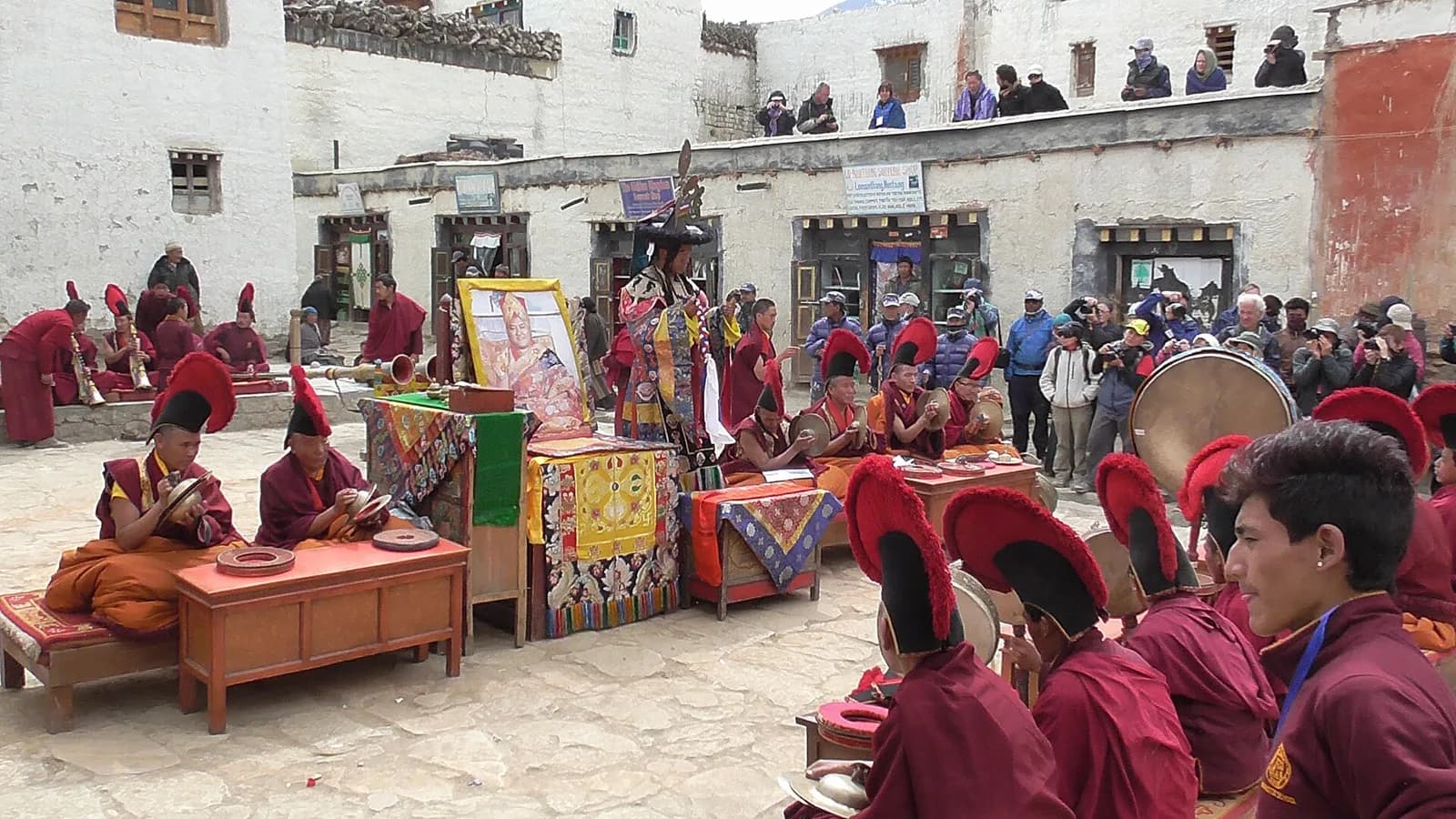
The Tiji festival is the most remarkable cultural event in Upper Mustang — a three-day cycle of masked monastic dances staged each spring inside the walled city of Lo Manthang, the former capital of the old Kingdom of Lo. Over three days, monks in elaborate costumes and masks re-enact the legend of a deity defeating a demon to save Mustang, culminating in a barley-flour effigy being hurled into the desert to the crack of antique muskets. Set against the eroded red cliffs of Nepal's Tibetan-cultured high desert, the Tiji festival in Upper Mustang is one of the few experiences that can justify the region's famously steep permit on its own.
This guide explains what Tiji actually means, what happens across its three days, when it falls, and the real logistics of getting yourself to Lo Manthang in time. For the full breakdown of the restricted-area permit and the standard trekking route, read it alongside our Upper Mustang trek permit guide — this post is the festival-focused companion.
Key takeaways
- Tiji (short for Tempa Chirim, "prayer for world peace") is a three-day Tibetan Buddhist festival in Lo Manthang, Upper Mustang, held annually in May.
- It dramatises the legend of Dorje Jono defeating a demon — the triumph of good over evil and the cleansing of the year's negativity.
- The dances are performed by the monks of Chhoede Monastery; the climax is an effigy cast into the desert amid musket fire.
- Dates follow the Tibetan lunar calendar and shift yearly — confirm the dates for your travel year.
- Attending requires a Restricted Area Permit (~USD 500), a mandatory guide, and a registered agency — no solo trekking.
- The route runs Pokhara → Jomsom → Lo Manthang; a full trip is roughly two weeks, at moderate altitude (Lo Manthang ~3,800 m).
What Tiji means
The name "Tiji" is a compressed form of the Tibetan phrase Tempa Chirim, which carries the sense of "prayer for world peace" and "the hope for the Buddha's teaching." But locals attach a cluster of meanings to it that do not translate cleanly: for the people of Lo Manthang, Tiji is about getting over problems, bringing balance back, and the yearly cleansing of accumulated darkness. It is, in effect, an annual spiritual reset for the whole kingdom.
At its narrative core is the legend of Dorje Jono (also rendered Dorje Sonam). The story tells of a deity who does battle with a powerful demon — a being whose chaos brings drought, disease, and ruin to Mustang. Across the festival, Dorje Jono harasses the demon, is reborn as the demon's own son, and finally defeats and banishes him, restoring harmony, fertility, and prosperity to the land. The three days of dance are the staged enactment of this cosmic struggle.
This is fundamentally a Tibetan Buddhist festival, reflecting Mustang's deep cultural ties across the nearby border. The guardians of the tradition are the monks of Chhoede Monastery (also spelled Choede or Chhode), a 15th-century institution that has overseen Tiji for generations.
The three days
Tiji unfolds as a sequence, each day building on the last. The dances are known collectively as the Tiji chham, and they are performed in the main square in front of the old royal palace, watched by villagers in their finest dress and by the small number of visitors who have made the journey.
| Day | Name | What it depicts | | --- | --- | --- | | Day 1 | Tsa Chham | The demon Ma Tam Ru Ta brings havoc; Dorje Jono begins to confront him | | Day 2 | Nga Chham | The story of Dorje Jono's birth as the demon's son and the deepening battle | | Day 3 | — | The demon is defeated and his effigy banished from the kingdom |
The build-up is considerable: monks prepare for weeks, crafting dozens of ritual tormas (sculpted offerings of barley flour and butter), including one shaped as an effigy of the demon. By the time the dances begin, the whole town has turned out.
The climax on the third day is the moment everyone waits for. The lead monk, embodying Dorje Jono, takes the effigy representing the demon's remains, and amid the firing of antique muskets and the cheers of the crowd, it is cast out into the surrounding desert — symbolising the final banishment of evil from Mustang for another year. The monks then offer blessings to locals and visitors, praying for peace, fertility, and well-being in the year to come.
When Tiji falls
Tiji follows the Tibetan lunar calendar, so it does not sit on a fixed Western date. It is a three-day event held annually, typically in May (occasionally brushing into late spring's edges depending on the year).
Because the dates move each year, the cardinal rule for planning is to confirm the exact dates for your specific travel year before you book flights or commit to an agency — a difference of a week or two will decide your entire itinerary. As a loose anchor, recent years have placed Tiji in the second or third week of May.
A second timing consideration works in your favour: Upper Mustang lies in the rain shadow of the Himalayas, so the late-spring window is dry and stable here even as the monsoon begins to build elsewhere. May is, in fact, one of the best times to be in Mustang regardless of the festival.
Getting to Lo Manthang
Reaching Lo Manthang is the real commitment, and Tiji does not shorten it. The standard approach:
| Stage | Typical means | Notes | | --- | --- | --- | | Kathmandu → Pokhara | Tourist bus or flight | See our Kathmandu–Pokhara transport guide | | Pokhara → Jomsom | Short mountain flight | Weather-dependent; the gateway to Mustang | | Jomsom → Lo Manthang | Trek (several days) or jeep | Through Kagbeni and the Mustang valley |
A complete Tiji trip — including travel, acclimatisation, the three festival days, and the return — typically runs around two weeks. Increasingly, travellers cover part or all of the Jomsom–Lo Manthang stretch by jeep along the rough road, which compresses the schedule and opens the festival to people who are not committed trekkers. Purists still walk it for the landscape.
Crucially, you must arrive in Lo Manthang at least a day before Tiji begins to be sure of seeing the opening day — and because accommodation in the small town fills up for the festival, this is not a trip to improvise. Many travellers combine the journey with a stop at the high pilgrimage temple of Muktinath, which sits on the way up the valley.
Permits and the rules of access
Upper Mustang is a restricted area, and the access rules are strict and non-negotiable. In brief:
- Restricted Area Permit (RAP): required for Upper Mustang, on the order of USD 500 for the first ten days, per person.
- ACAP: the Annapurna Conservation Area Permit is required in addition (roughly NPR 3,000).
- Registered agency mandatory: only a registered Nepali trekking agency can obtain the RAP for you — you cannot apply solo.
- Guide mandatory, no solo trekking: you must travel with a guide, and the restricted zone has long required this.
Because the permit is the expensive, paperwork-heavy part of a Mustang trip, our dedicated Upper Mustang trek permit guide walks through exactly what it covers, what it does not, and how to budget the full trip — read it before committing. The short version: timing a trek to coincide with Tiji is the one scenario where almost everyone agrees the steep permit suddenly looks like good value, because of what you are witnessing.
Acclimatisation and difficulty
Tiji is set at altitude, but it is moderate by Nepal's standards. Lo Manthang sits at roughly 3,800 m, and the trekking route tops out around 3,900 m — high enough to take seriously, but well below the punishing passes of the Everest and Annapurna high routes.
That said, altitude is altitude: ascend at a sensible pace, hydrate, and know the early warning signs. Our guide to altitude sickness on Nepal treks covers prevention and the symptoms that mean you should stop climbing. Travellers doing the route by jeep should be especially careful, since vehicles can carry you up faster than your body adjusts.
Because flights to and from Jomsom are weather-dependent and can be cancelled, build buffer days into your itinerary and carry trekking insurance with helicopter evacuation cover — standard advice for any remote Nepal region.
Attending respectfully
Tiji is a living religious ritual, not a performance staged for tourists, and Lo Manthang is a small community hosting a sacred event. A few principles keep you a welcome guest:
- Keep your distance from the dancing monks and the ritual space; never crowd or block the locals, for whom this is the year's most important event.
- Photography is generally allowed in the square, but treat it as sacred: no flash near the monks, no climbing on structures for a shot, and ask before photographing individual people up close. Follow your guide's and the organisers' instructions.
- Dress modestly and warmly — Mustang's high-desert days are bright but its mornings and evenings are cold.
- Support the local economy — stay and eat locally, and remember that visitor numbers are deliberately capped to protect this culture.
A little language helps too. The region is Tibetan-cultured, so a Tibetan-style "tashi delek" greeting is warmly received, while Nepali still works for logistics — our phrases every trekker should know covers the trail basics for the journey up.
Is Tiji worth building a trip around?
For the right traveller, Tiji is extraordinary — masked monks, musket fire, and a centuries-old morality play performed in a walled medieval city at the edge of the Tibetan plateau, in a region most people never reach. If you are drawn to Tibetan Buddhist culture, comfortable with the cost and the altitude, and able to organise around a date that shifts each year, timing your Upper Mustang trek to land on Tiji turns an already-special trek into something unforgettable.
It is not a casual add-on: the permit is expensive, the journey is long, the dates demand planning, and accommodation is limited. But for those who make it to Lo Manthang for those three days in May, Tiji is among the most singular festival experiences anywhere in Nepal.
Sources
- Action Nepal Treks — What is the Tiji Festival in Upper Mustang? (permit and guide details)
- Nepal Trek Adventures — Tiji Festival in Lo Manthang: dates, traditions, attractions
- Sublime Trails — Tiji Festival: A Celebration of Triumph Over Evil
- Mustang Trekking in Nepal — History of the Tiji Festival
Frequently asked questions
- When is the Tiji festival held in Upper Mustang?
- Tiji is a three-day festival held in Lo Manthang each year, usually in May. It follows the Tibetan lunar calendar, so the exact dates shift from year to year. Plan to arrive in Lo Manthang at least a day before it begins, and confirm the dates for your travel year before booking anything.
- What does the Tiji festival celebrate?
- Tiji is short for Tempa Chirim, a Tibetan phrase meaning prayer for world peace. The three days dramatise the legend of Dorje Jono, a deity who battles and banishes a demon to save the kingdom of Mustang from destruction. It celebrates the triumph of good over evil and the cleansing of the year's accumulated negativity.
- Where does the Tiji festival take place?
- Tiji is held in the central square of Lo Manthang, the walled former capital of the Kingdom of Lo in Upper Mustang, north-central Nepal. The masked dances are performed by the monks of Chhoede Monastery, and the action centres on the square in front of the old royal palace.
- Do I need a special permit to attend the Tiji festival?
- Yes. Upper Mustang is a restricted area, so you need a Restricted Area Permit in addition to the Annapurna Conservation Area permit. The restricted permit must be arranged through a registered Nepali trekking agency, you cannot trek solo, and a guide is mandatory. Budget around USD 500 for the first ten days of the restricted permit.
- How do you get to Lo Manthang for Tiji?
- The usual route is a flight from Pokhara to Jomsom, then several days of trekking or a jeep ride north through Kagbeni and the Mustang valley to Lo Manthang. A full Tiji trip typically runs around two weeks once you include travel, acclimatisation, and the festival itself.
- Is the Tiji festival trek difficult?
- It is moderate by Nepal standards. Lo Manthang sits at roughly 3,800 metres and the trail tops out around 3,900 metres, so altitude needs respect but the walking is not as demanding as the high passes. Many travellers now do part or all of the route by jeep, which makes it accessible to less experienced trekkers.
- Can I photograph the Tiji dances?
- Photography of the masked dances in the square is generally permitted, but treat it as a sacred ritual rather than a show. Keep your distance, do not block locals' views, never use flash near the monks, and follow any instructions from organisers or your guide. Ask before photographing individual people up close.
Related posts
Lo Manthang Upper Mustang: The Walled City Guide
A guide to Lo Manthang in Upper Mustang — the last walled city in the Himalayas, its monasteries, sky caves, royal palace, permits and how to visit.
Read postUpper Mustang Trek: Route, Permits & Lo Manthang Guide
A complete Upper Mustang trek guide — the route to Lo Manthang, the new 2026 USD 50/day permit, costs, difficulty, culture and the best time to go.
Read postUpper Mustang Trek 2026 — The $500 Restricted Area Permit, Explained
Why Upper Mustang costs more, what the permit covers, what you actually see, and why it's worth the price for the right trekker.
Read post