Monsoon Trekking Mustang: The Rain-Shadow Trek
Why monsoon trekking in Mustang works when the rest of Nepal is soaked — the rain shadow, flight risks, permits and what June to August really looks like.
When the rest of Nepal drowns in cloud, Mustang sits in the dry rain shadow behind the giants.
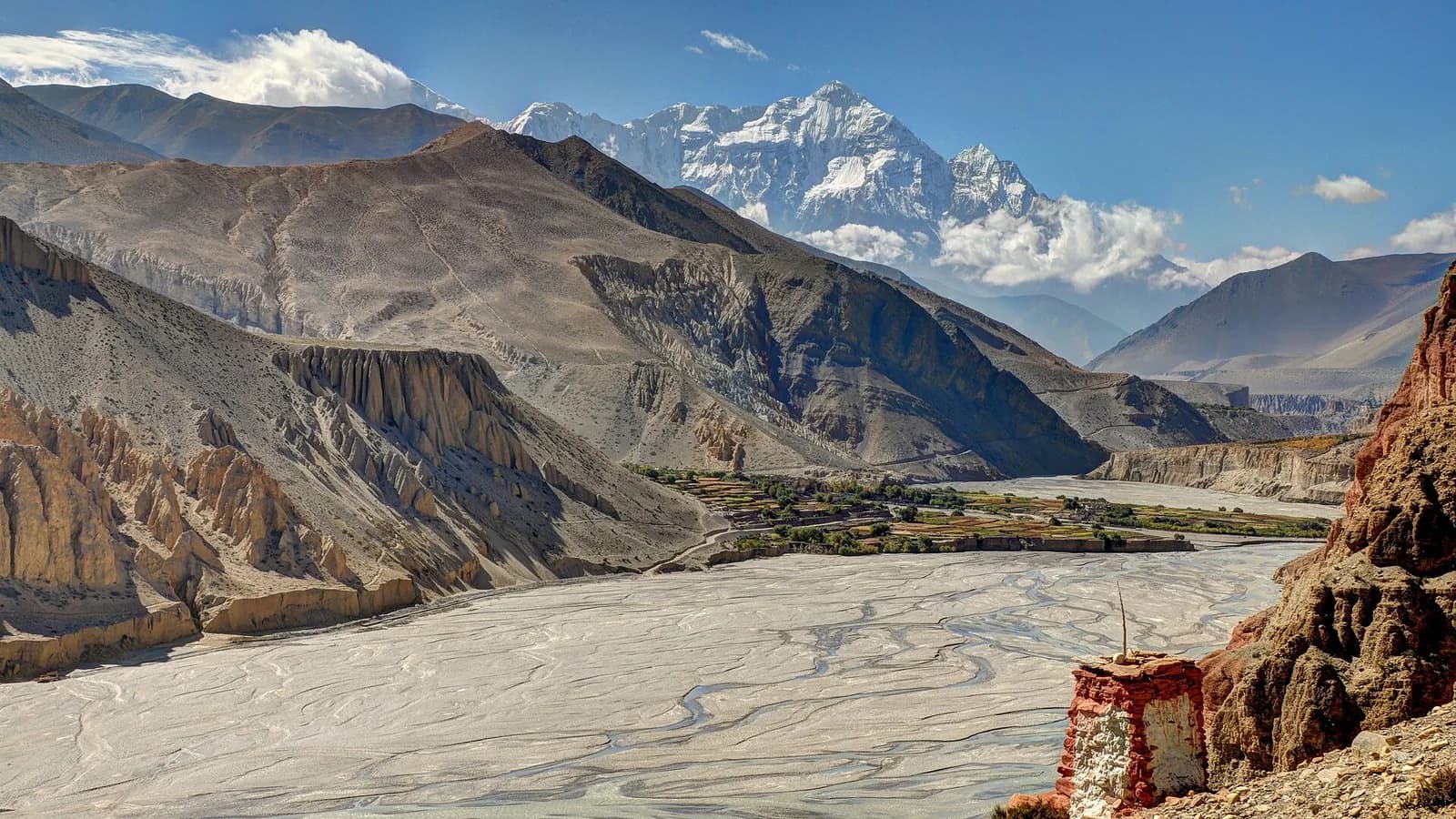
For most of Nepal, the four monsoon months are the off-season: trails turn to mud, leeches come out, and the big peaks vanish behind cloud. Monsoon trekking in Mustang flips that logic. The old Kingdom of Lo sits in the rain shadow behind the Annapurna and Dhaulagiri giants, so while the southern hills are drenched from June to August, Mustang stays dry, bright and walkable. It is one of the very few places in the country where you can trek through the wet season and still get blue skies over the cliffs.
That does not make it effortless. The weather wins on the trail but the catch is getting there — the lower approach still catches rain, roads can wash out, and the flight to Jomsom is notoriously unreliable in the monsoon. This guide explains why the rain shadow works, what June to August really looks like on the ground, and how to plan around the risks. For the wider seasonal picture, pair it with our monsoon season in Nepal guide; for the trek itself, see our full Upper Mustang trek walkthrough.
Key takeaways
- Mustang sits in the rain shadow of Annapurna and Dhaulagiri, so it stays dry through the June to August monsoon when most of Nepal is soaked.
- Average annual rainfall in Mustang is only around 250 to 300mm, against 3,000mm-plus in the southern hills.
- The real monsoon risk is access, not the trail: lower-valley showers, landslide-prone roads, and an unreliable Pokhara to Jomsom flight (suspended for roughly two months in 2025).
- It is a restricted area: a licensed guide via a registered agency is mandatory, even after the two-person minimum was lifted in March 2026.
- Permits in 2026 are USD 50 per person per day above Kagbeni plus NPR 3,000 ACAP and a TIMS card (as of June 2026).
- The upper desert is largely leech-free; the cultural high point, Tiji, falls in mid-May, just before the monsoon proper.
Why Mustang stays dry in the monsoon
Nepal's summer monsoon is driven by moist air sweeping north from the Bay of Bengal. According to the Department of Hydrology and Meteorology (DHM), the monsoon normally enters eastern Nepal around 13 June and withdraws by late September. That moisture, however, has to get over the main Himalaya first.
Along Mustang's southern edge stand two of the world's highest mountains: Dhaulagiri (8,167m) and the Annapurna massif (Annapurna I, 8,091m). As the monsoon air is forced up and over this wall, it cools, condenses and dumps its rain on the southern slopes. By the time any air spills onto the northern plateau, it is wrung almost dry. The result is a high-altitude desert — eroded red, grey and ochre cliffs, sparse scrub, and famously little rain.
The numbers tell the story. Reputable trekking sources put Mustang's average annual rainfall at roughly 250 to 300mm, a fraction of the 3,000mm-plus that falls on parts of southern Nepal. That is the whole reason the region is trekkable when the rest of the country is not.
Mustang versus the soaked south
| Area | Rough annual rainfall | Monsoon trekking | | --- | --- | --- | | Upper Mustang | ~250–300mm | Dry, recommended | | Dolpo (rain shadow) | under ~500mm | Largely dry | | Pokhara / southern hills | 3,000mm-plus | Wet, leech-prone |
Mustang is not unique here. The same physics make Dolpo and Nar Phu good wet-season options — see our Dolpo trek guide for the other classic rain-shadow walk.
What June to August actually feels like
On the upper trails, monsoon conditions are mild and pleasant. Trekking operators describe daytime temperatures in roughly the 15 to 22°C range, dropping to single digits at night. Skies are often clear and the desert colours look sharp and saturated — Mustang is a strong photography destination in summer precisely because the air is dry and the cliffs glow under the high sun.
The main daily nuisance is wind. Heat builds over the plateau and pulls strong southerly air up the Kali Gandaki gorge, with afternoon gusts that operators commonly cite around 40 to 50 km/h. It is not dangerous on the trail, but it slows you down and kicks up dust, so most walking is done in the calmer morning hours.
The lower approach is a different story
Be clear about geography. The rain shadow protects Upper Mustang, the restricted zone north of Kagbeni. The approach below that — Beni, Tatopani, and even Jomsom and Kagbeni themselves — sits lower and still catches genuine monsoon showers. Expect some mud, the odd leech on the green stretches near Beni, and a real chance of road disruption before you climb into the dry country. Conditions normalise quickly once you are above Kagbeni.
The real catch: getting in and out
This is where monsoon planning lives or dies. The trail is fine; the logistics are fragile.
Flights to Jomsom are unreliable
The classic start is a short flight from Pokhara to Jomsom (about 2,720m). In the monsoon this is the weak link. Strong winds funnel up the Kali Gandaki from late morning, so flights run early and are easily grounded by cloud or gusts. Worse, demand collapses in the wet season and airlines simply pause the route: in 2025, Tara Air suspended the Pokhara–Jomsom service from 16 June and Summit Air from early July, with flights resuming only in early September (Tourism Info Nepal). Do not assume the flight will exist, let alone run on time.
Roads can wash out
A rough road now links Pokhara and Beni up the Kali Gandaki to Jomsom and on toward Lo Manthang, and many monsoon trekkers travel overland by jeep instead of flying. That sidesteps the airport, but the lower sections are landslide-prone in heavy rain, and the wider 2025 monsoon was forecast above-normal, raising flash-flood and landslide risk nationwide. Roads can close for hours or days.
Build in buffer days
The practical takeaway is to add spare days to any monsoon itinerary, especially before an international flight home. Treat both the inbound and outbound legs as variable. Our broader best season to trek in Nepal guide puts this trade-off in context against the autumn and spring peaks.
Permits, guide and the rules
Permit rules in Mustang changed recently, and they are the same whatever the season.
| Item | 2026 cost (as of June 2026) | Notes | | --- | --- | --- | | Restricted Area Permit | USD 50 per person per day | Charged above Kagbeni; replaced the old flat USD 500 fee | | ACAP | NPR 3,000 | Annapurna Conservation Area entry | | TIMS card | ~USD 20 | Arranged via your agency |
A few rules matter especially for independent-minded trekkers. Upper Mustang is a restricted area, so a licensed guide booked through a registered Nepali agency is mandatory and you cannot lodge the permit application yourself. The long-standing two-person minimum was lifted in March 2026, so solo travellers can now obtain the permit — but you still walk with a guide, not alone. For the fine print on fees and paperwork, our focused Upper Mustang trek permit guide goes deeper than this overview.
What you actually see
The pay-off for the paperwork and the flight gamble is a landscape and culture that feel closer to Tibet than to the green Nepal most visitors picture.
Lo Manthang and the cliffs
The trail follows the upper Kali Gandaki north through Tibetan-style villages to Lo Manthang (around 3,800m), the walled former capital of the Kingdom of Lo, its medieval city walls still standing around centuries-old monasteries and a royal palace. The surrounding canyons are riddled with cliff-cut sky caves. Our Lo Manthang guide covers the walled town in detail.
Muktinath
On the lower stretch near Jomsom sits Muktinath (about 3,710m), one of the most important shared pilgrimage sites for both Hindus and Buddhists in the Himalaya. Many monsoon trekkers and jeep tours fold it into the route. See our Muktinath temple guide for what to expect.
Tiji — but that is May, not monsoon
Mustang's signature event is Tiji, a three-day masked-dance festival in Lo Manthang whose name traces to a prayer for world peace, performed by monks of the Choedhe monastery. It falls in mid-May — reported as 13 to 15 May in 2026 — which is late spring, dry, and just before the monsoon. If you want the festival and the calmest pre-monsoon weather, target May rather than the June to August window; our Tiji festival guide has the details.
Is monsoon the right time for you?
Monsoon trekking in Mustang suits a specific traveller: someone who wants empty trails, dramatic desert light and a genuinely different Nepal, and who can absorb the access risk with flexible dates. You trade the social buzz and guaranteed flights of the autumn peak for solitude and dry skies in a season when the rest of the country is washed out.
If your dates are rigid and you cannot afford a multi-day delay, the pre-monsoon May window — drier approach, working flights, and Tiji — is the safer bet, while die-hard rain-shadow walkers can also look at Dolpo. But if you have buffer days and want the plateau almost to yourself, the monsoon is one of Mustang's best-kept secrets.
Sources
- Department of Hydrology and Meteorology — Monsoon Onset and Withdrawal
- Kathmandu Post — Monsoon crosses into Nepal 15 days ahead of schedule (2025)
- Kathmandu Post — Met department predicts above-average monsoon rainfall this year (2025)
- Tourism Info Nepal — Pokhara–Jomsom flights suspended (June 2025)
- Tourism Info Nepal — Pokhara–Jomsom air service resumes (September 2025)
- Mountain Delights — Upper Mustang Trekking in Monsoon (rainfall and rain shadow)
- The Longest Way Home — Upper Mustang Permit 2026
- Best Heritage Tour — Mustang Tiji Festival 2026 dates
Frequently asked questions
- Can you really trek Mustang during the monsoon?
- Yes. Mustang sits in the rain shadow behind the Annapurna and Dhaulagiri massifs, so it stays dry while the rest of Nepal is soaked. June to August is one of the few windows when you can walk a Nepali trail in good weather, which is why Mustang, Dolpo and Nar Phu are the classic monsoon-season treks.
- How much rain does Mustang actually get?
- Very little. Reputable trekking sources put Mustang's average annual rainfall at roughly 250 to 300mm, against more than 3,000mm in parts of southern Nepal. The high Himalaya wrings the moisture out of the monsoon air before it reaches the plateau, leaving a high-altitude desert.
- What is the catch with monsoon trekking in Mustang?
- Access, not the trail itself. The lower approach through Beni, Jomsom and Kagbeni still catches monsoon showers, roads can be hit by landslides, and the Pokhara to Jomsom flight is unreliable. In 2025 airlines suspended that route for roughly two months over the monsoon, so you must build in spare days.
- Are the Pokhara to Jomsom flights running in the monsoon?
- Often not. In 2025 Tara Air grounded the Pokhara to Jomsom route from 16 June and Summit Air from early July, with service resuming only in early September. Even when flights run, strong winds funnel up the Kali Gandaki gorge from late morning, so flights are scheduled early and are easily delayed.
- How much does the Upper Mustang permit cost in 2026?
- Since late 2025 the old flat USD 500 fee is gone. The Restricted Area Permit is USD 50 per person per day above Kagbeni, plus the Annapurna Conservation Area Permit at NPR 3,000 and a TIMS card around USD 20. A 10-day visit still works out near USD 500 but shorter trips cost less. All figures as of June 2026.
- Do I need a guide to trek Mustang in the monsoon?
- Yes, regardless of season. Upper Mustang is a restricted area, so a licensed guide booked through a registered Nepali agency is mandatory and you cannot apply for the permit yourself. The two-person minimum was lifted in March 2026, so solo travellers can now go, but always with a guide.
- Are there leeches on the Mustang trek in monsoon?
- Barely. Leeches thrive in wet forest below about 3,000m, and Mustang is a dry, high, largely treeless desert, so the upper trails are essentially leech-free. You may meet a few on the green lower approach near Beni, but they vanish as you climb into the rain shadow.
- Is Tiji festival during the monsoon?
- No, it falls just before. Tiji, the masked-dance festival in Lo Manthang, is held in mid-May — reported as 13 to 15 May in 2026 — which is late spring and still dry. If you want the festival plus calm pre-monsoon weather, May is the sweet spot rather than the June to August window.
Related posts
Dry Trekking Nepal: Best Seasons and Rain-Shadow Trails
Dry trekking Nepal explained: the dry seasons for firm trails plus rain-shadow regions like Mustang and Dolpo that stay dry even in monsoon.
Read postMonsoon Season in Nepal: A Traveller's Honest Guide
When the monsoon season hits Nepal, what the rain really means for trekking and travel, and the rain-shadow regions that stay dry from June to September.
Read postNepal in Monsoon: What to Expect and Where to Go
A practical guide to Nepal in monsoon (June to September): what the rain is like, where to still trek, the risks and how to travel smart.
Read post