Monkey Temple Kathmandu: History, Myth & Meaning
The story behind the Monkey Temple in Kathmandu (Swayambhunath): its self-arisen legend, 5th-century roots, UNESCO status, and why it matters.
The lotus that lit a lake, the hill that became a city's soul.
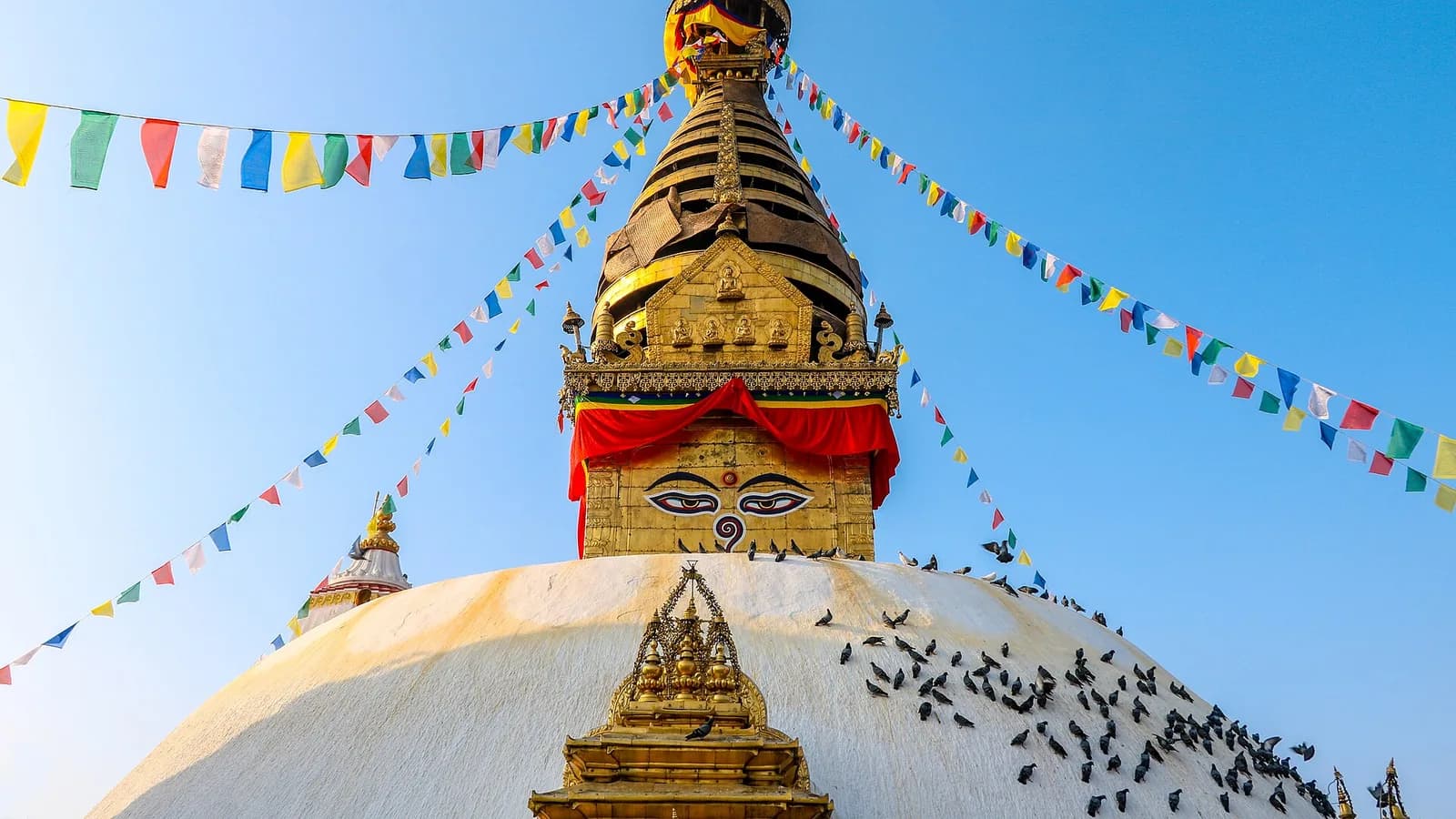
Most travelers meet the Monkey Temple in Kathmandu as a photo opportunity: a white dome, a golden spire, painted eyes, and a hill full of macaques. But Swayambhunath is one of the oldest and most layered sacred sites in the Kathmandu Valley, and the story behind it explains the whole geography of the city below. This post is a companion to our practical Swayambhunath visitor guide — that one covers fees, the climb, and how to handle the monkeys. Here we slow down and look at the history, the myth, and the meaning.
Key takeaways
- "Monkey Temple" is a nickname; the real name, Swayambhunath, means roughly "the self-arisen one" in Sanskrit.
- Legend ties the stupa to the draining of an ancient lake that became the Kathmandu Valley — a myth that doubles as a folk geology of the city.
- Written records point to a founding around the early 5th century CE, with later rebuilding by Buddhist and Malla-era patrons.
- It is one of seven monument groups in the Kathmandu Valley UNESCO World Heritage Site, inscribed in 1979.
- The hill is shared by Buddhist and Hindu worship, a clear example of Nepal's blended religious life.
- For fees, opening hours, the staircase, and monkey safety, use the linked visitor guide.
The name behind the nickname
Foreign visitors coined "Monkey Temple" for the obvious reason — troops of wild rhesus macaques live on the hill and are part of every visit. Some accounts put the resident population in the low hundreds; Wikipedia cites a figure of roughly 500 macaques. Either way, they are a permanent and protected feature of the site.
The site's actual name, Swayambhunath, is more telling. It comes from Sanskrit swayambhu — "self-existent" or "self-arisen" — joined to nath, "lord" or "protector." In other words, the name points not at the monkeys but at a much older idea: a sacred light that, by tradition, appeared on its own.
Why monkeys, in the legend?
There is even a mythic explanation for the macaques. In one well-known telling, the bodhisattva Manjushri let his hair grow long on the hill, and the lice in his hair are said to have turned into the monkeys that still live there. It is a charming origin story — and a reminder that at Swayambhunath, the wildlife and the theology are tangled together.
The myth: a lake, a sword, and a self-arisen light
The founding legend, preserved in the Swayambhu Purana, is one of the great origin stories of the Kathmandu Valley. In it, the valley was once a vast lake inhabited by nagas (serpent beings). A miraculous lotus rose from the water, radiating a self-created light — the swayambhu, the self-arisen.
To make the light accessible to pilgrims on foot, the bodhisattva Manjushri is said to have cut through the surrounding hills with his sword, draining the lake and leaving behind the fertile valley where Kathmandu now stands. The site of the radiant lotus became Swayambhunath.
Read literally, it is mythology. Read another way, it is a folk memory of real geology: the Kathmandu Valley genuinely was a lakebed in the distant past, and the legend encodes that truth in sacred form. For pilgrims, the takeaway is simpler — the hill is where the valley's light first appeared.
How old is it, really?
Pinning an exact date on a site this old is difficult, and you will see a wide range of claims from tour operators. The most commonly cited written source, the Gopalarajavamshavali chronicle, credits a founding around the early 5th century CE, associated with King Vrsadeva. Some Tibetan Buddhist traditions hold the underlying site is far older still.
What is better documented is the rebuilding. In the 15th century, a reconstruction of a then-dilapidated stupa was led by an Indian Buddhist monk, with support from a Malla-dynasty king. In the 17th century, Pratap Malla, a powerful king of Kathmandu, built the long eastern stairway that most pilgrims still climb today. The dome was extensively renovated in 2010, when its upper section was re-gilded using a reported 20 kg of gold.
| Era | What happened (per historical records) | | --- | --- | | Early 5th century CE | Traditional founding, linked to King Vrsadeva | | 15th century | Major reconstruction of a deteriorated stupa, Malla-era support | | 17th century | Pratap Malla builds the eastern stairway | | 2010 | Dome re-gilded with a reported 20 kg of gold |
Treat the early dates as tradition rather than precision. The honest summary: Swayambhunath is among the oldest stupas in the valley, and Boudhanath — the valley's other great stupa — is the larger of the two. If you want to compare them, our Boudhanath stupa guide is the place to start.
A UNESCO World Heritage Site
Swayambhunath is not listed by UNESCO on its own. It is one of seven monument groups that together make up the Kathmandu Valley World Heritage Site, inscribed on the list in 1979. The other six are the Durbar Squares of Kathmandu (Hanuman Dhoka), Patan and Bhaktapur; the great stupa of Boudhanath; and the Hindu temples of Pashupatinath and Changu Narayan.
That grouping is worth understanding, because it shapes how you can plan a trip. Visiting Swayambhunath puts you one stop into a connected set of monuments that document, in UNESCO's words, the artistic achievements of the valley's Newar civilization.
| Kathmandu Valley UNESCO monument | Type | | --- | --- | | Swayambhunath | Buddhist stupa | | Boudhanath | Buddhist stupa (the largest) | | Pashupatinath | Hindu temple complex | | Changu Narayan | Hindu temple | | Kathmandu Durbar Square (Hanuman Dhoka) | Royal square | | Patan Durbar Square | Royal square | | Bhaktapur Durbar Square | Royal square |
If you are mapping out which of these to see, our overview of Nepal's UNESCO sites lays out the full list, and Kathmandu Durbar Square covers the nearest of the three royal squares.
What you actually see on the hill
Beyond the monkeys and the view, the architecture itself carries meaning, and it helps to know what you are looking at.
The stupa and the eyes
The whitewashed dome represents the earth or the cosmos; on the gilded tower above it are the famous Buddha eyes, painted on all four sides so the gaze falls in every direction. Between the eyes is a curl often described as a "third eye," and below them a curved shape that, in the Nepali script, is the numeral one — read as a symbol of unity, the single path to enlightenment. The thirteen tiers of the spire are commonly explained as the stages on the way to nirvana.
Buddhist and Hindu side by side
Swayambhunath is one of the clearest places to see Nepal's religious blending in person. It is fundamentally a Buddhist site — among the most sacred for Newar Buddhists in particular — yet Hindu shrines and deities are woven into the same complex, and Hindus revere it too. A large gilded vajra (thunderbolt) sits at the top of the eastern stairway, and smaller temples and statues crowd the plaza. For background on how these traditions coexist across the country, see our notes on Buddhism in Nepal and Nepal's religious landscape.
The 2015 earthquake and what it meant
The magnitude-7.8 Gorkha earthquake of April 2015 struck the whole Kathmandu Valley hard, and Swayambhunath did not escape. Reports from the time describe the main stupa developing cracks running across the dome, while several of the smaller shrines on the hill were badly damaged or destroyed. Restoration work across the complex was carried out in the years that followed.
It is a reminder that these monuments are living, fragile heritage, not fixed backdrops — and part of why respectful behavior on site matters. Our guide to temple etiquette for tourists covers the basics of dress and conduct that apply at Swayambhunath as much as anywhere.
Planning a visit (in brief)
This post is deliberately about the why rather than the how — the practical details live in our companion guide. A few orienting points:
- Location: a hill in west Kathmandu, a short taxi ride from the Thamel tourist district.
- Getting up: a long eastern staircase (the historic approach) or a road that climbs much of the hill by vehicle.
- Entry fee: foreign visitors are generally charged a modest fee at the entrance. A figure of NPR 200 is widely quoted (as of June 2026), but published amounts vary between sources and can change — confirm the current rate locally or on official channels before you go.
- The monkeys: treat them as wild animals. Do not feed them or carry visible food, and read up on bite safety in advance.
For all of that in depth — the climb, timings, the view, monkey etiquette, and what to do if you are bitten — go to the full Swayambhunath visitor guide. If you would rather fold the temple into a wider day out, our roundup of Kathmandu day tours shows how it pairs with other sites, and the Pashupatinath guide covers the valley's most important Hindu temple. Travelers who will be near the macaques should also skim our Nepal vaccinations guide on rabies.
Why it stays with people
Plenty of travelers arrive at Swayambhunath for the panorama and leave thinking about the monkeys. But the deeper appeal is the layering: a self-arisen light, a drained lake, a hill that gave a valley its first sacred place, rebuilt by kings and monks across fifteen centuries and still in daily ritual use. The macaques are the nickname. The myth is the reason it has mattered for so long.
Sources
- Swayambhunath — Wikipedia
- Kathmandu Valley — UNESCO World Heritage Centre
- Swayambhu Stupa Legend: How Manjushri Created the Kathmandu Valley — Enlightenment Thangka
- Swayambhunath Stupa, Kathmandu — World Pilgrimage Guide (Sacred Sites)
- About Swayambhu Stupa — swayambhunath.com
- Assessing and investigating Swayambhunath after the Gorkha Earthquake of 2015 — ResearchGate
Frequently asked questions
- Why is it called the Monkey Temple?
- The hill around the stupa is home to large troops of wild rhesus macaques, so visitors nicknamed it the Monkey Temple. The proper name is Swayambhunath.
- What does Swayambhunath mean?
- It comes from Sanskrit: 'swayambhu' means self-existent or self-arisen, and 'nath' means lord or protector, so roughly the self-arisen lord.
- How old is the Monkey Temple in Kathmandu?
- Records credit a founding around the early 5th century CE, and some Buddhist traditions hold the site is far older, making it one of the valley's oldest shrines.
- Is the Monkey Temple Buddhist or Hindu?
- It is primarily a Buddhist stupa, but Hindu shrines and deities share the hill, so both Buddhists and Hindus worship there.
- Is Swayambhunath a UNESCO World Heritage Site?
- Yes. It is one of seven monument groups in the Kathmandu Valley site inscribed by UNESCO in 1979.
- Did the 2015 earthquake damage the temple?
- The main stupa cracked and several smaller shrines were damaged, but restoration work across the complex was carried out in the years that followed.
- Where can I find practical visiting tips and monkey safety advice?
- See our full Swayambhunath visitor guide for fees, the staircase climb, timings, and detailed monkey etiquette.
Related posts
Boudhanath Stupa: Architecture & Symbolism Guide
How to read the Boudhanath stupa — its mandala shape, the Buddha eyes, the 13 golden steps, and the meaning behind the clockwise kora walk.
Read postSwayambhunath: History & Meaning of the Stupa
The story behind Swayambhunath — the self-arisen stupa of Kathmandu, its Manjushri legend, Buddha eyes symbolism, and UNESCO status.
Read postBuddha Statue Nepal: A Traveller's Guide to the Best
Where to see the most striking Buddha statue sites in Nepal, from the giant golden trio at Swayambhu to the stone Buddha of Mustang.
Read post