Is Lukla Airport Dangerous? An Honest Pilot's-Eye View
Is Lukla airport dangerous? A clear, factual look at the runway, weather cancellations, safety record and how Everest trekkers fly in and out safely.
A 527-metre runway carved into a 2,845-metre mountainside — no second chances, no go-around.
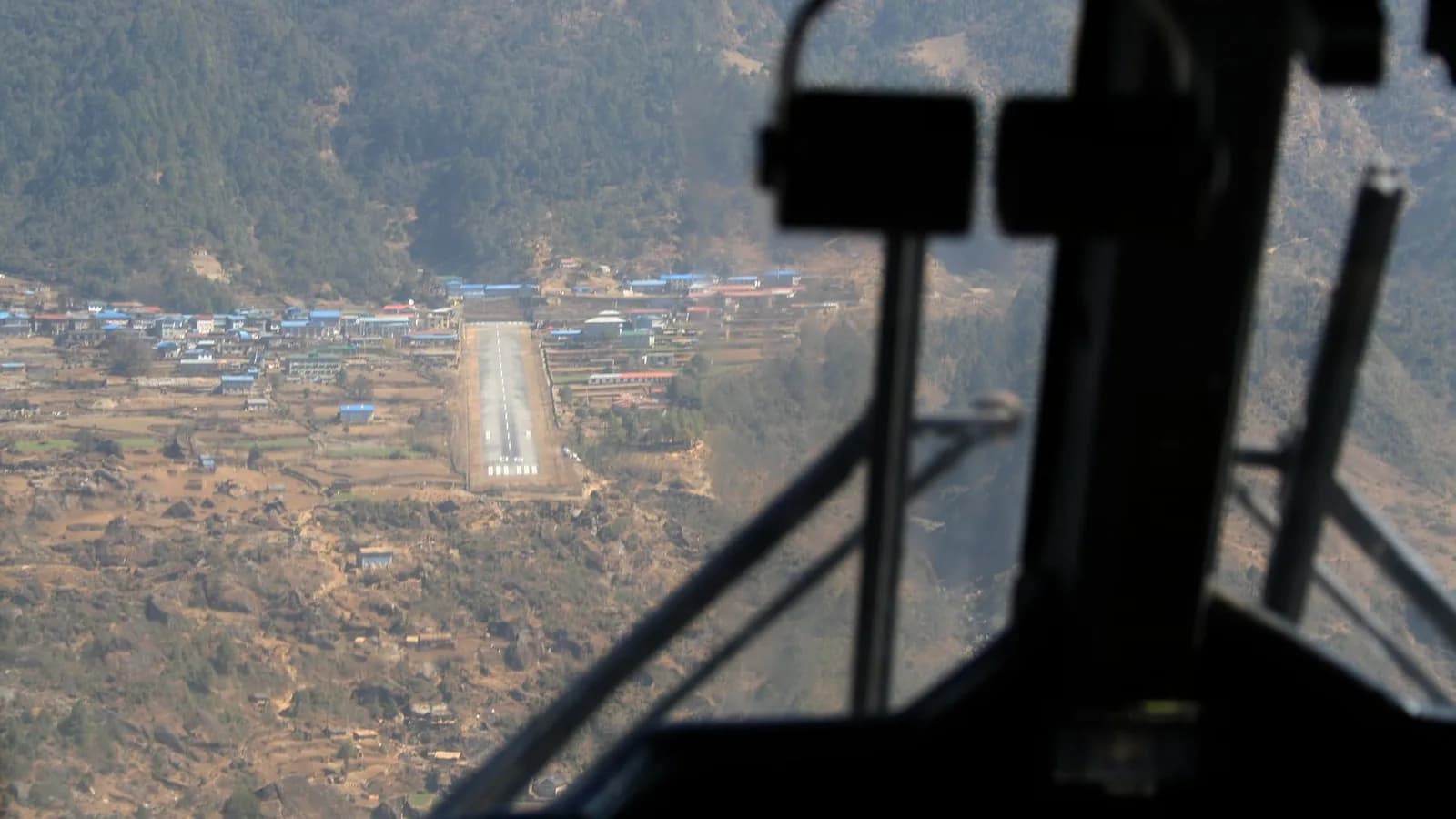
If you are flying to the start of the Everest Base Camp trek, one question tends to surface before any other: is Lukla airport dangerous? The short answer is that Lukla — officially Tenzing-Hillary Airport — is a genuinely demanding piece of aviation, with a tiny sloped runway, thin mountain air and weather that turns on a coin. But "demanding for pilots" is not the same as "reckless to fly into." Thousands of trekkers land here safely every season aboard purpose-built aircraft flown by specially trained crews. This guide separates the reputation from the reality, explains exactly why Lukla is hard, and shows what you can do to make your own flight as safe and stress-free as possible.
Key takeaways
- Lukla's runway is just 527 metres long with an 11.7 percent slope, sitting at 2,845 metres (about 9,334 feet) — there is no room for error and no go-around once committed.
- It was branded the world's most dangerous airport by a 2010 History Channel program, a label that has stuck for marketing reasons more than current statistics.
- The real day-to-day hazard for travellers is weather delays and cancellations, not crashes; roughly half of afternoon flights can be scrubbed for poor visibility.
- Serious accidents are rare relative to flight volume, but they have happened — the worst recent case being Yeti Airlines Flight 101 in October 2008 (18 dead, 1 survivor).
- Only small STOL aircraft — the Twin Otter, Dornier 228 and L-410 — and helicopters operate here, flown by crews trained specifically for the approach.
- You can manage almost all of the risk and inconvenience with buffer days, early-morning flights, good insurance and a willingness to consider alternatives like driving in or flying by helicopter.
Why Lukla has its fearsome reputation
Lukla's notoriety is not invented. In 2010 the History Channel program Most Extreme Airports rated Tenzing-Hillary Airport the most dangerous airport in the world, a title it had effectively held in the trekking imagination for more than two decades. That single broadcast cemented a label that travel sites have repeated ever since.
The airport was renamed in January 2008 to honour Tenzing Norgay and Sir Edmund Hillary, the two men first confirmed to have summited Everest in 1953. It is the principal gateway to the Khumbu, and for most trekkers the flight in is the unavoidable, white-knuckle opening act of the journey. The reputation, in other words, is half engineering reality and half theatre — and it helps to know which half you are dealing with.
What makes the runway so challenging
Strip away the drama and the difficulty comes down to a handful of hard physical facts.
| Feature | Lukla (Tenzing-Hillary) | Typical international runway | | --- | --- | --- | | Runway length | 527 m (1,729 ft) | Often 3,000 m or more | | Runway width | 30 m (98 ft) | 45 m or more | | Gradient | 11.7% slope | Effectively flat | | Elevation | 2,845 m (~9,334 ft) | Usually near sea level | | Go-around option | None | Standard |
The slope is a feature, not a flaw
That 11.7 percent gradient looks alarming, but it is deliberate. Aircraft land uphill, so the incline helps the plane decelerate on a runway barely a third of a kilometre long. They then take off downhill, using gravity to build speed before the ground falls away into the valley. It is an elegant solution to an impossible-looking site — but it means landings and departures can only happen in one direction each.
Thin air robs the engines
At 2,845 metres the atmosphere is noticeably thinner, and aircraft engines produce significantly less power than they would at sea level. Less thrust on a shorter strip is exactly the combination that leaves no margin, which is why only lightweight short-takeoff-and-landing types are allowed: the De Havilland Canada DHC-6 Twin Otter, the Dornier 228 and the Let L-410 Turbolet, alongside helicopters.
There is no second chance
The single most important fact about Lukla is that it has no go-around procedure. High terrain and a rock face sit immediately beyond the top of the runway; the bottom drops sharply into a valley. If an approach is not right, there is nowhere to safely climb away and try again. Pilots are committed once they pass a certain point — which is precisely why the airline only assigns experienced crews and flies in good visibility.
The safety record: what the numbers actually say
A fair look at Lukla has to acknowledge that accidents have occurred. Over the decades there have been several fatal incidents in and around the airport. The ones most often cited from recent history include:
- Yeti Airlines Flight 101 — October 2008. A DHC-6 Twin Otter struck terrain near the runway in poor visibility on approach. Of the 19 people aboard, only the captain survived. It remains the deadliest accident directly tied to the airport.
- Summit Air Flight 409 — May 2017. A Let L-410 crashed in the vicinity of Lukla, killing two of the three people on board.
- April 2019 runway collision. A Summit Air aircraft collided with a parked helicopter at the airport, resulting in three deaths.
These events are serious and should not be minimised. But they need context. Lukla handles a very high volume of flights through the peak spring and autumn trekking seasons, and the overwhelming majority land and depart without incident. The pattern in the accident history points repeatedly to the same root causes — degraded visibility and the unforgiving approach — rather than to faulty aircraft. That is also why the mitigations focus so heavily on weather discipline.
It is worth noting that not every Nepal aviation tragedy in the headlines involves Lukla. The July 2024 Saurya Airlines crash, for example, occurred on takeoff from Kathmandu's international airport, not at Lukla — a useful reminder to check where an incident actually happened before letting it colour your view of this specific flight.
The real risk for most trekkers: delays, not disaster
Here is the honest reframe. For the average visitor, the thing most likely to disrupt your trip is not a crash — it is the weather closing the airport. Lukla sits in a narrow Himalayan valley where cloud, wind and visibility can change within minutes, and the airport only operates when conditions are clearly within limits.
The practical effect is a lot of waiting. Reporting on the airport suggests that around half of afternoon flights can be cancelled for poor visibility, which is why almost all Lukla flights are scheduled for the calm early-morning window. Most delays last a few hours to a day, but a stubborn weather system can ground flights for two or three days in a row. Plan as if this will happen to you, and it becomes an inconvenience rather than a crisis. Building in spare days is one of the most useful habits we cover in our Everest Base Camp trek itinerary.
Why so many flights now leave from Ramechhap
During the busiest months — broadly April to May and October to November — scheduled Lukla flights often depart not from Kathmandu but from Manthali airport in Ramechhap, roughly a 4 to 5 hour drive east of the capital. This is not because the Lukla approach is any different; it is to relieve heavy congestion at Kathmandu's Tribhuvan International, where mixing international jets with tiny mountain planes causes cascading delays.
The trade-off is straightforward: you swap a long, pre-dawn road transfer for a much shorter flight (around 20 minutes) and a far lower chance of air-traffic delay, since Manthali handles little besides Lukla shuttles. Whether that is worth it depends on your schedule and how you feel about Nepal's mountain roads — our guide to domestic flights in Nepal puts the wider picture in context.
What it costs and how to book
Prices shift with season, airline and the foreigner versus local fare structure, so treat these as a guide and confirm at the time of booking. The figures below are typical published one-way fares (as of June 2026).
| Option | Typical one-way cost (as of June 2026) | Notes | | --- | --- | --- | | Kathmandu to Lukla (direct, fixed-wing) | USD 215 to 228 | Available outside peak congestion periods | | Ramechhap to Lukla (fixed-wing) | USD 175 to 190 + shared transfer ~USD 20 to 30 | Common in peak seasons; add the road transfer | | Sharing helicopter seat | from about USD 500 per person | Depends on group size and demand | | Private charter helicopter | from about USD 3,000 per aircraft | Most flexible in marginal weather |
Scheduled fixed-wing service is flown by carriers such as Tara Air, Summit Air and Sita Air, with the flight itself taking roughly 25 to 35 minutes from Kathmandu (less from Ramechhap). Helicopters cost far more but can sometimes fly when fixed-wing flights are grounded, which is why some trekkers keep a shared-heli option in reserve for the return leg.
How to fly into Lukla as safely as possible
You cannot change the runway, but you can stack the odds in your favour.
Fly early and build in buffer days
Book the earliest morning flights you can, when mountain air is calmest, and never schedule your Lukla return for the same day as an international departure. Leave at least one or two spare days at the end of the trek so a weather delay does not cost you your flight home.
Choose reputable operators and good insurance
Stick with established airlines and trekking companies that fly this route regularly. Make sure your travel insurance explicitly covers high-altitude trekking and helicopter evacuation — a medevac from the Khumbu can be extremely expensive and payment is often expected up front. Our overview of trekking insurance and helicopter evacuation explains what to look for.
Consider skipping the flight altogether
If the airport genuinely worries you, you do not have to use it. It is possible to drive and trek in via Salleri or Phaplu, reaching Lukla on foot over a few extra days. We cover this slower, road-based approach in Everest Base Camp without flying, and a helicopter is a third route in. None of these removes the mountains, but they do let you opt out of the runway.
Keep the risk in perspective
Finally, remember that the Lukla flight is the headline-grabber, but altitude is the larger statistical risk on an Everest trek. A disciplined ascent profile matters more to your overall safety than the airport ever will — a point we make in detail in is the Everest Base Camp trek safe.
So — is Lukla airport dangerous?
It is fairer to call Lukla demanding than reckless. The runway is short and steep, the air is thin, the weather is fickle and there is no margin for a botched approach — all of which is why it carries its dramatic reputation. Yet it is flown thousands of times each season by trained crews in aircraft built for exactly these conditions, and serious accidents are rare against that volume. For the vast majority of trekkers, the airport delivers a thrilling but routine flight, and the only real disruption is weather. Treat it with respect, give yourself buffer days, insure properly, and the gateway to Everest becomes one of the most memorable arrivals in travel rather than something to fear.
Sources
- Tenzing-Hillary Airport — Wikipedia
- A Look At Lukla Airport's Accident-Ridden History — Simple Flying
- Yeti Airlines Flight 101 — Wikipedia
- Summit Air Flight 409 — Wikipedia
- List of airplane accidents in Nepal — Wikipedia
- 2024 Saurya Airlines Bombardier CRJ200 crash — Wikipedia
- Lukla Flight Information 2026 — World Alpine Treks
- Kathmandu to Lukla Flight Price 2026 — Pride Nepal Travel
Frequently asked questions
- Is Lukla airport really the most dangerous airport in the world?
- It earned that label from a 2010 History Channel program, Most Extreme Airports, which rated it the most dangerous airport in the world for more than 20 years. The reputation comes from its short sloped runway, high altitude and unpredictable mountain weather rather than from constant crashes.
- How long is the runway at Lukla?
- The runway is just 527 metres (1,729 feet) long and 30 metres wide, with a steep 11.7 percent gradient. By comparison, most international runways exceed 3,000 metres, so Lukla gives pilots almost no margin for error.
- Why is there no go-around at Lukla?
- High terrain and a rock face sit immediately beyond the upper end of the runway, while the lower end drops steeply into a valley. There is simply nowhere safe to abort a landing and climb away, so committed approaches must be flown precisely the first time.
- How often are Lukla flights cancelled?
- Cancellations are common and weather-driven. Reporting suggests roughly half of afternoon flights can be scrubbed for poor visibility, which is why flights are scheduled for the calmer early morning and trekkers are advised to keep buffer days in their plans.
- Has there been a recent crash at Lukla?
- The deadliest recent accident was Yeti Airlines Flight 101 in October 2008, which killed 18 of 19 on board. Later incidents include a Summit Air crash in May 2017 and a runway collision in April 2019; serious accidents are rare relative to the thousands of flights flown each season.
- Is it safer to fly from Ramechhap instead of Kathmandu?
- Manthali airport at Ramechhap is used in peak seasons mainly to ease Kathmandu congestion, not because the flight itself is safer. The Lukla approach is identical; the trade-off is a 4 to 5 hour pre-dawn drive in exchange for a much shorter, less delay-prone hop.
- Can I trek to Everest Base Camp without flying into Lukla?
- Yes. You can drive and trek in via Salleri or Phaplu, adding several days but avoiding the flight entirely. Helicopters also serve Lukla, though charters are far more expensive than the scheduled fixed-wing fare.
- What aircraft fly into Lukla?
- Only small short-takeoff-and-landing aircraft and helicopters can use it, chiefly the De Havilland Canada DHC-6 Twin Otter, the Dornier 228 and the Let L-410 Turbolet, flown by experienced crews trained specifically for the approach.
Related posts
Is the Everest Base Camp Trek Safe? An Honest Guide
Is the Everest Base Camp trek safe? A clear look at altitude, the Lukla flight, insurance and the real risks — plus how trekkers stay safe.
Read postAma Dablam Climb: 2026 Expedition Guide (6,812m)
An Ama Dablam climb and expedition guide for 2026 — height, the Southwest Ridge route, camps, fixed ropes, difficulty, permits, cost and the best seasons.
Read postBest Time for Everest Base Camp Trek: Month Guide
The best time for the Everest Base Camp trek is spring and autumn. Here is how each month stacks up for weather, views, crowds and Lukla flights.
Read post