Devanagari Script: A Traveler's Guide to Nepal's Letters
What the Devanagari script is, where it came from, and how Nepal uses it — the writing system behind every sign, menu, and newspaper you will see.
Those curving symbols hanging from a horizontal line are not decoration — they are an alphabet, and a remarkably logical one.
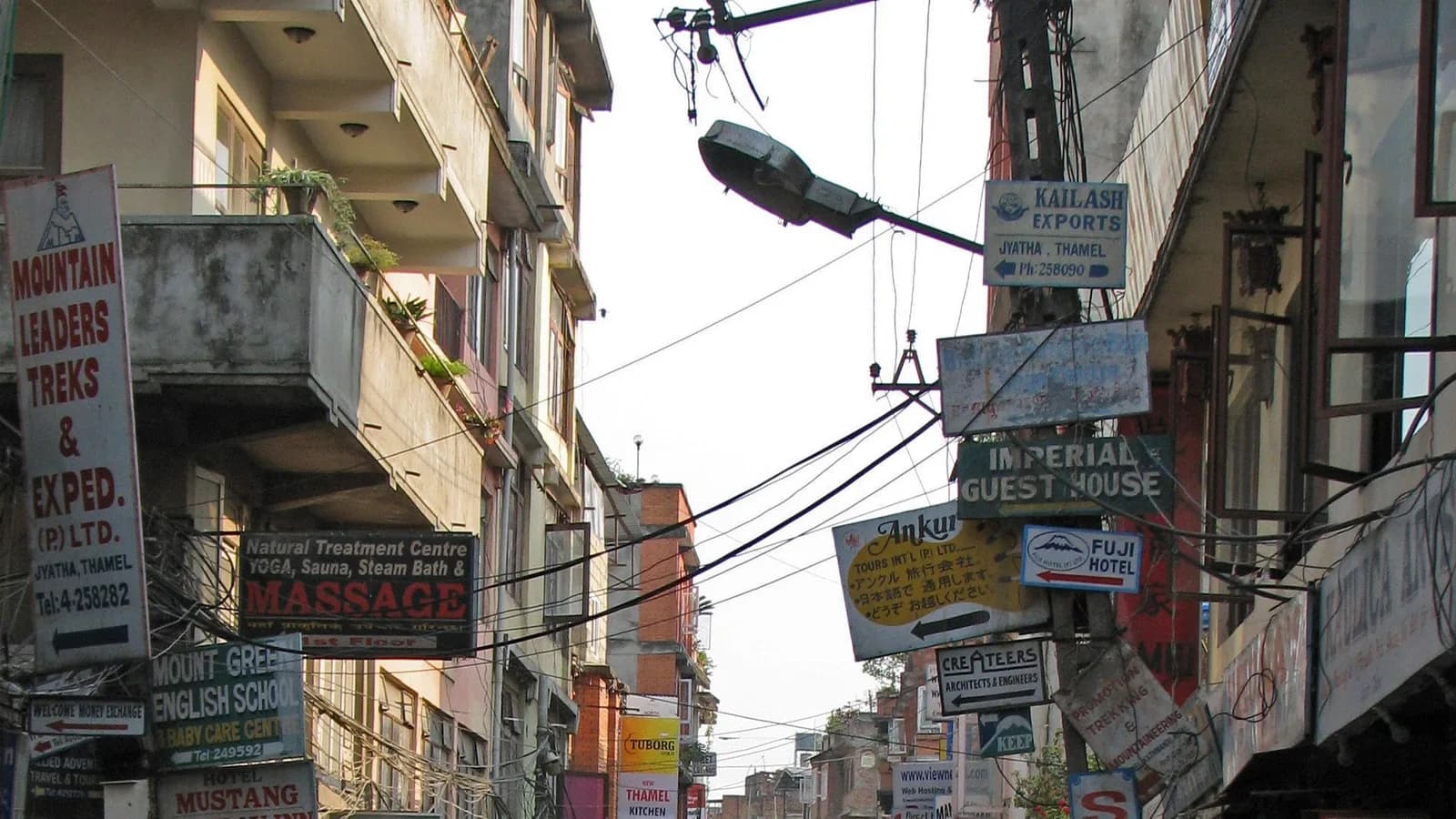
Step off the plane in Kathmandu and the first thing many travelers notice is the writing. Shop signs, bus destination boards, newspaper stands, temple inscriptions — all carry rows of curving symbols that seem to hang from a horizontal line. This is the Devanagari script, the writing system Nepal shares with Hindi, Marathi, Sanskrit and dozens of other languages. It looks impenetrable at first glance, but it is an alphabet with a logic that English can only envy.
This guide is about the script as a thing you encounter in Nepal: where it came from, how it is built, and why it behaves the way it does. If you want to actually learn the letters with audio for each one, our full Devanagari script reference is the place to start, and our Devanagari learning roadmap lays out an honest schedule. This article gives you the context that makes those letters make sense.
Key takeaways
- Devanagari is an abugida (alphasyllabary): each consonant carries a built-in short "a" sound unless a vowel mark changes it.
- It descends from the ancient Brahmi script, reaching its mature form by around the 11th century CE.
- It is one of the world's most widely used writing systems, serving roughly 120 languages, including Hindi, Marathi and Nepali.
- Nepali uses a familiar core of 11 vowels and 33 consonants, plus vowel marks called matras.
- The horizontal line across the top is the shirorekha (headline); letters hang beneath it.
- You do not need it to travel, but reading even a little unlocks signs, prices and place names.
What "Devanagari" actually means
The name is built from two Sanskrit pieces: deva, meaning "god" or "divine," and nagari, an adjective relating to a nagara — a town or city. Strung together, Devanagari is usually translated as something like "script of the divine city." According to Encyclopaedia Britannica, the script appears in inscriptions from the 7th century CE and settles into its mature form from the 11th century onward, while the specific compound name "Devanagari" is attested only later, by roughly the 18th century.
Before that, the script — or a related family of North Indian scripts — was simply called Nagari. An 11th-century scholar, Al-Biruni, referred to a North Indian Nagari script in his writings, which is one of the earliest external mentions of the system in something close to its current shape.
A writing system, not an alphabet (exactly)
English speakers reach for the word "alphabet," but Devanagari is technically an abugida, sometimes called an alphasyllabary. The defining trait: every consonant comes with a built-in vowel.
Take the consonant क. On its own it is not just "k" — it is "ka," with a short a baked in. To make a different vowel sound, you attach a small mark. To strip the vowel entirely, you add a special sign or join the consonant to the next one. Britannica sums it up neatly: a consonant symbol without diacritics "is read as the consonant followed by the letter a — that is, the a is implied rather than written."
This is why people describe Devanagari as a blend of an alphabet (separate symbols for separate sounds) and a syllabary (each base symbol is really a syllable). It is also why the script is so phonetically honest: once you know the rules, a written word tells you almost exactly how to say it. There is no English-style chaos where tough, though and through share letters but not sounds.
Where it comes from: the Brahmi family
Devanagari did not appear out of nowhere. It belongs to the Brahmic family of scripts that spread across India, Nepal, Tibet and Southeast Asia. The lineage runs roughly like this:
| Stage | Approximate era | Note | |---|---|---| | Brahmi | 3rd century BCE | The ancient ancestor of most Indian scripts | | Gupta / North Indian scripts | c. 4th–7th century CE | A monumental script that evolved from Brahmi | | Nagari | from c. 7th century CE | The North Indian script that gave rise to Devanagari | | Devanagari | mature by 11th century CE | The form used today across many languages |
That shared ancestry is why so many South Asian scripts — Bengali, Gujarati, Telugu, Tamil and others — look like distant cousins of Devanagari. They branched from the same Brahmi root at different times and drifted into their own shapes.
How far Devanagari reaches
Devanagari is not a niche script. Reference surveys describe it as the most widely used writing system of the Brahmic family and one of the most used on Earth — frequently ranked as the fourth most widely adopted writing system, used for well over a hundred languages and dialects.
The heavyweights written in Devanagari include:
- Hindi — hundreds of millions of speakers across India
- Marathi — tens of millions, centered in Maharashtra
- Nepali — the national language of Nepal
- Sanskrit — the classical liturgical and scholarly language
- Plus many regional languages such as Bhojpuri, Maithili, Konkani, Bodo and others
For a traveler, the practical upshot is large: the letters you learn for Nepal also let you sound out signs in much of northern India. The vocabulary differs, but the symbols carry over.
Nepal's wider language picture
Devanagari is the script, but Nepal is far from monolingual. The country is home to dozens of languages, and several of them — including Newar and others — have historically used Devanagari or scripts of their own. If you are curious about that mosaic, see our overview of the languages of Nepal. And if you already speak some Hindi, our comparison of Nepali versus Hindi explains how much of a head start that gives you (a lot for the script, less for the grammar).
The structure of Nepali Devanagari
Nepali uses a familiar core of the Devanagari character set. The traditional teaching breakdown is:
- 11 vowels (swar): अ आ इ ई उ ऊ ऋ ए ऐ ओ औ
- 33 consonants (vyanjan): the main body of the alphabet
- About 10 vowel marks (matras): the small signs that change a consonant's built-in vowel
Worth knowing: Nepali does not use the entire Devanagari Unicode set. The full block, encoded in Unicode from U+0900 to U+097F (128 code points), includes Vedic and Sanskrit-specific characters that rarely or never appear in everyday Nepali. So the script you will read on a Kathmandu menu is a comfortable subset, not the whole sprawling system.
The headline that ties it together
Look closely at any Nepali word and you will see a continuous horizontal bar running along the top. This is the shirorekha, or headline. Each letter is designed to hang from it, and when letters are written side by side in a word, their headlines connect into one unbroken line. It is the single most recognizable visual feature of Devanagari — and a useful reading aid, because the line shows you where one word's strip ends and the next begins.
Consonant groups arranged by the mouth
One elegant feature: the consonants are not in a random order like the Latin A-B-C. They are arranged by where in the mouth the sound is made, moving from the back of the throat toward the lips. The first five consonants are velar (back of the mouth), the next group palatal, then retroflex, then dental, then labial. Britannica notes this front-to-back logic as a hallmark of the script. For a learner it means the alphabet is a kind of phonetics map — sounds that feel similar live next to each other.
This is also where English speakers meet the script's main challenges. Devanagari cleanly distinguishes pairs that English blurs:
| Distinction | Example pair | What changes | |---|---|---| | Aspirated vs unaspirated | क (ka) vs ख (kha) | A puff of air after the consonant | | Retroflex vs dental | ट (ṭa) vs त (ta) | Tongue curled back vs against the teeth | | Voiced aspirated | घ, झ, ध, भ | Sounds with no direct English equivalent |
If those distinctions intrigue you, our piece on whether Nepali is hard for English speakers digs into exactly these sounds, and our list of common mistakes when learning Nepali covers the traps beginners fall into with the script.
Punctuation and numbers you will actually see
Two everyday features surprise newcomers.
First, the full stop. Nepali traditionally ends a sentence not with a period but with a vertical bar called the danda or purna biram ( । ), encoded as U+0964 in Unicode. You will see it closing sentences in newspapers and books. The Western period does appear in casual and digital writing, but the danda is the traditional mark.
Second, the digits. Nepali has its own shapes for the numbers zero through nine:
| Western | 0 | 1 | 2 | 3 | 4 | 5 | 6 | 7 | 8 | 9 | |---|---|---|---|---|---|---|---|---|---|---| | Devanagari | ० | १ | २ | ३ | ४ | ५ | ६ | ७ | ८ | ९ |
These turn up on bus route boards, price tags, calendars and license plates. Recognizing them is one of the highest-value things a traveler can learn, because it directly affects fares and bargaining. Our guide to Nepali numbers and bargaining puts them to practical use.
Where you will meet Devanagari in Nepal
You do not have to go looking for the script — it is everywhere a tourist goes:
- Shop and street signs, especially outside the most touristy blocks of Thamel
- Bus and microbus destination boards, often Devanagari only
- Newspapers and magazines at every stand
- Temple and monument inscriptions, including older stone carvings
- Menus in local eateries away from the tourist strip
- Product packaging and prices in shops and markets
Interestingly, a lot of what you will sound out is not "Nepali" at all but English loanwords spelled in Devanagari — होटल (hotel), रेस्टुरेन्ट (restaurant), कम्प्युटर (computer). The moment you can read those, the script stops feeling foreign and starts feeling like a code you have partly cracked.
Do travelers need to learn it?
Honestly, no — not to have a great trip. English is widespread in tourist hubs, signs in major areas are often bilingual, and Nepalis are famously patient with visitors. You can trek the Annapurna or Everest regions and never decode a single letter.
But there is a real payoff to learning even a handful:
- Read place names on signs and maps, so you know which bus is yours
- Check prices and numbers to avoid simple misunderstandings
- Recognize your own name when a Nepali friend writes it for you
- Show respect — making the effort registers, and often opens conversations
The investment is modest. A couple of focused hours is enough to recognize common letters; a week of light practice makes you genuinely functional at sounding out signs. For the actual learning, lean on our Devanagari reference with audio and the step-by-step learning roadmap, and pair them with the phrasebook and a few trekking phrases so you have vocabulary to attach the letters to. For structured lessons that build from the script upward, the Nepali lessons section walks you through it.
A short, honest verdict
Devanagari rewards a little curiosity out of all proportion to the effort. It is ancient, it is logical, and it is far more learnable than its tangled-looking surface suggests. You will not master it before your flight lands — but you might, by the end of your trip, glance at a shop sign and realize you just read it. That small click of recognition is one of the quiet pleasures of traveling in Nepal.
Sources
Frequently asked questions
- What is the Devanagari script?
- Devanagari is a left-to-right writing system used for Nepali, Hindi, Marathi, Sanskrit and many other languages. It is an abugida, meaning each consonant carries a built-in vowel sound unless a mark changes it.
- Is Devanagari an alphabet or a syllabary?
- It is best described as an abugida or alphasyllabary — a hybrid. Britannica calls it a combination of syllabary and alphabet, because each consonant symbol implies a following short 'a' unless a vowel sign overrides it.
- What does the word Devanagari mean?
- It comes from Sanskrit deva (god or divine) and nagari (relating to a city or town), often rendered as 'script of the divine city.' The name is attested in this form by around the 18th century.
- Is the Nepali script the same as the Hindi script?
- Both Nepali and Hindi are written in Devanagari, so the letters look nearly identical. Nepali uses a subset of the full character set and has its own spelling conventions, but if you can read one you can sound out the other.
- How many letters does Nepali Devanagari have?
- Nepali is typically taught as 11 independent vowels (swar) and 33 consonants (vyanjan), plus about 10 dependent vowel marks called matras. That core set covers almost everything you will read on signs and menus.
- Why do Devanagari letters have a line across the top?
- That horizontal bar is called the shirorekha or headline. Letters hang beneath it, and in connected writing the lines join so words read as a continuous strip rather than separate boxes.
- Do I need to learn Devanagari to travel in Nepal?
- No — English signage is common in tourist areas and Nepalis are welcoming. But learning even a few letters helps you read place names, bus boards and prices, and it is a small gesture of respect that locals notice.
- What are the numbers in Devanagari?
- Nepali uses its own digit shapes for zero through nine: ० १ २ ३ ४ ५ ६ ७ ८ ९. You will still see Western numerals too, but bus routes, prices and calendars often use the Devanagari forms.
Related posts
The Nepali Alphabet: A Traveler's Plain-English Guide
The Nepali alphabet explained for tourists: how many letters, vowels, consonants, matras and numerals — and why the script is easier than it looks.
Read postNepali Language: A Traveller's Guide to Nepal's Tongue
The Nepali language explained for visitors: where it comes from, how its grammar works, the Devanagari script, and the handful of words that open doors.
Read postNepali Names: Meanings, Surnames and Naming Customs
A guide to Nepali names: how first names are chosen, what common surnames like Sharma, Thapa and Gurung reveal, and the naming customs behind them.
Read post