Paragliding Pokhara: Cost, Season & Safety 2026
Paragliding Pokhara — tandem prices, the best season, what the flight is like, weight and age limits, and how to pick a safe operator at Sarangkot.
You run three steps off a hill and the ground just lets go — then the whole Annapurna range tips into view.
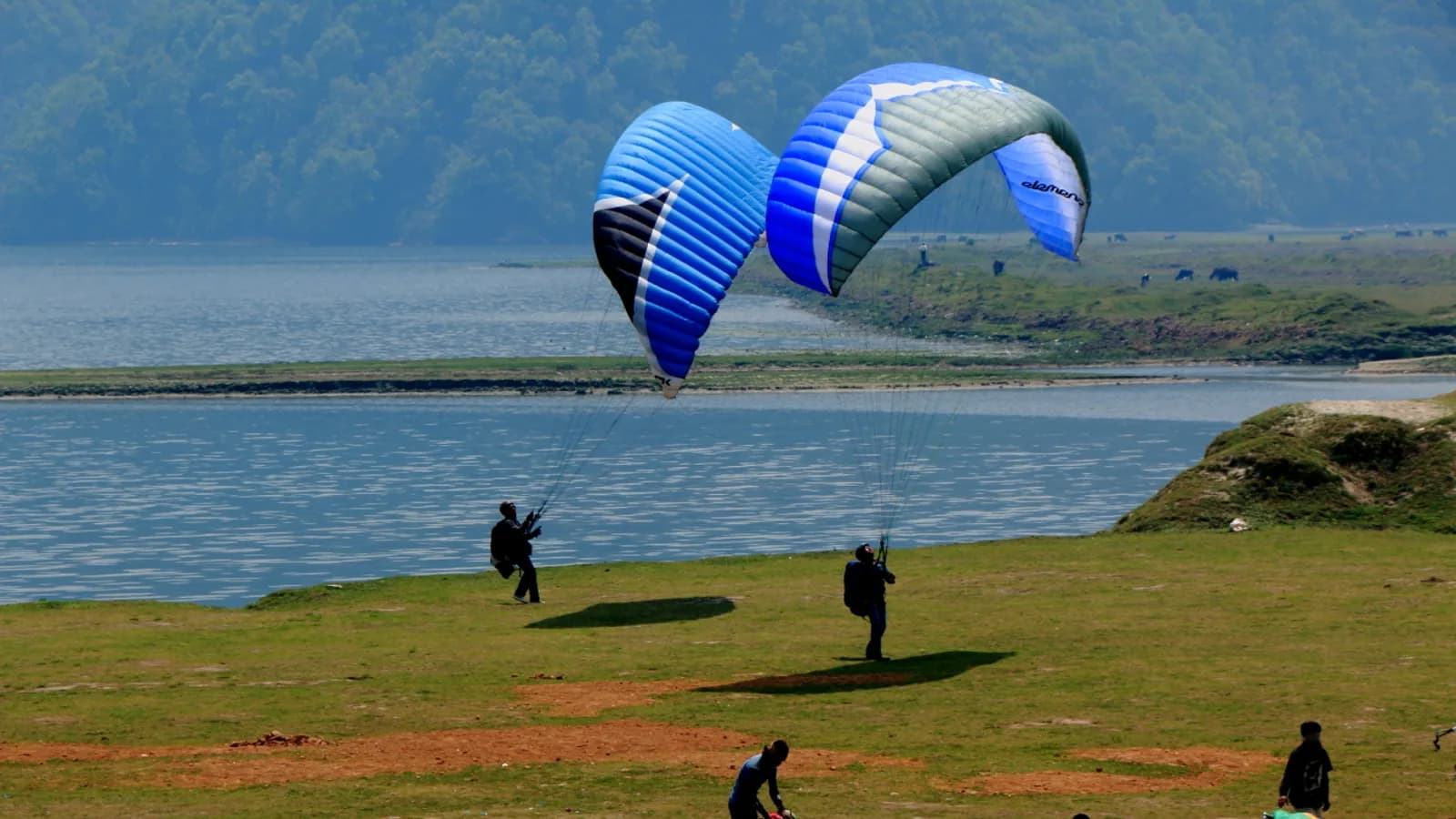
Few things in Nepal deliver a thrill as quickly as paragliding Pokhara. You drive up to a ridge, clip into a harness, run a few steps off the hillside, and within seconds the lake, the city and the entire Annapurna skyline drop away beneath your feet. It is the single most popular adventure activity in Pokhara, and one of the easiest big experiences to add to a Nepal trip because it needs no training and only a clear morning.
This guide covers what a flight actually costs, when the air is best, what the experience is like, the weight and age rules, and — most importantly — how to choose an operator you can trust. Prices and conditions shift, so treat the figures here as a guide and confirm when you book. All numbers are stamped with currency and date; sources are linked at the end.
Key takeaways
- A standard tandem flight of about 20–30 minutes is commonly around NPR 8,500 (as of early 2026); longer cross-country flights run NPR 12,000–13,000.
- The flying season runs roughly October to early May, with November and December offering the most stable air and clearest mountain views.
- Flights launch from Sarangkot (about 1,592 m) and land beside Phewa Lake, close to Lakeside.
- No experience is needed — you fly strapped to a licensed pilot who does all the work.
- Tandem flying has a good safety record; the key decision is picking a reputable, insured operator.
- Typical limits: maximum weight around 90–100 kg and a minimum age near 12, but confirm with your operator.
What it costs in 2026
Pricing in Pokhara is fairly consistent across operators, but it is worth comparing a couple before you commit, especially as a foreign visitor.
| Flight type | Airtime | Typical price (as of early 2026) | | --- | --- | --- | | Standard tandem | 20–30 min | Around NPR 8,500 | | Cross-country tandem | 40–60+ min | NPR 12,000–13,000 | | Photo/video add-on | — | NPR 1,000–2,000 |
A standard flight usually bundles in the short drive up to the launch, the flight itself with a trained pilot, taxes and insurance. Foreigners are sometimes quoted in US dollars — roughly 80 to 100 dollars for the standard flight — which can land a little above the direct rupee equivalent, so ask for the rupee price too.
If you are watching every rupee on your trip, paragliding is a splurge rather than a daily expense. Our Nepal travel budget guide puts it in context against accommodation, food and transport, and the ATM withdrawal guide and money exchange guide will help you have the right cash on hand, since many operators prefer it.
What is included — and what is not
Read the inclusions before you pay. A flight price normally covers transport to Sarangkot, the tandem flight and basic insurance. It does not usually cover photos and video, tips for the pilot, or any optional acrobatics. If a quote seems far cheaper than everyone else's, ask what has been stripped out.
The best season to fly
Pokhara's flying calendar is shaped by the weather. The season generally opens in late September or October and runs to about the start of May. Within that window, November and December are the standouts: the post-monsoon air is clean, the thermals are stable, and the mountains are at their crispest.
The summer monsoon (roughly June to September) brings cloud, rain and unpredictable air, and most operators wind flights down. If your trip falls then, treat paragliding as a maybe rather than a plan. For a broader view of when to come to Nepal at all, see the best time to visit Nepal.
Time of day matters
There are usually a few flight windows through the morning and early afternoon — commonly around mid-morning and again around the middle of the day. Morning air is often smoother, while midday thermals can give a livelier, more dynamic flight. If you are prone to motion sickness, ask for a calmer time slot and go easy on breakfast.
What the flight is actually like
You will be collected from Lakeside and driven up the winding road to Sarangkot, a ridge that also doubles as one of the area's great sunrise viewpoints. At the top your pilot fits your harness and helmet and runs through a short brief: how to run on take-off, where to put your hands, and how to lift your legs for landing.
The launch itself is over in moments. The wing fills, your pilot calls the run, you take a few committed steps down the slope, and then you are simply sitting in the air. From there it is calm — a slow, soaring drift with the Annapurna range, Machhapuchhre (the Fishtail), Annapurna South, Manaslu and Dhaulagiri stacked along the horizon, and Phewa Lake mirroring the sky below. If the thermals are working, you may circle upward with the hawks. The landing is gentle: a glide down to the grass beside the lake and a few steps to a stop.
Acrobatics — only if you ask
Many pilots can throw in spirals and wingovers for an extra hit of adrenaline, but only on request. If you want a serene scenic flight, say so clearly at the start; if you want the rollercoaster, agree it before take-off so there are no surprises in the air.
Safety and choosing an operator
This is the part that matters most. Paragliding in Pokhara is regulated by the country's civil aviation authority, and reputable operators fly licensed pilots on certified equipment. Tandem pilots typically train for well over a year and log many hundreds of solo hours before they carry passengers, and Pokhara's career pilots know this specific valley's winds intimately.
The honest picture on safety: over the years there have been a small number of serious accidents in Pokhara, including some fatalities, but most have involved solo pilots rather than commercial tandem flights. Tandem flying with a qualified pilot has a good record. Incidents do still happen — in mid-2025, for example, two paragliders came down in Phewa Lake on landing and all four people aboard were rescued unharmed — which is exactly why operator choice and a willingness to cancel for weather matter.
A simple checklist before you book
- Confirm the pilot is licensed and the operator carries passenger insurance.
- Ask about the equipment and roughly how recently the wing was checked.
- Trust a weather call. Good operators make the decision at the launch site, not the sales office, and will reschedule or refund rather than fly in marginal conditions.
- Read recent reviews for how a company handles cancellations and refunds.
- Walk away if something feels off. No flight is worth ignoring your gut.
Because the same advice applies to every adventure in Nepal, it is worth reading up on trekking insurance and helicopter evacuation so you understand what your travel policy actually covers — confirm that it includes paragliding, as some policies exclude it. And to keep your booking smooth, our guide to common tourist scams in Nepal will help you spot a hard-sell or a too-good-to-be-true quote.
How to fit it into a Pokhara trip
Paragliding pairs naturally with a relaxed Lakeside stay. A single flight, including the drive up and down, takes only a couple of hours, so it slots easily into a morning before a boat on Phewa Lake or a lazy afternoon in a cafe. Many people fly on their first clear morning in town, which leaves a buffer day in case the weather turns.
If you are arriving overland, our guides to the Kathmandu to Pokhara tourist bus and the wider Kathmandu to Pokhara transport options cover how to get there. And if you are weaving Pokhara into a longer route, the two-week Nepal itinerary shows where a flying day fits alongside trekking and culture.
Getting up to Sarangkot
Most operators include transport to the launch in the price, so you rarely need to arrange your own ride. If you do want to see the famous Sarangkot sunrise first and fly later, you can go up early independently and meet your operator at the agreed window — just coordinate timings the day before.
A few practical tips
- Wear closed shoes — trainers or light boots — for the running take-off and landing, not sandals.
- Dress in layers. It is cooler at altitude and in the air than down at the lake.
- Skip a heavy meal right before flying if your stomach is sensitive, and mention motion sickness to your pilot.
- Secure loose items. Anything not zipped away can be lost in the air; use a strap for glasses.
- Bring cash. Many operators prefer it, and card facilities are not guaranteed at the launch.
Sources
- Paragliding in Pokhara: Updated Cost & Location 2025/26 — Nepal Holiday
- Paragliding in Pokhara Cost Details — Haven Holidays Nepal
- Paragliding in Pokhara — Cost, Safety & Best Time to Fly — Save Mountain Treks
- Best Time for Paragliding in Pokhara — Save Mountain Treks
- Paragliding in Pokhara, Nepal — Cost 2026/2027 — Nepal Trek Adventures
- Paragliding Pokhara Guide 2025 — The Everest Holiday
- Four rescued after paragliding crash in Pokhara — Khabarhub
- Two paragliders crash in Pokhara — The Rising Nepal
Frequently asked questions
- How much does paragliding in Pokhara cost?
- As of early 2026, a standard tandem flight of roughly 20 to 30 minutes is commonly around NPR 8,500, while longer cross-country flights of 40 to 60 minutes run closer to NPR 12,000 to 13,000. Photos and video shot by the pilot usually cost an extra NPR 1,000 to 2,000. Foreign visitors are sometimes quoted in US dollars at roughly 80 to 100 dollars for the standard flight, so it pays to compare a few operators.
- When is the best time to go paragliding in Pokhara?
- The flying season generally runs from about late September or early October through to roughly the start of May. November and December are prized for their stable air and clear mountain views. Flights pause during the summer monsoon when clouds and rain make conditions unreliable.
- Is paragliding in Pokhara safe?
- Tandem flying with a licensed pilot has a good track record, and the Pokhara valley is regarded as one of the world's better paragliding sites because of its predictable thermals. Most serious incidents over the years have involved solo pilots rather than commercial tandem flights. Choose a reputable operator, check that they carry insurance, and trust a pilot who delays or cancels for weather.
- Where do paragliding flights take off and land in Pokhara?
- Most flights launch from Sarangkot, a ridge at roughly 1,592 metres about 30 minutes by road from the Lakeside area. The usual landing zone is beside Phewa Lake, close to the tourist strip, so you finish near where most travellers stay.
- What is the weight and age limit for tandem paragliding?
- Limits vary by operator, but a maximum passenger weight in the region of 90 to 100 kg is typical for safety. Children are often allowed from about age 12, with a parent or guardian present for younger teens. If you are near a weight or health limit, call ahead and confirm before you travel to Pokhara.
- How long does the paragliding flight last?
- A standard tandem flight gives you roughly 20 to 30 minutes of airtime once you are off the launch. Cross-country options extend that to an hour or more and climb higher, but they cost more and depend on the day's conditions.
- Do I need any experience or training to fly?
- No. Tandem paragliding means you fly strapped to a qualified pilot who handles the launch, the flying and the landing. Your only real job is to run a few steps off the slope on take-off and lift your legs for the landing. The pilot briefs you on both before you go.
- Can I get photos and video of my flight?
- Yes. Most pilots carry a small action camera on a pole and can film you during the flight for an extra fee, usually somewhere around NPR 1,000 to 2,000. Agree the price and what you will receive before take-off, and bring a way to copy the files afterwards.
Related posts
Bungee Jumping Nepal: Sites, Cost & Guide (2026)
Bungee jumping Nepal — Kushma, the Last Resort and Pokhara compared, with heights, prices, weight and age limits, safety and how to choose your jump.
Read postParagliding Pokhara Cost: 2026 Price Breakdown
Paragliding Pokhara cost explained — standard vs cross-country prices, photo add-ons, foreigner rates, what is included, and how to avoid overpaying.
Read postPokhara Bungee Jumping: Tower, Cost & Guide 2026
Pokhara bungee jumping — the Hemja tower over the Seti gorge, height, prices, weight and age limits, safety, combos and how it compares to Kushma.
Read post