The Nepalese Rupee: History, Notes and How to Read It
A traveller's guide to the Nepalese rupee — its history, the NPR symbol and code, what is on the banknotes, and how to spot a genuine note.
Every Nepalese rupee note carries Everest — once you know the wildlife on each one, the money tells its own story.
The Nepalese rupee is more than just the cash in your pocket on a trip to Nepal — it is a small, portable piece of the country's story, stamped with Mount Everest, one-horned rhinos and Himalayan temples. This guide looks at the rupee itself: where it came from, its NPR code and symbol, what the imagery on each note means, and how to tell a real note from a fake. For the day-to-day mechanics of carrying and changing money, our companion Nepal currency guide for tourists covers exchange rates, ATMs and cards in detail — this piece is the back-story to the banknotes in your hand.
Key takeaways
- The currency is the Nepalese rupee, code NPR, written Rs and spoken as rupaiya; one rupee divides into 100 paisa.
- It was introduced in 1932, replacing the silver mohar, and has been issued by Nepal Rastra Bank since the central bank's founding in 1956.
- Mount Everest appears on every circulating note (5–1,000 rupees), replacing the king's portrait around 2007–2008 as Nepal moved to a republic.
- Each denomination has its own colour and wildlife on the reverse — the rhino on the 100, the tiger on the 500, elephants on the 1,000.
- Genuine notes show a watermark, security thread and intaglio feel; pale colour and a blurry watermark are warning signs of a fake.
- The rupee is pegged to the Indian rupee (about 1 INR = 1.6 NPR), and recent years have seen a 2024 note withdrawal and a redesigned 100-rupee note in late 2025.
A short history of the rupee
Nepal's money has changed shape many times. Before the modern rupee, the country used silver coins called mohar. The rupee was introduced in 1932, replacing the mohar at a rate of two mohar to one rupee, and was first known in Nepali as the mohru. That makes the rupee, in its current form, more than ninety years old.
The bigger turning point came in 1956, when Nepal Rastra Bank (NRB) — the country's central bank — was established. From then on, the issuing and regulation of the currency, the printing of standardised banknotes, and the management of exchange rates all sat with NRB, which remains the authority behind every rupee today. If you ever want to check an official exchange rate rather than trust a money changer's board, NRB publishes daily reference rates.
From the king to Everest
For most of the twentieth century, Nepali notes carried the portrait of the reigning king, reflecting the country's status as a monarchy. That changed around 2007, when the king's image was replaced by Mount Everest on newly issued notes — a shift that came just before Nepal formally abolished the monarchy and became a republic in 2008. The Everest design has defined the look of the currency ever since, and it is why every note you handle today, from the humble 5 to the 1,000, shows the world's highest mountain.
NPR: the symbol and the code
Like its neighbours, Nepal calls its currency the rupee, a name shared with India, Pakistan, Sri Lanka and others. To keep them apart in banking and on currency apps, each has a three-letter ISO code, and Nepal's is NPR. So when you see NPR on an airline receipt, a hotel bill or a converter, that is the Nepalese rupee specifically.
In everyday life you will more often see it written as Rs (for example Rs 500) or with the rupee sign. Locals call it the rupaiya when speaking Nepali. None of this is complicated, but the distinction matters in one situation: if you are comparing prices or exchange rates online, make sure you are looking at NPR and not the Indian INR, because the two are different currencies with different values.
| Detail | Nepalese rupee | |---|---| | Currency code | NPR | | Common written form | Rs | | Spoken (Nepali) | rupaiya | | Subunit | 100 paisa | | Issuing authority | Nepal Rastra Bank |
What the banknotes look like
The circulating notes run 5, 10, 20, 50, 100, 500 and 1,000 rupees. (A handful of unusual denominations — 1, 2, 25 and 250 — exist but are collector curiosities you are very unlikely to receive.) Every note shows Mount Everest on the front, while the reverse carries a different animal or landmark and its own dominant colour. That colour-plus-wildlife pairing is the easiest way to recognise notes at a glance, especially when you are juggling change in a dim shop.
| Note | Dominant colour | Notable imagery | |---|---|---| | Rs 10 | Brown | Antelopes on the reverse | | Rs 100 | Green/lilac | Taleju Temple; a one-horned rhinoceros on the reverse | | Rs 500 | Brown/violet | A tiger on the reverse | | Rs 1,000 | Blue/grey | An elephant on the reverse |
The 1,000-rupee note is the highest denomination in normal use, and it is printed on a durable cotton-and-linen paper rather than ordinary wood-pulp paper, which is partly why it survives so well in circulation. Knowing the wildlife shortcut is genuinely useful on the ground: ask a vendor for "the rhino note" and they will hand you a hundred. The animals also connect the money to Nepal's national parks — you can meet the real one-horned rhino in Chitwan and read about the Bengal tiger that lends the 500 its image.
Coins and the (almost) forgotten paisa
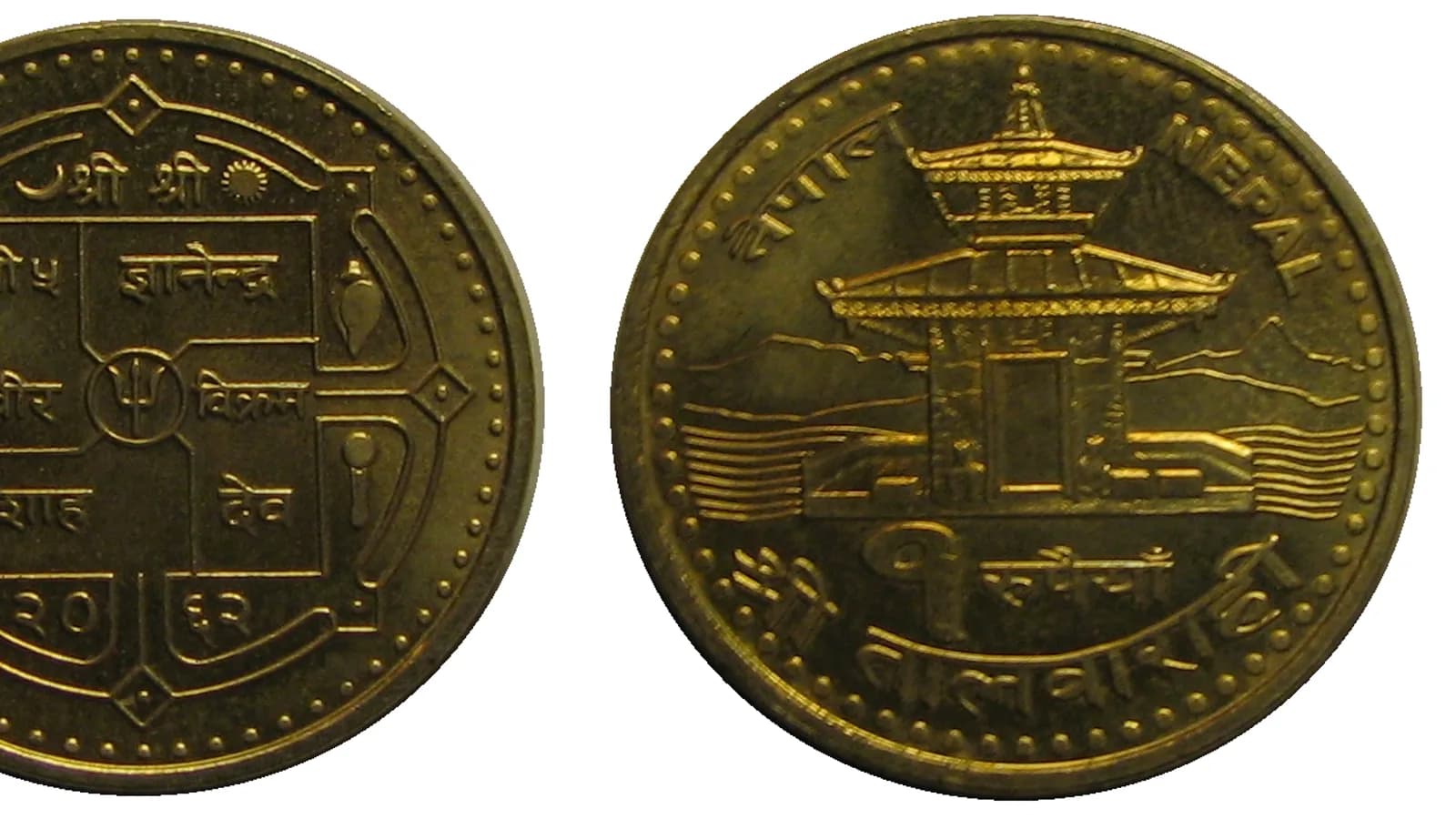
In theory, one rupee splits into 100 paisa, exactly as a dollar splits into cents. Paisa coins, along with low-value rupee coins, were once part of daily change. In practice, decades of inflation have made them all but disappear from circulation — prices are now set and paid in whole rupees, and you will almost never see a coin as a tourist. If a price ends in an odd amount, it is simply rounded.
How to spot a genuine note
Counterfeits exist, so it is worth a few seconds' check on larger notes, especially if you ever change money outside a proper bank or licensed dealer. Nepal Rastra Bank builds several security features into genuine notes, and you do not need special equipment to read most of them. The detail below reflects what reputable forensic and currency references describe (as of June 2026):
- Watermark. Hold the note up to bright light and look at the right-hand side. On a genuine note you will see a clear watermark — on recent issues, Everest and the rhododendron, Nepal's national flower. On a fake, this area often looks like a smudge or a cluster of dark dots.
- Security thread. A genuine note has a security thread that you can read when held to the light. On counterfeits, the thread is usually crude and the text is hidden or missing.
- Feel of the paper. Real notes have a firm, slightly gritty, textured feel from intaglio (raised) printing. Counterfeits tend to feel slippery, waxy or unusually thick.
- Colour depth. Authentic notes have deep, sharp colours. A note that looks faded or washed-out compared with others of the same value is a red flag.
If a note ever fails these checks — or is badly torn — do not accept it. Genuine but heavily damaged notes can also be refused by vendors; a bank will usually swap a damaged note for a clean one. And because changing money on the street is where dud notes most often appear, only ever exchange with a licensed dealer who gives a receipt. Our Nepal tourist scams roundup explains why a stranger offering a "great rate" on the pavement is always best ignored.
The peg to the Indian rupee
One feature that surprises visitors is that the Nepalese rupee does not float freely. Since the early 1990s it has been pegged to the Indian rupee at a fixed rate of roughly 1 Indian rupee = 1.6 Nepalese rupees (an arrangement whose roots reach back decades). India is Nepal's dominant trading partner, and the peg buys a degree of exchange-rate stability with its much larger neighbour.
For a traveller, the peg has two practical effects. First, because the rupee tracks the Indian rupee, the NPR-to-US-dollar rate tends to move with the Indian rupee against the dollar. Second, Indian 100-rupee notes are widely usable in Nepal in a way no other foreign currency is — though higher Indian denominations have long been restricted, with the rules shifting in recent years, so always confirm the current position before relying on big Indian notes. The full set of rules sits in our Nepal currency guide.
A currency that keeps evolving
The rupee is not a museum piece — Nepal Rastra Bank keeps updating it. Two recent developments are worth knowing:
- Withdrawal of older high-value notes (2024). From 2024, NRB moved to phase out pre-2019 versions of the 500 and 1,000 notes, citing counterfeiting and security concerns. As a visitor you do not need to track which series is which: simply use the current notes that banks and ATMs dispense, and let any older ones go back through the till.
- A redesigned 100-rupee note (late 2025). In November 2025, NRB issued a new 100-rupee banknote, keeping Everest on the design alongside the national map and other national symbols. The redesign attracted regional commentary because of the map it depicts, which reflects the official map Nepal adopted in 2020 — an area where Nepal and India hold differing territorial views. For a traveller, the note is simply legal tender like any other; the wider question is a diplomatic matter between the two governments rather than anything that affects how you spend it.
The broader point is reassuring: whatever the year's news, the notes the banks hand you are valid currency. You spend them the same way regardless of the politics around a particular design.
Putting the rupee to use
Once you can recognise the notes and trust the ones you are holding, the rupee becomes one of the easy parts of a Nepal trip. A little local number sense helps when you are bargaining or counting change — our guide to Nepali numbers for bargaining walks through saying prices out loud. From there, the fun part is spending: see what to buy in Nepal for ideas on where those rhino and tiger notes go furthest, and the practical Nepal currency guide for exchange rates, ATMs, cards and how much cash to carry.
Handled with a bit of knowledge, the Nepalese rupee is a friendly, characterful currency — mountain on the front, wildlife on the back, and a long history folded into every note.
Sources
- Nepalese rupee — Wikipedia
- Banknotes of the Nepalese rupee — Wikipedia
- Foreign Exchange Rate — Nepal Rastra Bank (central bank)
- Forensic Examination of Security Features of High Denomination Nepalese Currency Notes (PDF) — IJSDR
- Why Nepal's new Rs 100 banknote has reignited the India-Nepal border discussion — ThePrint
- Nepal issues new NPR 100 banknote featuring updated map — ANI News
- Nepali Currency: History, Value, and Features of the Nepal Rupee — Himalayan Dream
Frequently asked questions
- What is the symbol and currency code for the Nepalese rupee?
- The international currency code is NPR, and the rupee is also written locally as Rs or with the symbol Rs (the rupee sign). The NPR code exists to tell it apart from the Indian, Pakistani, Sri Lankan and other rupees, which all share the same name. In Nepali the currency is spoken as the rupaiya.
- When was the Nepalese rupee introduced?
- The rupee was introduced in 1932, replacing the older silver mohar at a rate of two mohar to one rupee, and was first known in Nepali as the mohru. Nepal Rastra Bank, the country's central bank, was established in 1956 and has issued the currency ever since.
- Why is Mount Everest on every Nepalese banknote?
- Mount Everest replaced the portrait of the king on Nepali notes from around 2007 to 2008, just before Nepal became a republic in 2008. Since then every circulating note from 5 to 1,000 rupees carries Everest on its face, which makes the design instantly recognisable as Nepali.
- What is the highest denomination Nepalese rupee note?
- The 1,000-rupee note is the highest denomination in everyday circulation. Notes run 5, 10, 20, 50, 100, 500 and 1,000 rupees, with rare 1, 2, 25 and 250 notes you are very unlikely to handle. There are also low-value coins, but visitors deal almost entirely in notes.
- How can I tell if a Nepalese rupee note is genuine?
- Hold the note up to the light and look for a clear watermark (Everest and the rhododendron flower) on the right, a security thread you can read through the paper, and a firm, slightly textured feel. Genuine notes have deep, sharp colours; counterfeits tend to look pale, feel slippery and show a blurry watermark.
- Did Nepal change its banknotes recently?
- Yes. From 2024 Nepal Rastra Bank moved to withdraw older pre-2019 versions of the 500 and 1,000 notes over counterfeiting concerns, and in late 2025 it issued a redesigned 100-rupee note. As a tourist you can simply use whatever current notes the banks and ATMs give you.
- Is the Nepalese rupee the same as the Indian rupee?
- No, they are separate currencies, but the Nepalese rupee is pegged to the Indian rupee at a fixed rate of about 1 Indian rupee to 1.6 Nepalese rupees, in place since the early 1990s. Indian 100-rupee notes are widely accepted in Nepal; higher Indian denominations have been restricted, so confirm the current rule before carrying them.
- What are paisa in Nepalese currency?
- One rupee is divided into 100 paisa, the same way a dollar splits into cents. Paisa coins were used for very small amounts in the past, but inflation means they have almost vanished from daily life. In practice everything is now priced and paid in whole rupees using banknotes.
Related posts
Nepal Currency Guide — The Nepalese Rupee for Tourists
What the Nepalese rupee looks like, how it compares to USD, the Indian rupee rules, and how to carry money in Nepal without getting caught out.
Read postNepalese Rupee Exchange Rate: A Traveller's Guide
How the Nepalese rupee exchange rate works for tourists — the Indian rupee peg, the floating USD rate, where to find it, and what changers really cost.
Read postNepalese Rupee to USD: Approximate Rate & Money Tips
How the Nepalese rupee to USD rate works, an approximate figure for mid-2026, why it moves, and how to exchange dollars for rupees without overpaying.
Read post