Nepal Air Pollution: Causes, Seasons and What It Means
A clear explainer on Nepal air pollution: the real causes, how bad it is by the numbers, the health stakes, and what it means for travellers.
Nepal's air pollution is not just a Kathmandu traffic problem — it is geography, fire, farming and weather layered on top of one another.
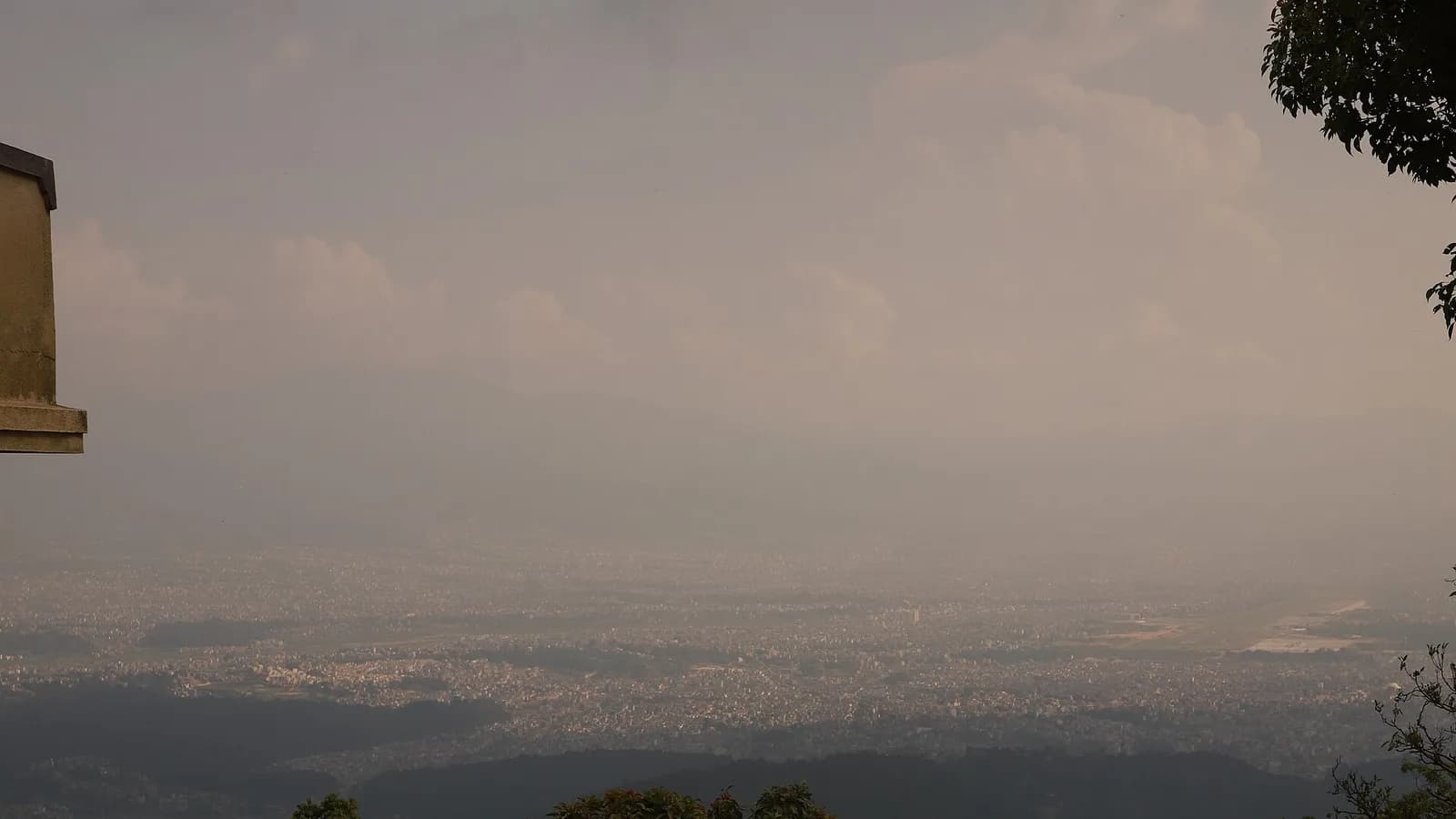
When people search for Nepal air pollution, they usually have one of two things in mind: a traveller worried about a hazy trip, or a reader trying to understand why a country famous for the world's highest mountains keeps appearing on "most polluted" lists. This guide is the country-wide explainer behind both — the real causes, how bad it is by the numbers, the health stakes, how it differs region by region, and what it means if you are planning a visit. For the visitor-specific, day-to-day version focused on the capital, see our companion guide to Kathmandu air quality.
Key takeaways
- Nepal's national average PM2.5 was about 42.8 µg/m³ in 2024 and roughly 37.4 µg/m³ in 2025 (IQAir) — several times the WHO guideline, ranking around 12th most polluted of 143 countries.
- The pollution is concentrated: heavy in the Kathmandu Valley and the Terai lowlands, far lighter in the high mountains and remote hills.
- Causes stack up — traffic, road and construction dust, brick kilns, industry, open burning, crop-residue and forest fires, and household cooking smoke.
- Geography and weather amplify it: winter inversions, the bowl-shaped valley, and transboundary smoke from the Indo-Gangetic Plain.
- The health burden is large for residents — roughly 48,000 PM2.5-linked deaths in 2019 and a multi-year hit to life expectancy (AQLI).
- For travellers it is mostly a dry-season, city-level issue; the air is cleanest during the monsoon and on most trekking routes.
The numbers: how bad is it?
Start with the headline figures, because the reputation and the reality both need context. According to IQAir's country data, Nepal's annual average PM2.5 was about 42.8 µg/m³ in 2024, easing to roughly 37.4 µg/m³ in 2025, which placed it around the 12th most polluted country out of 143 assessed. Set against the World Health Organization's recommended annual limit of just 5 µg/m³, that is a level the WHO classes as well into the unhealthy range over a full year.
So Nepal's air is genuinely a serious public-health problem — but it is not uniformly catastrophic, and it is not the worst in the region by annual average. The crucial nuance is that the burden is unevenly distributed in space and time: a resident of central Kathmandu in January breathes something completely different from a trekker in the Khumbu in October.
What actually causes it
Nepal's pollution is not one problem but several layered together. Understanding the sources explains both the seasonality and the geography.
Traffic, dust and the urban mix
In Kathmandu and other towns, vehicle exhaust — much of it from older diesel engines — combines with road and construction dust to form a persistent urban haze. Rapid, unplanned urban growth and stop-start traffic keep emissions high and stir dust into the air. Brick kilns ringing the Kathmandu Valley and scattered industry add a heavy seasonal load, especially through the dry winter brick-making season.
Open burning and fires
A large share of the worst pollution comes from burning. Open burning of municipal waste happens year-round, while crop-residue burning and forest fires spike in the pre-monsoon months. The scale can be enormous: in 2025, more than 1,800 wildfires were recorded from January onward, and the smoke — loaded with PM2.5 and black carbon — was the main driver of that spring's pollution crisis, according to ICIMOD and the Kathmandu Post.
Household and rural sources
Away from the cities, household cooking and heating smoke — from biomass burned indoors — is a significant exposure for rural families, even though it draws fewer headlines than urban smog.
Geography and weather as a multiplier
Finally, physics makes it worse. The Kathmandu Valley is a bowl at around 1,400 metres; calm winter air settles into it under a temperature inversion that acts as a lid, trapping everything emitted inside. On top of that, transboundary smog drifts north from the densely populated Indo-Gangetic Plain across the open border, so even cleaner-burning days inherit pollution from elsewhere. The same emissions on an open, windy plain would simply disperse.
The seasonal cycle
Because so many sources are weather-driven, Nepal's air follows a strong annual rhythm — the single most useful pattern for a traveller to grasp.
| Period | Air quality | Why | |---|---|---| | Nov–Jan | Worst | Winter inversions trap traffic, kiln and burning emissions; transboundary smog. | | Feb–May | Often severe | Pre-monsoon forest and crop fires add heavy smoke; air still dry and stagnant. | | Jun–Sep | Cleanest | Monsoon rain and wind wash particulates out; readings fall sharply. | | Oct | Clear, rising | Post-monsoon clarity with the sharpest mountain views before smog rebuilds. |
In IQAir's monthly breakdown for Kathmandu, August has been the cleanest month (around 11.8 µg/m³ in 2019) while January has been the dirtiest (around 102.7 µg/m³). If your priority is clean air or clear peaks, this cycle should shape your timing — we lay out the full argument in best month for clean air in Nepal, alongside the broader Nepal weather by month and best time to visit Nepal guides.
The health stakes
For Nepal's residents, this is a major health issue, not a cosmetic one. Research cited by the Kathmandu Post attributed roughly 48,000 deaths in Nepal in 2019 to ambient PM2.5, and the Air Quality Life Index has estimated that air pollution strips several years off the average Nepali's life expectancy. Fine particulates penetrate deep into the lungs and bloodstream, raising the long-term risk of respiratory and cardiovascular disease.
It is important to keep the scale honest for visitors, though: these are chronic, lifelong-exposure impacts on residents, not the risk profile of a two-week holiday. A short-stay traveller's concern is comfort and short-term irritation, addressed simply with timing and a mask — see our practical pollution mask Kathmandu guide.
How Nepal fits the regional picture
Nepal's air problem cannot be understood in isolation, because it is stitched into one of the most polluted air basins on the planet: the Indo-Gangetic Plain that sweeps across northern India, Bangladesh and Nepal's southern lowlands. Much of the smog that settles over the Terai — and that drifts up to the Kathmandu Valley in winter — is transboundary, blown in from across the open border rather than generated locally. That is why even a relatively clean-burning day in Kathmandu can still inherit a grey haze from hundreds of kilometres away.
Set against its neighbours, Nepal lands in the middle of a bad regional pack. By annual average, India and Bangladesh typically rank higher on the global pollution tables, while Nepal sits around 12th of 143 countries in IQAir's 2025 data. But averages flatter Kathmandu: on its very worst winter and spring days the city has repeatedly topped the single most polluted major city ranking worldwide — for instance on 1 April 2025 and on multiple dates through late 2025 and 2026 — occasionally above Delhi. The reason is the valley's smog-trapping bowl, which turns a regionally typical pollution load into an unusually concentrated local dose.
There is a sobering Himalayan footnote, too. The black carbon in this smoke does not just harm lungs; deposited on snow and ice, it darkens the surface and accelerates melt. Researchers have linked black carbon to a meaningful share of glacial melt across parts of the Hindu Kush Himalaya — a reminder that Nepal's air pollution is also, quietly, a mountain and water-security story, not only a public-health one.
Where the air is cleanest
One of the most reassuring facts for travellers is how localised the pollution is.
The polluted zones
Two areas carry most of the burden: the Kathmandu Valley, where geography and density concentrate everything, and the Terai — the flat, industrial, densely farmed lowland strip along the Indian border, which shares the Indo-Gangetic Plain's smog and adds its own brick kilns, traffic and crop fires.
The clean zones
By contrast, the high mountains and remote hill regions generally enjoy clean air, far from kilns, traffic and smoke-trapping valleys. Most classic trekking routes — the Everest, Annapurna and Langtang regions — sit in this cleaner air for the bulk of the journey. So while a Kathmandu arrival in winter may feel smoggy, the experience changes quickly as you head up. Our hidden gems of Nepal and eco-trekking Nepal guides lean into these cleaner, quieter corners.
What it means for your trip
Translated into travel decisions, the picture is encouraging:
- It is mostly a city, dry-season problem. Plan to spend the heart of your trip in the hills, the mountains or on safari, and the polluted days become a minor part of the whole.
- Timing helps a lot. October and November give clean, clear conditions; the monsoon gives the cleanest air of all, at the cost of cloud and views.
- A mask covers the bad days. For the handful of poor-air days you might hit in Kathmandu, a good N95 is enough — details in pollution mask Kathmandu.
- Sensitive travellers should plan harder. If you have asthma or a heart condition, weight your route toward clean areas and read our is Nepal safe overview as you prepare.
The bottom line
Nepal's air pollution is a real and serious problem — driven by traffic, dust, kilns, burning and fire, and amplified by geography and weather — with a heavy long-term cost for the people who live there. But it is concentrated in particular places and seasons, which is exactly why it rarely defines a well-planned visit. Understand the cycle, choose your timing, keep your city days efficient, and breathe easy almost everywhere else. For the day-to-day, capital-focused version of this guide, head to Kathmandu air quality; to pick your window, see best month for clean air in Nepal.
Sources
- Nepal Air Quality Index (AQI) and Air Pollution information — IQAir
- Kathmandu Air Quality Index (AQI) and Nepal Air Pollution — IQAir
- Kathmandu choked on polluted air for 75 of the last 90 days — ICIMOD
- Raging wildfires drive pollution surge in Kathmandu — The Kathmandu Post
- Adverse Health Consequences of Poor Air Quality in Nepal: A Wake-Up Call — PMC
Frequently asked questions
- How bad is air pollution in Nepal?
- By national average it is serious but not the world's worst. Nepal's annual average PM2.5 was around 42.8 micrograms per cubic metre in 2024 and about 37.4 in 2025, ranking it roughly the 12th most polluted country of 143 assessed by IQAir. That is several times the WHO guideline, with the burden concentrated in the Kathmandu Valley and the Terai lowlands during the dry season.
- What causes air pollution in Nepal?
- Several sources stack up: vehicle exhaust and road dust in cities, brick kilns and industry, open burning of waste and crop residue, seasonal forest fires, and household cooking smoke in rural areas. Geography and weather make it worse, because winter inversions and the bowl shape of the Kathmandu Valley trap pollutants, and smoke also drifts in from across the southern border.
- Is air pollution worse in winter in Nepal?
- Yes, markedly. The dry, still winter air from roughly November to January traps pollutants near the ground, and the pre-monsoon fire season from February to May adds wildfire smoke. The cleanest air comes during the monsoon, June to September, when rain washes the atmosphere out.
- Which part of Nepal has the cleanest air?
- The high mountains and remote hill regions generally have the cleanest air, well away from traffic, kilns and the smoke-trapping valleys. Pollution is concentrated in the densely populated Kathmandu Valley and the industrial, low-lying Terai belt along the Indian border. Most trekking routes sit in much cleaner air than the cities.
- Does air pollution in Nepal affect tourists?
- It can, mainly in Kathmandu and mainly in the dry season, where hazy days obscure mountain views and poor-air days can irritate the throat and eyes. Most healthy short-stay visitors manage with a mask on bad days and by spending the bulk of their trip in cleaner hill, mountain and safari areas.
- How many people does air pollution kill in Nepal?
- The toll is significant. Research cited by the Kathmandu Post attributed roughly 48,000 deaths in Nepal in 2019 to ambient PM2.5 air pollution, and the Air Quality Life Index has estimated that pollution shortens the average Nepali life by several years. These are long-term resident impacts, not short-visit risks for travellers.
- Is Nepal's air pollution getting better or worse?
- It fluctuates year to year rather than moving in a clean line. Annual averages have dipped at times, but severe pollution episodes — driven by drought, wildfires and transboundary smog — have been intense in recent years, including the heavy spring of 2025. There is active policy attention, but no quick fix given the regional and climatic drivers.
- Does forest fire smoke affect Nepal's air?
- Heavily, during the pre-monsoon months. In 2025 more than 1,800 wildfires were recorded from January onward, and the resulting smoke was a major driver of the spring pollution spike across the Kathmandu Valley, adding PM2.5 and black carbon to the air.
Related posts
Kathmandu Air Quality: A Visitor's Honest Guide
What Kathmandu air quality is really like for visitors: how bad it gets, the worst and best months, how to check a live AQI, and how to plan around it.
Read postKathmandu Pollution: Causes and Traveller Tips
What causes Kathmandu pollution, from traffic and brick kilns to winter inversions and wildfires, plus practical tips to plan a healthy visit.
Read postBest Month for Clean Air in Nepal (and the Trade-Off)
The best month for clean air in Nepal is the monsoon, but that hides a real trade-off with mountain views. How the air-quality calendar works.
Read post