EBC Trek by Road: Reach Everest Base Camp Without Flying
How to do the EBC trek by road — driving Kathmandu to Salleri, Phaplu or Surke by jeep, then walking to Everest Base Camp. Routes, costs, days and seasons.
Skip the Lukla flight, trade two days of your life for a jeep, and walk to Base Camp the way the pioneers did — from the ground up.
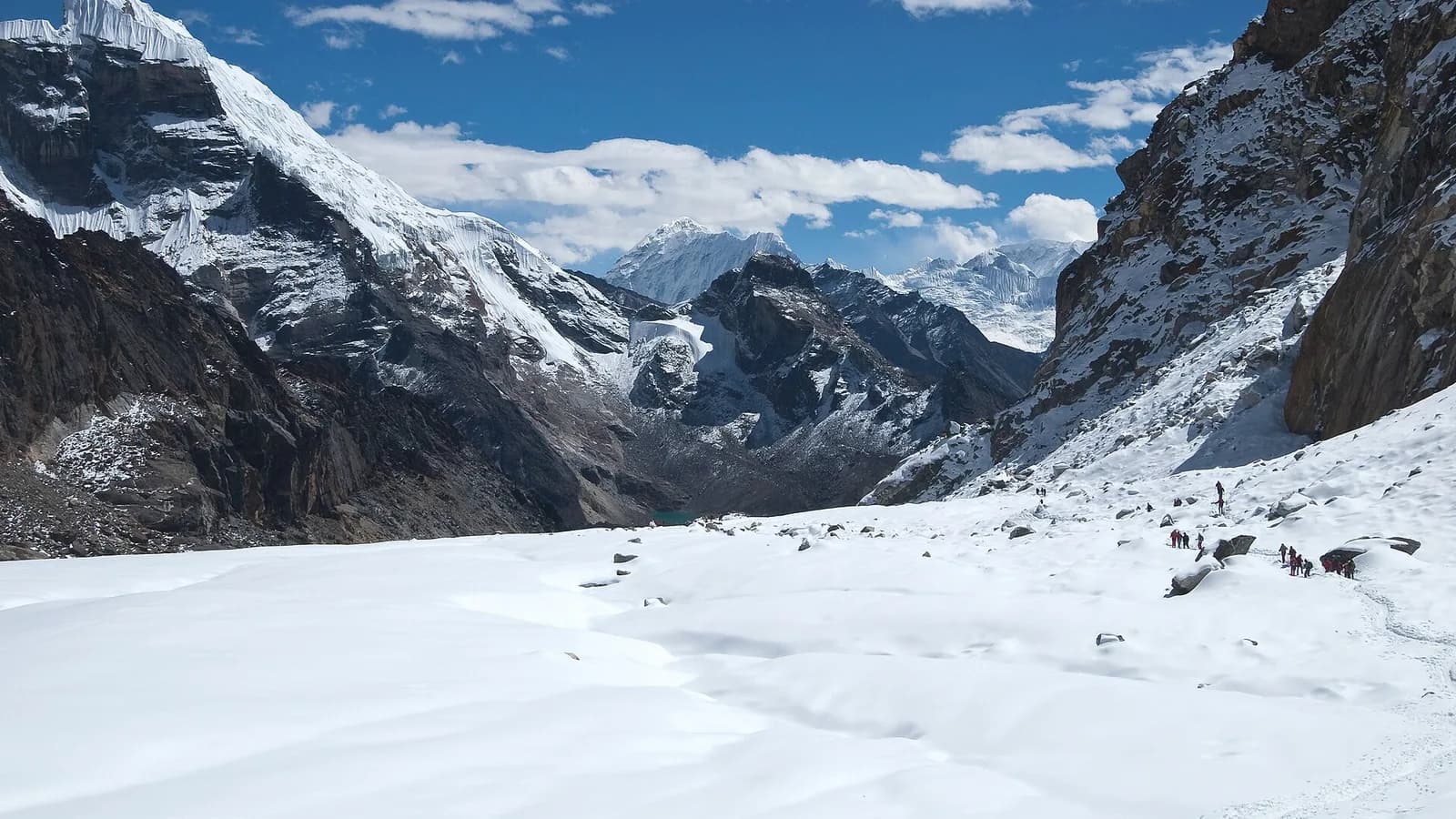
The EBC trek by road is the answer to a simple question: can you reach Everest Base Camp without boarding the notorious flight to Lukla? You can. Instead of a 30-minute hop into one of the world's most weather-dependent mountain airstrips, you spend a day or two grinding east from Kathmandu in a jeep, start walking from a road-head in the lower Solu region, and climb to Base Camp the long way — through Sherpa villages and forest that flight-in trekkers never see. It costs less in airfare, removes the flight-cancellation gamble, and gives your body more time to adjust to altitude. The trade-off is time and a bumpy ride.
This guide explains the routes, the drive, the costs, the seasons, and who the overland approach actually suits.
Key takeaways
- No road reaches Base Camp. Every "by road" option ends at a road-head — Salleri, Phaplu, Surke or Thamdanda — from which you trek on foot through Sagarmatha National Park.
- The drive is long. Kathmandu to Salleri or Phaplu runs roughly 9 to 14 hours; pushing to the Surke road-head can mean 17 to 18 hours total, usually split over two days.
- It is usually cheaper than flying, because you swap an expensive return Lukla flight for a jeep ticket — but extra trekking days claw back part of the saving.
- It adds days, not difficulty. Starting lower means two to four extra trekking days (about a week via Jiri), which doubles as built-in acclimatization.
- Permits and the guide rule are unchanged. Arriving overland does not exempt you from the Sagarmatha National Park and Khumbu Pasang Lhamu permits.
- Season matters more than usual. The unpaved stretch beyond Salleri is best in spring and autumn and can become impassable in the monsoon.
Why skip the Lukla flight at all?
The flight from Kathmandu (or, in peak seasons, from Ramechhap) to Lukla is the standard gateway to the Everest region, but it has a reputation. Lukla's Tenzing-Hillary Airport sits on a short, sloping runway hemmed in by mountains, and flights are routinely delayed or cancelled when cloud rolls in. A weather hold can cost you a day or more at either end — sometimes enough to derail a tight itinerary.
People choose the road route for four main reasons:
- They want to avoid the flight — either out of a genuine fear of flying or to sidestep the cancellation risk that can strand you in Kathmandu or Lukla.
- They want to save money. The return flight is one of the priciest single legs of an Everest trip, and a jeep ticket is a fraction of it.
- They want better acclimatization. Starting low and walking up for extra days is exactly the slow-ascent profile that helps prevent altitude sickness, which is the single biggest reason people fail to reach Base Camp. See our guide to altitude sickness on Nepal treks for why this matters.
- They want the old-school experience of walking through lower Solu, the way trekkers did before Lukla's airstrip existed.
If none of those apply to you, the flight is faster and the obvious choice. For everyone else, read on.
The road options: where the jeep actually drops you
"EBC by road" is not one route. It is a family of options defined by how far east the jeep takes you before your boots hit the trail. The further the road-head, the shorter the walk — and the rougher the drive.
| Road-head | Drive from Kathmandu | Walk to the main EBC trail | Best for | |---|---|---|---| | Jiri | ~7-9 hrs (about 190 km) | ~6-7 trekking days to Namche | The full classic / historical route | | Salleri / Phaplu | ~9-14 hrs | ~3-4 trekking days | The popular balance of drive and walk | | Surke / Thamdanda | ~17-18 hrs (split over 2 days) | ~45 min to ~2 hrs to join the Lukla trail | Shortest possible walk-in |
A few practical notes on each:
Jiri — the classic overland route
Before Lukla's airstrip was built in the 1960s, trekkers — including the early Everest expeditions — started at Jiri. The town still has a small park and memorial to Sir Edmund Hillary and Tenzing Norgay Sherpa, who made the first ascent of Everest in 1953. The Jiri route adds roughly a week of walking through Bhandar, Sete, Junbesi and Nunthala before joining the standard trail near Phakding. Full round-trip itineraries run about 19 to 22 days. It is the most scenic and the most demanding overland choice.
Salleri and Phaplu — the popular middle ground
Most "EBC by road" packages sold today drive to Salleri (around 2,360 m) or nearby Phaplu, the administrative centre of the Solukhumbu district. From here you trek north through lower Solu — past villages such as Junbesi (around 2,700 m) and Taksindu — and meet the main Everest trail in two or three days. This is the sweet spot for travellers who want to skip the flight without committing to the full Jiri marathon.
Surke and Thamdanda — the new road-heads
Road construction has crept ever closer to Lukla. Operators report that the section from Paiya to Surke was completed in late 2024, meaning jeeps and motorbikes can now reach Surke — only a short walk below Lukla. From the Surke or Thamdanda road-head, you can be on the standard trail within roughly 45 minutes to a couple of hours, joining it around Cheplung or Chaurikharka. This gives almost the same start as flying in, minus the flight. The catch is the drive itself: the full Kathmandu-to-Surke run is the longest and roughest of the lot.
What the drive is actually like
Expect an early start — most jeeps leave Kathmandu around 5 to 6 a.m. The first half of the journey heads east on sealed highway through Dhulikhel and along the Arniko corridor toward Khurkot, then turns north into the hills.
The two halves of the drive feel completely different:
- Kathmandu to Salleri is mostly blacktop — long, but on a proper road.
- Beyond Salleri the surface turns to narrow, unpaved mountain track with bumps, switchbacks and exposure. Travellers routinely describe this stretch as rough and tiring, and in places you may need to wait out or even help push through a bad patch after rain.
This is ground travel for people who would rather endure a long road day than risk a cancelled flight — not a comfortable transfer. If you get carsick on winding roads, come prepared. For a wider picture of road conditions and driving in the country, see is it safe to drive in Nepal.
Costs: how the road route compares
Prices in the Everest region move with fuel costs, season and group size, so treat every figure here as an indication and confirm current rates with a registered operator before you book.
| Item | Indicative price | Notes | |---|---|---| | Shared jeep, Kathmandu to Salleri | ~USD 14 per person (as of 2025) | Local jeep ticket; buses are cheaper | | Shared jeep through-ticket to Surke | ~USD 55-65 per person (as of 2025) | Moves with fuel prices | | Private jeep to Salleri / Phaplu | ~USD 290 per jeep (as of 2024-2025) | Mahindra Scorpio or Tata Sumo | | Sagarmatha National Park permit | NPR 3,000 for foreign trekkers (as of 2026) | Same as the flight-in route | | Khumbu Pasang Lhamu permit | NPR 2,000 for foreign trekkers (as of 2026) | Often issued en route |
The headline saving is the flight you do not buy. A return Lukla flight is one of the costliest single items on a standard Everest trip, and a jeep ticket replaces it for a fraction of the price. But the road route also adds trekking days, and every extra day on the trail adds teahouse, food and guide costs. So the real saving is smaller than the airfare gap alone suggests. For a full breakdown of trip costs, compare our Everest Base Camp trek cost guide for 2026.
Permits and rules still apply
Arriving overland changes nothing about the paperwork. For the Everest region you need:
- The Sagarmatha National Park entry permit (NPR 3,000 for foreign trekkers, as of 2026).
- The Khumbu Pasang Lhamu Rural Municipality permit (NPR 2,000 for foreign trekkers, as of 2026), usually issued at a checkpoint such as Lukla or Monjo rather than in Kathmandu.
The old TIMS card is not required for this trek; the local municipality permit replaced it. Nepal's national rule requiring trekkers on designated routes to use a licensed guide hired through a registered agency also still applies, and enforcement in the Everest region has been uneven — so budget for a guide and confirm the current position before you set off. Our full Everest Base Camp permits guide for 2026 covers the details, and do I need a guide for Everest Base Camp digs into the guide rule.
When to go — and when not to
Season is more decisive for the road route than for the flight, because the drive depends on the state of an unpaved mountain road.
- Spring (roughly March to May): stable weather, firm roads, the Everest climbing season in the background. A strong choice.
- Autumn (roughly late September to November): the clearest skies and most reliable conditions of the year. The peak window.
- Monsoon (June to August): avoid. Rain turns the Salleri-to-Surke section to mud, landslides are a risk, and the road can become temporarily impassable. Cloud also smothers the mountain views you came for.
- Winter (December to February): the road can stay drivable — operators reported good conditions on the Kathmandu-to-Surke road as late as December 2025 — but high-altitude cold and possible snow on the upper trail make it a serious proposition.
For a month-by-month view across the country, see the best time to visit Nepal.
Does the road route help with altitude?
This is the quietly compelling argument for going overland. The biggest reason trekkers fail to reach Base Camp is not fitness — it is altitude. Flying into Lukla drops you at around 2,840 m in minutes, whereas the road route starts you lower in Solu and has you walk upward over additional days. That slow, stepped ascent is exactly the profile that helps your body acclimatize.
It is not a substitute for the dedicated rest days at Namche Bazaar (around 3,440 m) and Dingboche (around 4,410 m) that every sensible itinerary includes — you still need those. But the extra walking days through lower Solu give you a gentler on-ramp than the abrupt arrival a flight delivers. Treat the bonus acclimatization as a genuine benefit, not a licence to skip rest days or hurry the climb.
Is the EBC trek by road right for you?
Choose the road route if you fear the Lukla flight or want to dodge its cancellation risk, if you want to trim airfare from the budget, if you have the extra days to spare, or if the idea of walking up through old Sherpa country appeals more than a quick flight. Choose the flight if your holiday is short, your priority is reaching Base Camp with minimum fuss, and a long, rough jeep day sounds worse than a 30-minute flight.
For most people the decision comes down to two resources: time and tolerance for a hard road. If you have plenty of the first and some of the second, the overland approach to Everest Base Camp is one of the most rewarding ways to start the walk. If you are still deciding which trek to do at all, our overview of trekking in Nepal is a good next stop.
Sources
- Travelling Mandala — Everest Base Camp Trek Without Flying to Lukla
- Green Valley Nepal Treks — Everest Base Camp Trek by Road Itinerary, Cost 2025 and 2026
- Nepal Mother House Treks — Kathmandu to Lukla Bus/Jeep, Drive from Kathmandu to Lukla at Surke
- Destinet — Everest Base Camp Trek Without Flying / Jeep Ride to and From Thamdanda
- Nepal Eco Trekking — Everest Base Camp Trek by Road / Jeep
- Himalayan Recreation — How to Obtain Everest Base Camp Trek Permits and Fees in 2026
- Adventure Himalayan Travels — Jiri to Everest Base Camp Trek: 19 Days Itinerary and Cost
Frequently asked questions
- Can you really reach Everest Base Camp without flying to Lukla?
- Yes. You drive east from Kathmandu by jeep to a road-head in the Solu region — usually Salleri, Phaplu, Surke or Thamdanda — and then walk the rest of the way on foot. No road reaches Base Camp itself; the last stretch is always a trek through Sagarmatha National Park.
- How long does the drive from Kathmandu take?
- Reaching Salleri or Phaplu typically takes 9 to 14 hours depending on road conditions, usually as a single long day. If you push on to the newer road-head near Surke or Thamdanda, operators describe the full Kathmandu-to-Surke drive as 17 to 18 hours in good conditions, normally split with an overnight in Salleri.
- How much does the jeep cost?
- Shared jeep tickets from Kathmandu to Salleri were quoted around USD 14 per person, and through-tickets to Surke roughly USD 55 to 65 per person (as of 2025), with prices moving with fuel costs. A private Mahindra Scorpio or Tata Sumo to Salleri or Phaplu was quoted near USD 290 per jeep (as of 2024-2025).
- How many extra days does the road route add?
- Driving in and out instead of flying adds roughly two to four trekking days versus the standard Lukla itinerary, because you start lower and walk up through Solu. The classic full overland route from Jiri adds about a week.
- Is the EBC road route cheaper than flying?
- Often, yes. A return Lukla flight is one of the most expensive legs of the trip, so swapping it for a jeep ticket can cut transport costs noticeably. You trade that saving for extra trekking days, which add teahouse and guide costs, so the total gap is smaller than it first looks.
- What is the best time of year to drive to EBC?
- Spring (roughly March to May) and autumn (roughly late September to November) give the most stable weather and the firmest roads. Avoid the June to August monsoon, when the unpaved sections beyond Salleri turn muddy and can become temporarily impassable.
- Do I still need permits if I arrive by road?
- Yes. The transport method does not change the rules. You still need the Sagarmatha National Park entry permit and the Khumbu Pasang Lhamu Rural Municipality permit, and Nepal's national guide rule still applies. Carry the same documents you would for the flight-in route.
- Is the jeep ride comfortable?
- The Kathmandu-to-Salleri leg is mostly sealed road, but the section beyond Salleri is rough, narrow mountain track with bumps and switchbacks. Travellers commonly describe it as long and tiring rather than relaxing, so it suits people who prefer ground travel over a feared flight, not those seeking comfort.
Related posts
Everest Base Camp Without Flying: The Overland Route
How to reach Everest Base Camp without flying — Jiri and Salleri jeep routes, the classic Hillary trail, extra days, altitude perks and real trade-offs.
Read postHow Hard Is the Everest Base Camp Trek? (2026)
How hard is the Everest Base Camp trek? An honest look at altitude, daily distance, training and the Lukla flight — so you know what to expect.
Read postHow Many Days Is the Everest Base Camp Trek?
How many days is the Everest Base Camp trek? The honest answer: 12 on the trail, 14 door-to-door, with shorter heli and longer Gokyo options compared.
Read post