Teej Festival Nepal: Red Saris, Fasting, and Dance
Teej festival in Nepal explained for travelers — the three days, the red saris, the nirjala fast, the dancing at Pashupatinath, and how it is changing.
Teej is the one day a year when Pashupatinath turns into a sea of red, and the loudest sound in Kathmandu is women singing.
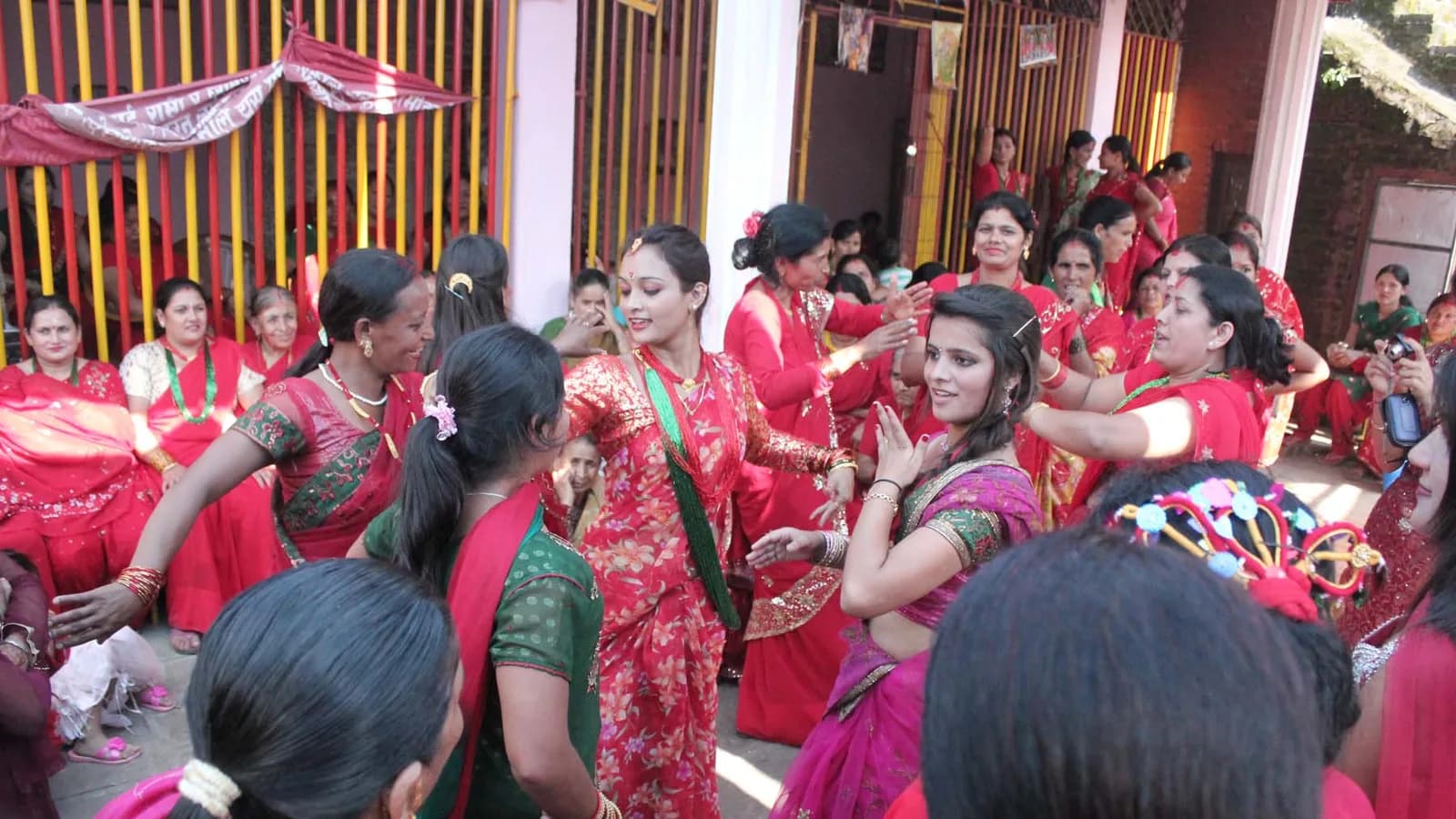
For most of the year, Kathmandu's soundtrack is traffic and temple bells. For one day in late summer, it becomes the sound of thousands of women singing together, dressed head to toe in red, fasting in the monsoon heat. That day is the heart of the Teej festival — Nepal's great women's celebration, and one of the most visually overwhelming events a traveler can stumble into.
Teej is devotional, joyful, exhausting, and quietly changing. It mixes strict fasting with lavish feasting, ancient mythology with modern debates about women's rights. If your trip lands in the Bhadra month, this guide explains what is actually happening, where to witness it, and how to read a festival that is more layered than it first appears.
Key takeaways
- Teej is a women's festival in Nepal honoring the goddess Parvati and her devotion to Shiva, falling in the month of Bhadra (usually late August or early September).
- It follows the lunar calendar, so the date shifts every year — always confirm the year's date rather than trusting a fixed future date.
- The classic structure is three days: Dar Khane Din (feasting), Hartalika Teej (the main fasting day), and Rishi Panchami (purification).
- On the main day many women keep a nirjala fast — no food and no water for around 24 hours — while dressed in red and gathering to sing and dance.
- Pashupatinath Temple in Kathmandu is the most famous gathering point, turning into a sea of red.
- Teej is evolving: alongside tradition, it now hosts conversations about women's empowerment, and also some honest criticism about cost and old gender expectations.
What Teej is and who it is for
Teej is, first and foremost, a festival of and for women. At its center is a story from Hindu mythology: the goddess Parvati longed to marry Shiva, and undertook severe penance and fasting — across many lifetimes, the legend says — to win him. Moved by her devotion, Shiva accepted her. Teej commemorates that union and that devotion.
In its traditional form, married women fast and pray for the long life and wellbeing of their husbands, while unmarried women may fast in the hope of a good partner. But that framing is widening. Increasingly, Teej is celebrated as a festival of womanhood itself — a rare, sanctioned space for women to gather, dress up, sing freely, and step out of daily routines. We will come back to that tension later, because it is part of what makes Teej so interesting.
The name itself is humble: "Teej" refers to the third day after the new moon, when the festival's main observances begin.
When Teej happens
Teej is tied to the lunar calendar, falling in the Nepali month of Bhadra, on the third day of the waxing moon (Shukla Paksha). In the Western calendar, that usually lands in late August or early September, right in the monsoon season.
| Detail | Teej | | --- | --- | | Calendar | Lunar (Bhadra month, Shukla Paksha) | | Western timing | Late August to early September | | Season | Monsoon (warm, humid, rainy) | | Core length | 3 days |
Because it is lunar, the date moves around the calendar each year, sometimes by a couple of weeks. Do not plan a non-refundable trip around a date you read in an article — including this one. Confirm the year's Teej date with the Nepal Tourism Board or a reliable Nepali calendar close to your travel dates. For seasonal context, our guide to Nepal's weather by month explains what late August and September actually feel like (warm, green, and wet), and our best time to visit Nepal guide puts the monsoon shoulder season in perspective.
The three days of Teej
Traditionally, Teej unfolds over three distinct days, each with its own mood.
Day 1 — Dar Khane Din (the feast)
Teej opens, somewhat counterintuitively, with a feast. On Dar Khane Din, women gather — often at their maternal homes, or these days at restaurants and party venues — to eat a rich, generous meal called dar. The idea is to eat well before the fast. There is music, there is dancing, and there is an unmistakable sense of reunion, as women return to family and old friends. In practice, dar gatherings now often stretch across several days leading up to the main day.
Day 2 — Hartalika Teej (the fast)
This is the heart of the festival. On Hartalika Teej, many women keep a nirjala fast — nirjala meaning "without water." For roughly 24 hours they take no food and, in the strictest observance, not even a sip of water, all while praying for their families. The name "Hartalika" comes from the myth in which Parvati's friend (aalika) helped spirit her away (harit) to avoid an unwanted marriage, allowing her union with Shiva.
Dressed in red, women stream to temples to perform puja, offer bel (bilva) leaves to Shiva, light lamps, and sing. The atmosphere is at once intensely religious and deeply communal — devotion and celebration braided together.
Day 3 — Rishi Panchami (the purification)
Teej closes with Rishi Panchami, a day of ritual purification. Women honor the seven sages (saptarishi), bathe in ritual fashion, and make offerings. It formally ends the fasting cycle and rounds off the festival.
The red saris and the sea of color
If one image defines Teej, it is the color red. Red is considered auspicious for married women in Hindu tradition — a symbol of good fortune and a healthy marriage. So on the main day, women dress in red saris, red tika on the forehead, and red and green bangles (the green pote, or glass-bead necklaces, are a married woman's mark).
The effect, en masse, is staggering. Temple courtyards and riverside steps fill with thousands of women in scarlet and green, moving and singing together. For a photographer, it is one of the most striking scenes in the entire Nepali calendar. For everyone else, it is simply unforgettable.
Pashupatinath: the epicenter
The single most famous place to witness Teej is Pashupatinath Temple in Kathmandu, the holiest Shiva shrine in Nepal. From before dawn on the main day, women in red pour into the temple complex and along the ghats of the Bagmati River. They queue for hours to worship, offer flowers and bel leaves, light oil lamps, and sing devotional songs in clapping, swaying groups.
A practical note for travelers: the inner sanctum of Pashupatinath is open only to Hindus, but the wider complex, the riverbanks, and the surrounding areas are open to all and are where most of the visible celebration happens. If you plan to visit, read our Pashupatinath temple guide for foreigners first — it covers access, the ghats, and what you can and cannot see.
Beyond Pashupatinath, you will find Teej celebrations at Shiva temples across Kathmandu, Pokhara, Lalitpur, and towns nationwide, as well as song-and-dance gatherings in homes, community halls, and public squares.
The music and dance
Teej is not a quiet festival. Teej songs are a genre of their own, released by artists weeks in advance, and the dancing is energetic and collective. Traditionally the songs expressed women's joys and sorrows — the ache of being far from a maternal home, the difficulties of married life — sung in a setting where it was socially acceptable to voice them.
That tradition has expanded. Modern Teej songs increasingly take on themes of women's rights, education, and gender equality, turning the festival into a kind of annual cultural conversation as much as a celebration. Song-and-dance competitions and live-streamed events at Pashupatinath now draw enormous audiences.
A festival that is changing
Here is where Teej gets genuinely thought-provoking, and where an honest guide should not look away.
On one hand, Teej has become a platform for women's empowerment. NGOs and women's groups use the occasion to talk about education, health, gender equality, and domestic violence. Many women describe it as a precious, sanctioned space to gather, perform, and be heard.
On the other hand, the festival draws real criticism. Some commentators note that its core message still centers a wife's devotion to her husband. Others point out that even a festival "for women" can come loaded with rules about how women should look and behave. And there is growing concern about commercialization and cost — the pressure to buy new saris and jewelry, the expensive dar parties, and the worry that a cultural and devotional event is drifting toward an extravagant, marketed spectacle.
None of this is for an outside visitor to judge. But knowing the conversation exists helps you watch Teej as the layered, contested, very-much-alive tradition it is, rather than a simple postcard.
How to experience Teej respectfully as a traveler
Teej is welcoming to respectful observers. A few guidelines will help you fit in rather than intrude.
- Dress modestly and consider red. If you want to join the spirit, wearing red or a kurta is a warm gesture; at minimum, dress conservatively, especially at temples. See our temple etiquette guide.
- Ask before close-up photos. Wide shots of crowds and temples are fine. For portraits of individual women, ask first — a smile and a gesture toward your camera is enough.
- Remember it is partly a fasting day. Many women around you have had no food or water for hours in the heat. Be patient in queues and crowds.
- Respect the inner sanctum rules. At Pashupatinath, non-Hindus cannot enter the main shrine. Enjoy the ghats and the wider complex instead.
- Solo female travelers will find it especially welcoming. Teej is a women's space, and joining a group of singing women is one of the friendliest experiences Nepal offers. Our solo female travel guide has broader tips.
If you want to mark the occasion with a gift or souvenir, red bangles and pote are inexpensive and meaningful — our guide on what to buy in Nepal has more ideas.
A few useful phrases
- "Subha Teej" — Happy Teej
- "Ramro chha" — It's beautiful / nice
- "Photo khichna hunchha?" — May I take a photo?
- "Tapailai Teej kasto chha?" — How is your Teej?
Is Teej worth planning around?
If your travel window touches late August or early September, Teej is a remarkable thing to witness — visually it is one of the most arresting days in Nepal, and emotionally it offers a window into Nepali womanhood you simply cannot get on an ordinary temple visit. Build a morning at Pashupatinath into your plans, dress respectfully, and let the wave of red and song carry you.
Just confirm the year's date before you commit, come ready for monsoon weather, and watch with the awareness that Teej is not a frozen tradition but a living one — devotional, joyful, and quietly debating its own future.
Sources
Frequently asked questions
- When is the Teej festival in Nepal?
- Teej falls in the Nepali month of Bhadra, usually late August or early September, following the lunar calendar, so the exact date shifts each year and should be confirmed for your travel year.
- What is the Teej festival about?
- Teej is a women's festival honoring the goddess Parvati and her devotion to Shiva, blending fasting, prayer, feasting, red saris, and group singing and dancing.
- How long does Teej last?
- Teej is traditionally a three-day festival: Dar Khane Din feasting, the main Hartalika fasting day, and Rishi Panchami purification, though celebrations often spread over a longer period.
- What is the nirjala fast at Teej?
- On the main day many women keep a nirjala fast, going without food and even water for around twenty-four hours while praying for their families' wellbeing.
- Why do women wear red during Teej?
- Red is considered auspicious for married women in Hindu tradition, so women dress in red saris, red tika, and red and green bangles, making temples a striking sea of red.
- Where is the best place to see Teej in Kathmandu?
- Pashupatinath Temple is the most famous Teej gathering point, where thousands of women in red come to sing, dance, and worship throughout the main day.
- Can tourists watch the Teej festival?
- Yes, the public celebrations are open to respectful observers, though Pashupatinath's inner temple is for Hindus only and you should ask before photographing people closely.
- Is Teej only for married women?
- No, married women pray for their husbands and families while unmarried women may also fast and join in, and the festival increasingly celebrates womanhood more broadly.
Related posts
Maha Shivaratri at Pashupatinath — Festival Guide for Visitors
Maha Shivaratri turns Pashupatinath into Nepal's biggest Shiva pilgrimage. What to expect from the crowds, sadhus, and night vigil, and how to visit.
Read postThe Dog Festival of Nepal: A Short Visitor's Guide
The dog festival of Nepal, Kukur Tihar, is the viral day when every dog gets a garland and a tika. A quick guide to what it is and where to see it.
Read postGai Jatra: Nepal's Cow Festival of Grief and Humor
Gai Jatra is Nepal's festival of cows — a Newar procession for the year's dead that turns grief into satire, costume, and laughter. A traveler's guide.
Read post