Rato Machhindranath Jatra: Patan's Chariot Festival
Rato Machhindranath Jatra is Nepal's longest chariot festival in Patan — a 60-foot nail-free chariot, the rain god, and Bhoto Jatra, explained for visitors.
A god of rain, a chariot taller than the houses, and a festival that takes two months to cross a single city.
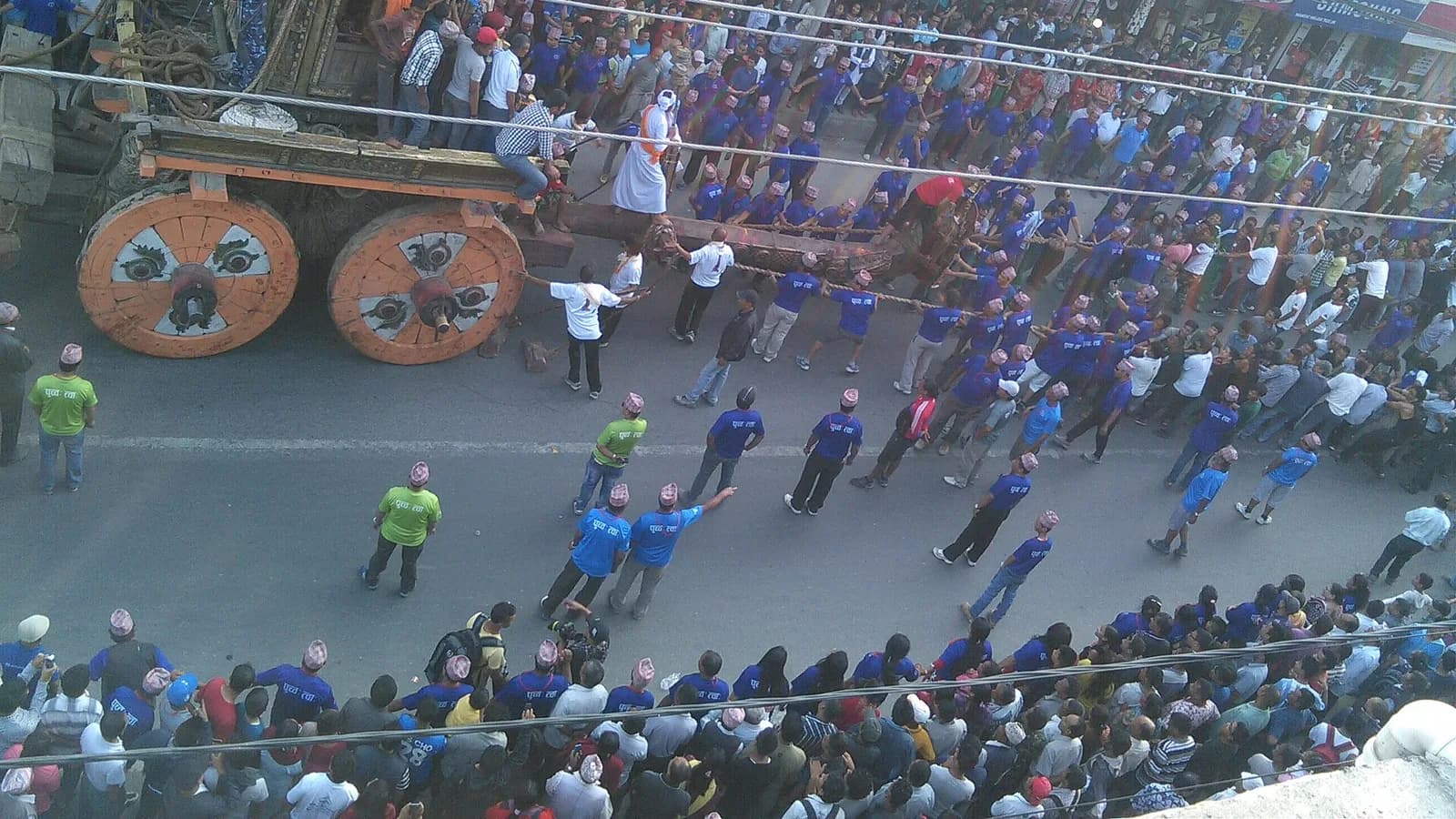
If you want to understand the Kathmandu Valley's deepest cultural roots, skip the postcard temples for an afternoon and find the chariot. Rato Machhindranath Jatra is the longest chariot festival in Nepal — a sprawling, weeks-long pilgrimage on wheels that hauls a rain god through the medieval lanes of Patan (Lalitpur) each spring. It is not a single-day spectacle you catch and tick off. It is a slow-moving, living ritual that turns an entire city into a stage, and it ends with one of the most peculiar and beloved ceremonies in the country: the showing of a sacred vest.
This guide explains who the god is, why a 60-foot tower of wood and rope is dragged across town by hand, what the famous Bhoto Jatra actually is, and how to experience it all respectfully as a visitor.
Key takeaways
- Rato Machhindranath Jatra is Nepal's longest chariot festival, held over roughly two months in spring (commonly April or May into early June) in Patan (Lalitpur).
- The festival honours Rato Machhindranath, a deity of rain and compassion known in Newar as Bunga Dyah and as Karunamaya — revered by both Buddhists and Hindus, which makes it a rare shared celebration.
- A 60-foot chariot built without a single nail is pulled by hand through Patan's old streets, from Pulchowk to Jawalakhel, over several staged days.
- The grand finale is Bhoto Jatra, when an official displays a jewel-studded sacred vest to the crowd from the chariot.
- The deity lives half the year in Patan and half in the nearby village of Bungamati; on a roughly twelve-year cycle, the chariot is built in Bungamati and pulled all the way to Patan.
- Always confirm the exact dates for your travel year, since they shift with the lunar calendar.
Who is Rato Machhindranath?
The deity at the heart of this festival wears many names, and that is precisely the point. In Newar he is Bunga Dyah; he is also called Karunamaya, "the compassionate one." The Nepali name Rato Machhindranath means "Red Machhindranath" — rato refers to the red colour of the deity's image.
What makes him remarkable is how he bridges two faiths. To Vajrayana Buddhists he is understood as an aspect of Avalokiteshvara (Lokeshwor), the bodhisattva of compassion. To many Hindus he is linked to the saint Machhindranath. Above all, across both communities, he is believed to bring the monsoon rains — the lifeblood of a valley whose rice paddies depend on a timely arrival of water.
That dual identity is why you will see Buddhist and Hindu devotees, priests, and rituals woven together throughout the festival without contradiction. In a world where religious lines are often sharply drawn, the chariot of Rato Machhindranath rolls right across them.
The legend: a drought, a journey, and the rain
The story most often told traces the festival back more than a thousand years, to a catastrophic twelve-year drought that gripped the Kathmandu Valley. By tradition, the sage Gorakhnath had captured the rain-bringing serpent deities (the Nagas) and sat in meditation upon them, withholding the rains.
To break the crisis, a trio set out on a long journey to Kamaru Kamakhya in Assam, India, to invite the deity to the valley: King Narendra Deva of Bhaktapur, the Tantric priest Bandhudatta Acharya, and a farmer of Patan, Lalit Jyapu (Ratnakar). The three represented the valley's ancient cities. When the deity arrived, the story goes, the rains returned and the land was reborn.
Historians place the festival's institution in the reign of King Narendra Deva (640–683 AD), tied to celebrating the deity's arrival and the end of the drought. Whatever the precise history, the festival's purpose has stayed constant for centuries: a public plea for rain, prosperity, and the well-being of the valley.
The chariot: 60 feet of wood, bamboo, and rope
The chariot itself is an engineering marvel, and arguably the real star of the show.
Each year, builders assemble a towering structure — commonly cited at around 48 to 60 feet tall — at Pulchowk, at the western end of Lalitpur. It is built almost entirely by hand, using timber, bamboo, and natural-fibre rope, following Newar techniques handed down for generations. There are no nails and no metal joints. The whole leaning, swaying tower is lashed together and balanced on four massive wooden wheels.
A tall, pine-needle-clad spire rises from the chariot, and the red image of the deity is enthroned inside. A smaller companion chariot, dedicated to the deity Chakuwa Dyah, accompanies it during the procession.
When it is finally hauled into motion by hundreds of people pulling on thick ropes, the chariot creaks, towers overhead, and occasionally lurches alarmingly — part of the drama (and part of why you keep your distance).
The route through Patan
The procession does not happen all at once. It advances in stages over several days, resting at appointed stops along the way as the chariot is pulled deeper into the old city.
| Stage | Landmark | Note | | --- | --- | --- | | Start | Pulchowk | Where the chariot is built and the journey begins | | Through | Gabahal, Mangal Bazaar, Sundhara | Heart of historic Patan, near Patan Durbar Square | | Through | Chakrabahil, Lagankhel, Kumaripati | Busy old-city junctions | | Finish | Jawalakhel | Site of the climactic Bhoto Jatra |
Pulling the chariot is considered an act of devotion, and on certain stretches the work is divided by tradition — one segment, for example, is pulled exclusively by men. Crowds line the rooftops and balconies along the way, and the air fills with music, chanting, and the smell of incense.
If you are mapping out the surrounding area, our Patan (Lalitpur) guide and the Patan Durbar Square overview will help you find your bearings between procession days.
Bhoto Jatra: the showing of the sacred vest
The festival's emotional and ceremonial climax is Bhoto Jatra, the "Festival of the Vest," held at Jawalakhel.
On the appointed day, often in the presence of the head of state and huge crowds, an official climbs onto the chariot and holds up a jewel-studded black vest (bhoto) from all four sides so that everyone gathered can see it. That is the entire ceremony — and yet hundreds of thousands of people come to witness it.
The legend behind the vest
The vest comes with its own story. By tradition, a farmer once received the jewel-studded garment from a Naga (serpent) deity — in some tellings, as thanks for curing the serpent king's wife. The vest was later lost or stolen, and years afterward the farmer spotted it being worn at the festival. A dispute over ownership broke out, and with no way to settle it, the vest was entrusted to Rato Machhindranath for safekeeping. So each year it is shown to the public, as if still inviting its rightful owner to step forward and claim it.
The completion of Bhoto Jatra signals that the festival has reached its end, and that the deity can begin the next phase of his year.
Bungamati and the twelve-year cycle
Rato Machhindranath does not live in one place. He keeps two homes and moves between them.
For about six months, the deity resides in his temple in the urban heart of Patan. For the other half of the year, he is carried south to the farming village of Bungamati, a few kilometres from Patan, often described as his "first home." This back-and-forth between city and village is itself a cherished ritual.
There is also a rarer rhythm layered on top. In most years the chariot is built in Patan. But on a roughly twelve-year cycle, the chariot is constructed in Bungamati and pulled the entire long distance to Patan before the usual procession even begins. That makes a "Bungamati year" an especially significant and elaborate edition of the festival — worth knowing about if you are trying to choose which year to visit.
If you enjoy this kind of deeply local, living tradition, you may also like the valley's other great chariot events: Bisket Jatra in Bhaktapur and Indra Jatra in Kathmandu, the latter famous for the chariot of the living goddess Kumari.
When does it happen, and how to plan your visit
Because the festival is tied to the lunar calendar, its dates shift from year to year. As a rough guide, the chariot building and procession unfold across spring — commonly from April or May, with Bhoto Jatra often landing around late May or early June. The whole affair stretches across roughly two months, so even a multi-week trip will only catch part of it.
A few practical notes for travellers:
- Confirm the year's dates first. Look for the Bhoto Jatra date in particular, since that is the single biggest day and is often a public holiday in the Kathmandu Valley.
- Watching the street procession is free. If you also want to explore Patan Durbar Square, note that foreigners pay a separate entry fee there — carry cash and your passport.
- Mind the crowds. Chariot-pulling days and Bhoto Jatra get dense and high-energy. Stay clear of the ropes and the chariot's path, watch from raised ground or a rooftop café if you can, and keep valuables secure.
- Be a respectful guest. This is a sacred religious event, not a show staged for tourists. Ask before photographing people up close, follow the crowd's cues, and dress modestly. Our Nepal etiquette guide covers the basics.
What to expect on a procession day
Don't expect a fixed schedule posted at a gate. The chariot moves when the priests, astrologers, and pullers are ready, which can mean long pauses and sudden bursts of motion. Settle in, follow the sound of the crowd, and treat the waiting as part of the experience. A short stop at the nearby Durbar Square, a cup of tea on a balcony, and patience will reward you far more than rushing.
Sources
- Rato Machindranath Jatra — Wikipedia
- The Legendary Tale of Rato Machindranath Jatra — Inside Himalayas
- Rato Machhindranath Jatra: A Festival That Moves With the City — Hotel Shanker
- Kathmandu Valley's longest festival begins — Makalu Khabar
- Rato Machhindranath fest concludes with Bhoto Jatra — The Rising Nepal
- Rato Machhindranath Jatra and Bhoto Jatra in Lalitpur — Nepal Kameleon Holidays
- Rato Machhindranath Jatra — Volunteers Initiative Nepal
Frequently asked questions
- When is Rato Machhindranath Jatra celebrated?
- It runs over roughly two months in spring, usually from April or May through early June, with the climactic Bhoto Jatra often falling around late May or the start of June, so confirm the exact dates for your travel year.
- Where does Rato Machhindranath Jatra take place?
- The chariot procession winds through the old streets of Patan (Lalitpur), starting at Pulchowk and ending at Jawalakhel, with the deity linked to the nearby village of Bungamati south of the city.
- What is the Bhoto Jatra?
- Bhoto Jatra is the festival's finale at Jawalakhel, where an official holds up a jewel-studded black vest from all four sides of the chariot so the gathered crowd can see it, tied to an old legend about a disputed garment.
- Who is Rato Machhindranath?
- He is a rain and compassion deity known in Newar as Bunga Dyah and as Karunamaya, revered by Buddhists as an aspect of Avalokiteshvara and by Hindus as linked to the saint Machhindranath, which makes the festival a shared Hindu-Buddhist event.
- Why is the chariot built without nails?
- The towering wooden chariot is assembled by hand using only timber, bamboo, and natural-fibre rope following traditional Newar techniques passed down for centuries, with no metal nails or joints.
- Is Rato Machhindranath Jatra free to watch?
- Watching the chariot in the public streets is free, though Patan Durbar Square charges foreigners a separate entry fee, so carry cash and your passport if you plan to combine the two.
- What is the every-12-year procession?
- Most years the chariot is built in Patan, but on a roughly twelve-year cycle it is constructed in Bungamati and pulled all the way to Patan first, making that an especially significant year for the festival.
- Is the festival safe and suitable for tourists?
- Yes, foreign visitors are welcome to watch, but the chariot pulling and the Bhoto Jatra crowds get dense and energetic, so keep clear of the ropes, guard your valuables, and watch from raised ground.
Related posts
Bisket Jatra: Bhaktapur's New Year Chariot Festival
Bisket Jatra is Bhaktapur's wild new year festival — a chariot tug-of-war, a giant pole, and the Nepali solar new year, explained for travelers.
Read postGai Jatra: Nepal's Cow Festival of Grief and Humor
Gai Jatra is Nepal's festival of cows — a Newar procession for the year's dead that turns grief into satire, costume, and laughter. A traveler's guide.
Read postIndra Jatra: The Gods, Days and Rituals Decoded
A field decoder for Indra Jatra — what the Yosin pole, Sweta Bhairav, Pulukisi, Lakhe and the named festival days actually mean in Kathmandu.
Read post