Everest Base Camp: What It Actually Is
A plain-English guide to Everest Base Camp — where it sits, the two base camps, the climbing-season tent city, and why you can barely see Everest from it.
It is not a summit, not a building, not even a fixed dot on a map — just a patch of glacier where the climbing begins.
Almost everyone has heard of Everest Base Camp, yet very few can say what it actually is. It is not the summit of Everest. It is not a lodge or a monument. It is not even a permanent point you could pin on a map with certainty — it sits on a glacier that creeps downhill a little every year. This post is the plain-English answer to "but what is it?", and it pairs with our full Everest Base Camp trek guide, which covers the day-by-day route, costs and planning in detail.
Think of this as the context, not the itinerary: where Base Camp sits, why there are two of them, what the famous "tent city" really is, and why you can stand right there and barely see the mountain itself.
Key takeaways
- Everest Base Camp (the southern one, in Nepal) sits at about 5,364 m on the Khumbu Glacier, and its exact position drifts as the glacier moves.
- There are two base camps — South in Nepal and North in Tibet — on opposite sides of the mountain.
- It is the staging point for climbers, not a summit; the real climb begins above it through the Khumbu Icefall.
- In spring, the South camp becomes a temporary tent city of expeditions; the rest of the year it is mostly bare glacier.
- You can barely see Everest's summit from Base Camp — the classic view is from Kala Patthar nearby.
- The whole area lies inside Sagarmatha National Park, a UNESCO World Heritage Site since 1979.
What "base camp" really means
In mountaineering, a base camp is simply the lowest, safest, most established camp an expedition uses — the place where climbers eat, sleep, acclimatize and store gear before pushing up the mountain in stages. For Everest, that staging point is a stretch of the Khumbu Glacier at roughly 5,364 m (about 17,598 ft) on the Nepali side.
It is deliberately not on the mountain proper. Above it the terrain turns technical and dangerous very quickly, so the camp sits on comparatively stable glacier below the first major obstacle. From here, climbers spend weeks ferrying loads up to a series of higher camps before any summit attempt.
For trekkers, the meaning flips. You are not staging anything — Base Camp is the destination. You walk in, take it in, and walk back out. Crucially, trekkers do not sleep at Base Camp; the nearest lodges are at Gorak Shep, a short walk away. The figures below come from established Everest sources and the UNESCO listing (linked at the end), but glaciers move and logistics shift, so treat them as well-supported ranges rather than fixed points.
The numbers at a glance
| Feature | Figure | |---|---| | South Base Camp elevation (Nepal) | ~5,364 m (~17,598 ft) | | Sits on | Khumbu Glacier (among the highest glaciers on Earth) | | Mount Everest summit | 8,848 m | | Nearest trekker lodges | Gorak Shep (~5,164 m) | | Best viewpoint | Kala Patthar (~5,545–5,643 m) | | Protected area | Sagarmatha National Park (124,400 hectares) | | UNESCO World Heritage since | 1979 |
There are two Everest Base Camps
This surprises a lot of first-time visitors: Everest has two base camps, one on each side of the international border.
- South Base Camp lies in Nepal, on the Khumbu Glacier. This is the one almost every trekker means, and the one you reach on the classic walk in from Lukla.
- North Base Camp lies in Tibet (China), on the opposite, drier side of the mountain, and is reached by road rather than a long trek.
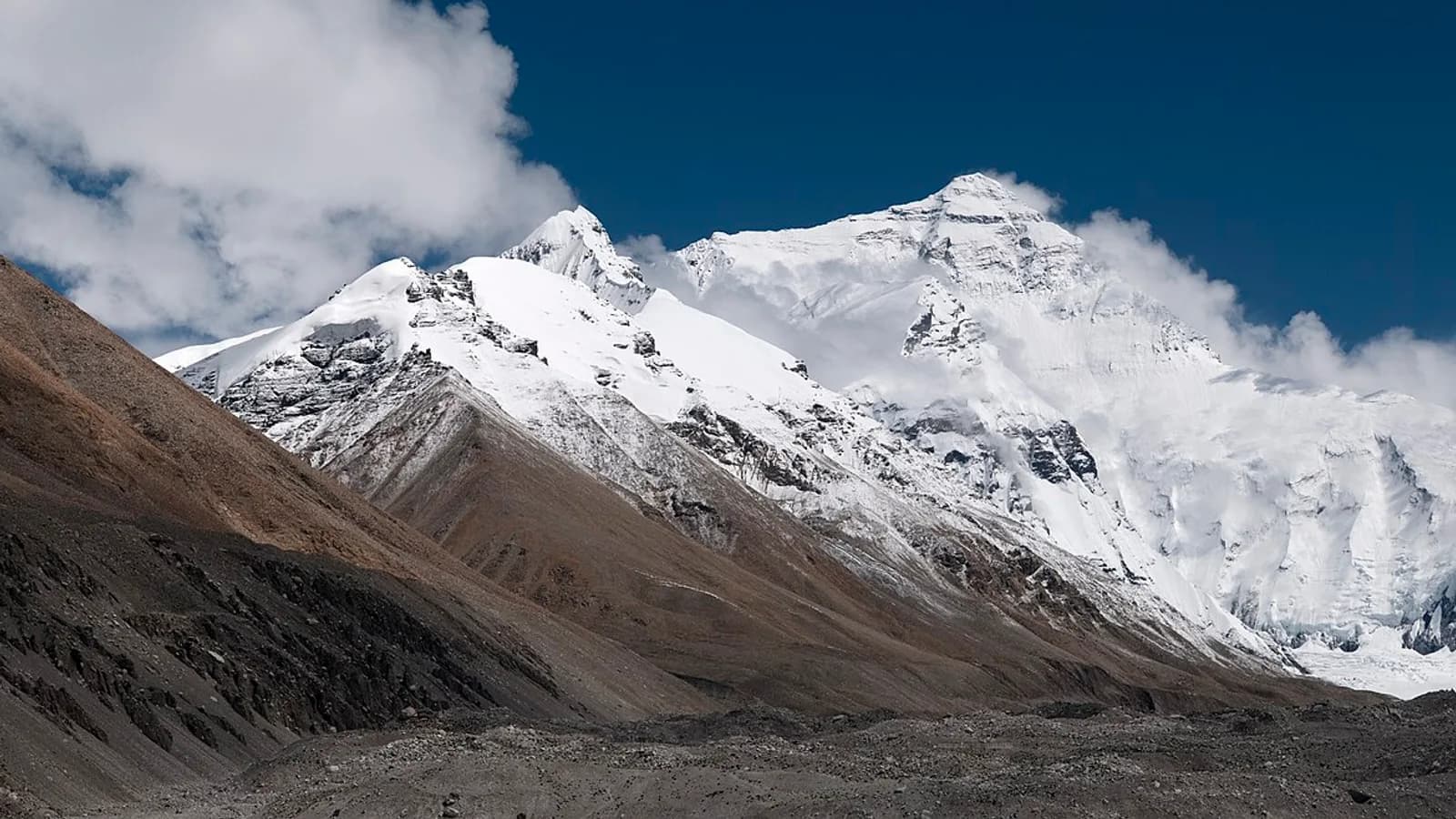
They are not linked by any trekking trail — the summit and its ridges sit between them. So when people say "I'm going to Everest Base Camp," they almost always mean the southern, Nepali camp, reached on foot through Sherpa country. Our hero photo here actually shows the north face of Everest from the Tibetan side, a reminder that the mountain looks completely different depending on where you stand.
Why you can barely see Everest from Base Camp
Here is the great irony of the trek. You walk for days to reach the foot of the highest mountain on Earth — and from Base Camp itself, you can hardly see its summit. Closer ridges and the bulk of the West Shoulder block the view, so what you mostly see is the chaotic jumble of the icefall and the surrounding walls.
The postcard shot of Everest glowing at sunrise is almost always taken from Kala Patthar ("Black Rock" in Nepali), a dark hill above Gorak Shep that rises to roughly 5,545–5,643 m. From there the summit stands clear above the Khumbu Glacier, which is exactly why nearly every itinerary builds in a pre-dawn climb of Kala Patthar rather than relying on the view from Base Camp. If a clear mountain view matters most to you, Kala Patthar — not Base Camp — is the real prize. We compare the experience with other classic walks in our Everest Base Camp vs Annapurna Base Camp piece.
The tent city: Base Camp in climbing season
For most of the year, the South Base Camp is a quiet, almost featureless expanse of rock and ice. But for a few weeks each spring, it transforms.
During the main climbing season, hundreds of expedition members and their support teams move in, and Base Camp becomes a temporary tent city: rows of sleeping tents, dining and kitchen tents, communication setups, and medical facilities, all pitched directly on the glacier. It functions like a pop-up village at altitude, complete with its own rhythms and hazards — and it is dismantled and carried out again when the season ends.
This is worth knowing before you go, because it shapes what you will actually see:
- Trek in spring (roughly March–May) and you may witness the full expedition circus — colourful tents, climbers acclimatizing, the buzz of summit preparations.
- Trek in autumn (roughly September–November), the other prime trekking window, and you will usually find the glacier largely empty of expeditions, with clearer skies but little human activity at the camp itself.
Neither is "better" — but if seeing the climbing operation is part of the appeal, the season you choose decides whether you find a tent city or a bare stretch of moraine. For the trade-offs in weather and crowds, see best time for Everest Base Camp trek.
What lies above: the Khumbu Icefall
Stand at Base Camp and look up the glacier, and you are looking at the start of the climb proper — the Khumbu Icefall. This is a steep, constantly shifting section of the Khumbu Glacier riddled with house-sized ice towers (seracs) and deep crevasses. As the glacier grinds downhill, blocks of ice collapse and crevasses open without warning.
It is the first major obstacle climbers face above Base Camp, and one of the most feared parts of the entire route. Crossing it safely requires fixed ropes, ladders, mountaineering experience, and careful timing — usually in the cold pre-dawn hours when the ice is most stable. This is precisely where the trekker's world ends and the mountaineer's begins. Walking to Base Camp needs fitness and good acclimatization; going beyond it into the icefall is a different undertaking entirely, with its own expedition permit and serious risk.
The landscape and culture around it
Everest Base Camp does not sit in a vacuum. It lies deep inside Sagarmatha National Park, the protected heart of Nepal's Everest region.
- A UNESCO World Heritage Site since 1979, the park covers about 124,400 hectares of Solu-Khumbu.
- Beyond Everest itself, it shelters seven peaks over 7,000 m, along with dramatic glaciers, deep valleys and rare high-altitude wildlife.
- It is the homeland of the Sherpa people, whose villages, monasteries and mountaineering heritage give the trek its distinctive character.
The walk to Base Camp threads through this landscape — past the trading hub of Namche Bazaar, hillside monasteries, and yak pastures — so the journey is as much cultural as it is alpine. To go deeper on the people whose lives are bound up with the mountain, read about the Sherpa people.
A short history: how Base Camp earned its fame
Base Camp's place in the popular imagination is tied to one date. On 29 May 1953, Tenzing Norgay and Edmund Hillary became the first climbers confirmed to reach Everest's summit, climbing the South Col route on a British expedition led by John Hunt. That ascent — and the long line of expeditions before and after it — turned the Khumbu Glacier staging point into the most famous base camp on the planet.
Today, that legacy cuts two ways. The South Base Camp remains the launch pad for hundreds of summit hopefuls each spring, while the trek to reach it has become a bucket-list walk in its own right for travellers with no intention of climbing a metre higher. Both groups end up in the same spot on the same glacier — one to begin a climb, the other to complete a journey. Before you join them, it is worth understanding the very real demands of the altitude: see our guide to altitude sickness in Nepal.
Getting there, in brief
Reaching Base Camp is a trek, not a climb, but it is still a serious high-altitude undertaking. In short:
- Most trekkers fly into the mountain airstrip at Lukla, then walk for several days up the Dudh Koshi valley, gaining height gradually through Sherpa villages.
- You need two permits — the Sagarmatha National Park entry permit and the Khumbu Pasang Lhamu Rural Municipality permit. A TIMS card is generally not required in the Everest region. Confirm current fees before you travel.
- The make-or-break factor is altitude, not technical skill. Slow ascent and acclimatization days matter far more than raw speed or strength.
For the full route, costs, packing and a day-by-day plan, head to the complete Everest Base Camp trek guide, which this post complements.
Sources
- Sagarmatha National Park — UNESCO World Heritage Centre
- Everest base camps — Wikipedia
- 1953 British Mount Everest expedition — Wikipedia
- Sir Edmund Hillary and Tenzing Norgay — National Geographic
- Edmund Hillary — Britannica
- How to Obtain Everest Base Camp Trek Permits and Fees in 2026 — Himalayan Recreation
- Permits for Everest Base Camp Trek — Discovery World Trekking
- Kala Patthar Trekking Guide — Nepal Tibet Trekking
Frequently asked questions
- How high is Everest Base Camp?
- The South Base Camp in Nepal sits at about 5,364 m (around 17,598 ft) on the Khumbu Glacier. The exact spot shifts slightly each year because the glacier underneath it is always moving.
- Are there two Everest Base Camps?
- Yes. The South Base Camp is in Nepal and the North Base Camp is in Tibet (China). Trekkers from Nepal reach the southern one; the two sit on opposite sides of the mountain and are not connected by any trekking route.
- Can you see Mount Everest from Everest Base Camp?
- Barely. From Base Camp itself the summit is mostly hidden behind closer ridges and the West Shoulder. The famous postcard view comes from Kala Patthar, a dark hill above Gorak Shep, which is why nearly every itinerary climbs it.
- Is there a tent city at Everest Base Camp?
- During the spring climbing season the South Base Camp fills with hundreds of expedition tents, kitchens and medical posts and feels like a temporary village. Outside that window it is largely bare glacier with little to see but rock and ice.
- Do you climb the mountain at Everest Base Camp?
- No. Trekkers walk to Base Camp and turn around. The actual climb of Everest starts above it through the Khumbu Icefall, which requires mountaineering skill, fixed ropes and a separate expedition permit.
- What is the Khumbu Icefall?
- It is a steep, broken section of the Khumbu Glacier just above Base Camp, full of shifting ice towers and deep crevasses. It is the first and one of the most dangerous obstacles climbers cross on the way up Everest.
- Is Everest Base Camp inside a national park?
- Yes. It lies within Sagarmatha National Park, a UNESCO World Heritage Site since 1979 that covers the Everest region of Solu-Khumbu and protects its peaks, glaciers and Sherpa cultural landscape.
- What permits do you need to reach Everest Base Camp?
- Two: the Sagarmatha National Park entry permit and the Khumbu Pasang Lhamu Rural Municipality permit. A TIMS card is generally not required in the Everest region. Always confirm current fees before you go.
Related posts
EBC Trek: What 'EBC' Means & Quick Orientation
Confused by 'EBC trek'? Here is what EBC means, how high it is, what it costs, and the season, permit and Lukla basics for the Everest Base Camp trek.
Read postEverest Base Camp Helicopter Return: 2026 Guide
Everest Base Camp helicopter return — how it works, real costs, weight limits, the shifting landing rules, and who it suits. A factual 2026 guide.
Read postEverest Base Camp Tour: How to Choose in 2026
An Everest Base Camp tour can mean a two-week trek, a luxury trip or a half-day helicopter flight. How to pick the right style and what it costs.
Read post