Bhaktapur Durbar Square: A Visitor's Guide
A monument-by-monument guide to Bhaktapur Durbar Square — the 55-Window Palace, Golden Gate, Vatsala Temple, fees, hours and history.
Stand in this square and you are standing in a Malla king's open-air throne room, carved in brick and gilded copper.
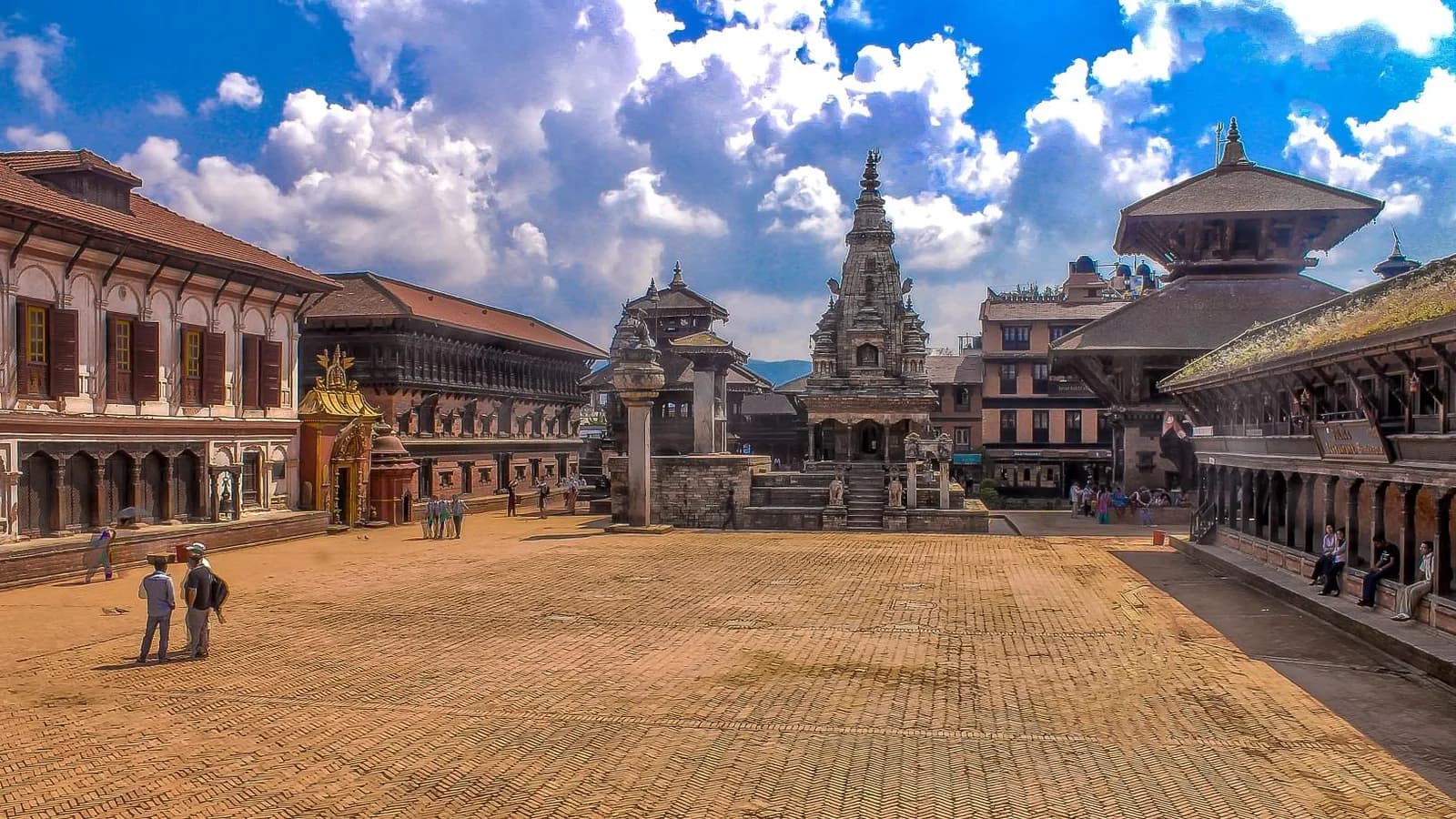
Bhaktapur Durbar Square is the royal heart of Nepal's best-preserved medieval city, a brick-paved plaza ringed by pagoda temples, carved-wood palaces and gilded gateways built by the Malla kings who ruled here for centuries. If Kathmandu Durbar Square feels busy and Patan feels compact, Bhaktapur Durbar Square feels open and unhurried — a place where you can stand in the middle of a 17th-century courtyard and turn slowly through 500 years of architecture. This guide walks the Square monument by monument and covers the practical details: fees, hours, history and how it fits into a wider Bhaktapur visit.
Key takeaways
- Bhaktapur Durbar Square is one of the seven monument zones in the Kathmandu Valley UNESCO World Heritage property, inscribed in 1979.
- The official entry fee is USD 15 or NPR 2,000 for non-SAARC foreigners, and NPR 500 for SAARC and Chinese nationals (as of July 2025); the ticket can be extended up to seven days.
- The signature monuments are the 55-Window Palace, the Golden Gate, the Vatsala Temple with its "barking dogs" bell, and the stone Siddhi Lakshmi temple.
- The Square once held 99 courtyards; only around 15, linked to the Taleju shrine, survive today after centuries of earthquakes.
- The 2015 Gorkha earthquake damaged 116 monuments here; most major structures have since been restored.
- One ticket also covers Taumadhi, Dattatreya and Pottery squares, so budget a half to full day for the whole old town.
A short history of the Square
Bhaktapur — also called Bhadgaon or Khwopa — was an independent kingdom in the Kathmandu Valley before the late-18th-century unification of Nepal. From roughly the 12th to the 18th century, Malla rulers turned the city into a showcase of Newari art, and the Durbar Square (durbar means "palace") grew up around the royal residence and the temple of the protective goddess Taleju.
In its heyday the palace complex reportedly contained ninety-nine courtyards. Today only around fifteen remain, most of them directly connected to the Taleju shrine. The losses were not the result of neglect so much as repeated disaster: a catastrophic 1934 earthquake severely damaged the Square, and the 2015 Gorkha earthquake damaged 116 historical and cultural monuments across Bhaktapur. What stands today is a mix of original Malla-era construction and careful restoration, and in places you can still see rebuilding in progress.
Why it earned UNESCO status
UNESCO inscribed the Kathmandu Valley on the World Heritage List in 1979 as a property made up of seven monument zones: the Durbar Squares of Hanuman Dhoka (Kathmandu), Patan and Bhaktapur, the Buddhist stupas of Swayambhu and Boudhanath, and the Hindu temples of Pashupati and Changu Narayan. The valley's tiered temples — fired brick set in mud mortar, timber frames, terracotta-tiled roofs and gilded brass ornament — represent a complete tradition of Newari religious architecture, and Bhaktapur is widely considered its most intact survivor. For the full set, see our overview of Nepal's UNESCO sites.
The monuments, one by one
The Square is compact enough to cover on foot in a couple of hours, but each structure rewards a closer look. Here are the highlights in the rough order most visitors encounter them.
The 55-Window Palace
The Palace of Fifty-Five Windows (Pachpanna Jhyal) is the Square's defining building — a long brick façade lined with a row of black, lacquered, intricately carved sandalwood windows. It was commissioned by King Bhupatindra Malla after a 1681 earthquake destroyed an earlier palace built in the 15th century during the reign of Jayayakshya Malla, and it was completed in 1708. The carved windows are among the finest woodwork in the valley, and the building today also houses Nepal's National Art Gallery, one of the country's earliest museums, holding paubha scroll paintings, stone and metal sculpture, and palm-leaf manuscripts.
The Golden Gate (Sun Dhoka)
Set into the palace wall is the Golden Gate, known locally as Lun Dhwakha — a gilded copper doorway crowned by a figure of the goddess Taleju flanked by mythical creatures. It is often described as one of the most richly worked gateways in the Himalaya. The gate was first planned in 1646 by King Jagajjyoti Malla but was actually constructed between 1751 and 1754 by the craftsmen Subhakara, Karunakara and Ratikara. It is the formal entrance to the inner Taleju courtyards, the spiritual core of the old palace.
The Vatsala Temple and the "barking dogs" bell
In front of the palace stands the stone Vatsala Devi Temple, a shikhara-style shrine dedicated to a form of the mother goddess. Beside it hangs a large bronze bell offered by Bhupatindra Malla in 1699. It is popularly called the "barking dogs" bell, after a local belief that its toll once set the neighbourhood dogs howling. Vatsala is one of several temples in the city consecrated to the goddess in her protective forms, traditionally raised to shield Bhaktapur from epidemics.
The Siddhi Lakshmi (Lohan Dega) Temple
At the eastern end of the Square rises the Siddhi Lakshmi Temple, a tall stone shikhara shrine reached by a stairway lined with paired stone guardians — attendants, horses, rhinoceroses, lions and camels ascending in tiers. Built in the 17th century, it is one of the most photographed corners of the Square thanks to that ceremonial staircase.
The Taleju complex and surviving courtyards
Behind the Golden Gate lies the heart of the royal palace: the Taleju temple and its connected courtyards, including the Taleju and Kumari chowks. Taleju was the lineage deity of the Malla kings, and these inner courts remain religiously active. Non-Hindus are generally not permitted into the innermost shrine areas, so respect the signs and barriers; this is a living place of worship, not only a monument.
Beyond the main Square
Your single ticket covers far more than the palace plaza. Bhaktapur's old town is really a chain of connected squares, and most visitors string them together on foot.
| Square | A few minutes' walk | What it is known for | |---|---|---| | Durbar Square | — | Royal palace, 55-Window Palace, Golden Gate, Vatsala and Siddhi Lakshmi temples | | Taumadhi Square | About 5 minutes south | Nyatapola Temple, the tallest pagoda in Nepal | | Dattatreya Square | About 15 minutes east | Older quarter, the famous carved Peacock Window | | Pottery Square | About 10 minutes | Working potters and rows of drying clay vessels |
Nyatapola Temple
A short walk south of Durbar Square brings you to Taumadhi Square and Nyatapola, a five-storey pagoda that is the tallest temple in Nepal. Completed in the early 18th century under Bhupatindra Malla, it is dedicated to the goddess Siddhi Lakshmi and is famous for surviving major earthquakes with little structural damage — a testament to Newari engineering. The staircase is guarded by five pairs of stone figures rising in strength from wrestlers at the base to deities at the top. It is not technically inside Durbar Square, but no visit is complete without it.
Pottery Square and Dattatreya
Pottery Square is exactly what it sounds like: an open quarter where potters still throw and sun-dry clay vessels, especially in dry weather. Dattatreya Square, the oldest part of the city, holds the Dattatreya Temple and the celebrated Peacock Window, a wooden lattice carved into the shape of a fanned peacock tail. Together they show that Bhaktapur is not a frozen museum but a working town that happens to be 500 years old.
Practical information
Entry fees
The fee is collected at ticket booths on the main approaches to the old city, and it is checked. Based on the official Bhaktapur tourism information, the rates (as of July 2025) are:
| Visitor | Fee | |---|---| | Non-SAARC foreigners | USD 15 or NPR 2,000 | | SAARC nationals | NPR 500 | | Chinese nationals | NPR 500 (passport required) | | Nepali citizens | Free |
The ticket covers the whole historic core — Durbar, Taumadhi, Dattatreya and Pottery squares. If you plan to stay in Bhaktapur, take your passport to the Tourist Information Center and the same ticket can be extended for up to seven days at no extra cost; longer stays require a special visitor pass with passport and visa copies. Fees are set by local authorities and can change, so treat the figures as a guide and confirm on arrival. For a fuller cost-versus-value discussion, see our Bhaktapur day-trip guide.
Hours and timing
The old city is a residential area with public ticket gates rather than a single building, so there is no firm closing time, but the practical visiting window is daylight hours. Aim to arrive early — morning light is cleanest, the squares are quietest, and in spring the afternoon valley haze can wash out the views. Two to three hours covers the Square comfortably; a half to full day lets you add the other squares, lunch and the back alleys.
Getting there
Bhaktapur lies about 14 km east of central Kathmandu, roughly a 45-minute drive depending on traffic. Options from Thamel include a private taxi, a ride-hailing car, the local bus from the city, or an organised tour van with a guide. The old city itself is vehicle-free, which is a large part of why it feels so intact — once you are through the gate it is all narrow brick lanes and open courtyards on foot.
Visiting respectfully
Bhaktapur Durbar Square is full of active Hindu and Newari shrines, and people live in the buildings around the plaza. A few simple courtesies go a long way:
- Dress modestly, covering shoulders and knees near temples.
- Walk around shrines and statues rather than climbing on them.
- Obey "no photography" signs, especially at the inner Taleju courtyards.
- Ask before photographing residents, particularly in doorways and windows.
- Step aside for any religious procession; festival days here are genuine, not staged.
Our temple etiquette guide for tourists covers the details. If you can time your trip to a festival, the spring Bisket Jatra chariot festival transforms the squares into something extraordinary — though it also brings big crowds.
Pairing it with food and the wider valley
Bhaktapur is famous for juju dhau, the thick, sweet "king's curd" served in clay pots, sold at shops around the squares. The old town also has solid Newari kitchens; our Newari food guide explains dishes like bara, chatamari and samay baji so you can order with confidence. With one more day, pair Bhaktapur with Patan for two contrasting Newari capitals, or read up on all seven UNESCO sites to plan a heritage-focused valley loop.
Is it worth it?
For most travelers, yes. The Square packs an exceptional density of Malla-era architecture into a small, walkable, traffic-free area, and the ticket stretches across several adjoining squares. The fee is real and noticeably higher than what locals pay, but as open-air heritage sites go, Bhaktapur Durbar Square is one of the most rewarding places you can spend a morning in Nepal.
Sources
Frequently asked questions
- How much is the entry fee to Bhaktapur Durbar Square?
- As of July 2025 the official fee is USD 15 or NPR 2,000 for non-SAARC foreigners, NPR 500 for SAARC and Chinese nationals (passport required), and free for Nepali citizens.
- Does the Bhaktapur ticket cover the whole old city?
- Yes. The single ticket admits you to the historic core, including Durbar Square, Taumadhi Square with Nyatapola, Dattatreya Square and Pottery Square.
- Can I extend the ticket if I stay several days?
- Yes. You can have the ticket extended for up to seven days at the Tourist Information Center; longer stays need a special visitor pass with your passport and visa copies.
- When was Bhaktapur Durbar Square listed by UNESCO?
- The Kathmandu Valley was inscribed on the UNESCO World Heritage List in 1979 as seven monument zones, and Bhaktapur Durbar Square is one of them.
- How long do I need at the Square?
- Allow at least two to three hours for the Square alone, or a half to full day if you also walk to Taumadhi, Dattatreya and Pottery squares.
- Was Bhaktapur damaged in the 2015 earthquake?
- Yes. The 2015 Gorkha earthquake damaged 116 monuments in Bhaktapur, and a long restoration program has rebuilt most of the major structures.
- What is the best time of day to visit?
- Early morning gives the cleanest light and fewest crowds, especially in spring when afternoon haze can settle over the valley.
- Is Bhaktapur far from Kathmandu?
- No. Bhaktapur sits about 14 km east of central Kathmandu, roughly a 45-minute drive depending on traffic.
Related posts
Patan Durbar Square: A Visitor's Guide to Lalitpur
Patan Durbar Square is Lalitpur's UNESCO-listed palace plaza of Newari temples, courtyards and bronze art. History, monuments, fees and tips.
Read postBisket Jatra: Bhaktapur's New Year Chariot Festival
Bisket Jatra is Bhaktapur's wild new year festival — a chariot tug-of-war, a giant pole, and the Nepali solar new year, explained for travelers.
Read postBoudhanath Stupa: Architecture & Symbolism Guide
How to read the Boudhanath stupa — its mandala shape, the Buddha eyes, the 13 golden steps, and the meaning behind the clockwise kora walk.
Read post