Mardi Himal Trek: How Hard Is It Really?
A fitness, pacing and acclimatisation guide to the Mardi Himal trek — elevation profile, hardest days, and how fit you need to be.
Short does not mean soft — Mardi gains height fast, then makes you earn the ridge.
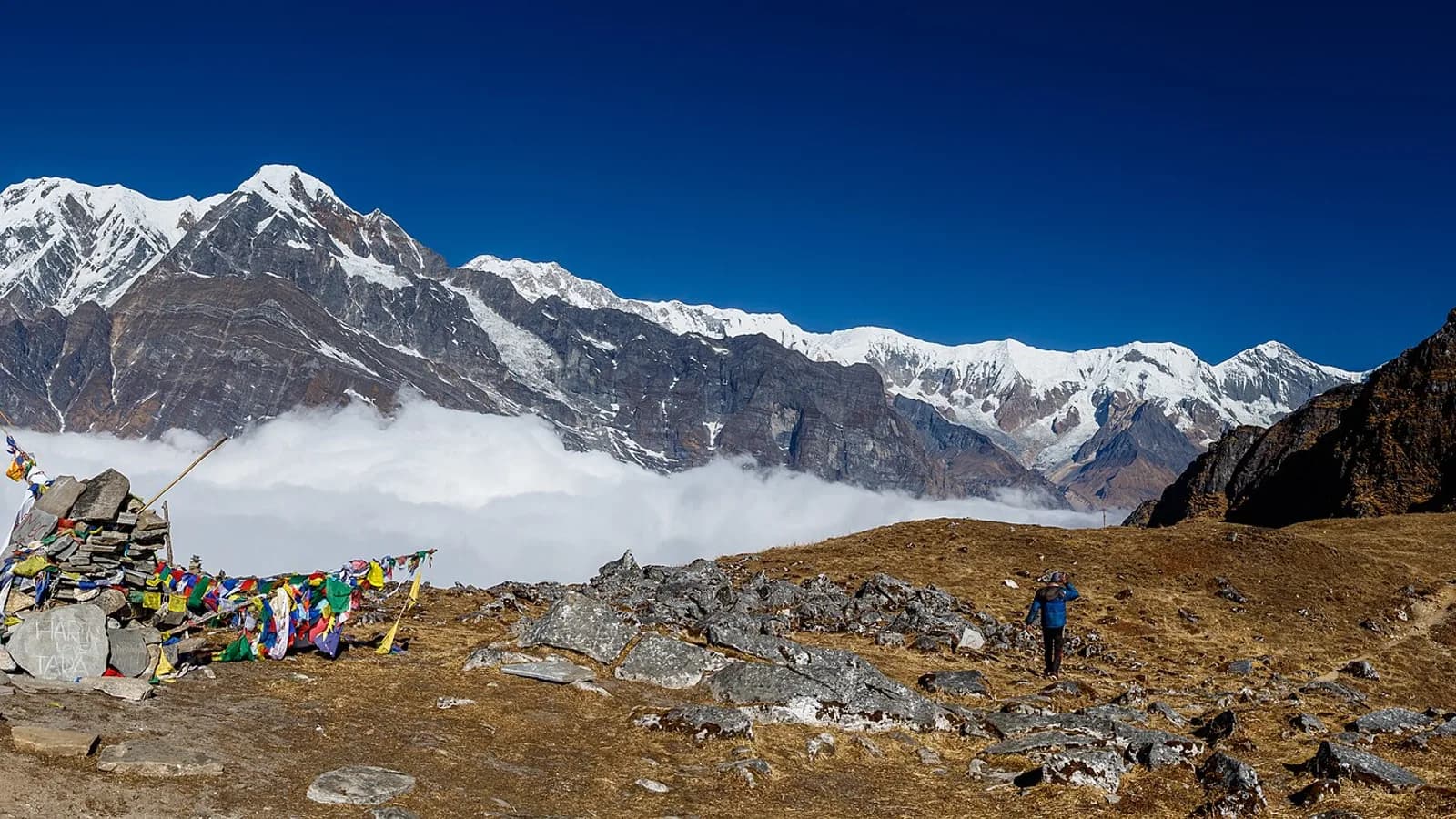
If you have read our hidden-gem overview of Mardi Himal, you already know it is a short, scenic ridge walk above Pokhara with a viewpoint that rivals far longer treks. What that piece does not dig into is the question most people actually ask before booking: how hard is the Mardi Himal trek, really? This complementary guide focuses on difficulty, fitness, the elevation profile, and how to pace and acclimatise so the short itinerary does not catch you out.
The honest answer is that Mardi Himal is moderate — easier than Everest or Annapurna Base Camp, but not a stroll. It is short, and short treks tempt people to rush. The trail gains height quickly, and the summit-day push to the viewpoint is a genuine effort. Get the pacing right and a first-time trekker enjoys every day of it.
Key takeaways
- Mardi Himal is graded moderate: no technical climbing, but several steep days and a demanding viewpoint push.
- The trek covers roughly 45–55 km over 4–6 days; five days is the comfortable sweet spot.
- You sleep no higher than High Camp (~3,580 m), so altitude-sickness risk is lower than on higher treks — but rushing the short itineraries is the main danger.
- The hardest day is the pre-dawn climb to the Upper Viewpoint (~4,200 m), often cold, dark and on rocky ground.
- A few weeks of regular cardio at home is enough preparation for most reasonably active travellers.
- A licensed guide is mandatory for foreigners in the Annapurna region (rule effective 1 April 2023).
How difficulty is graded
Trekking operators almost universally describe Mardi Himal as moderate. In practical terms that means there is no scrambling, no ropes, no crampons and no high pass to cross — but you should be ready to walk 4–6 hours a day on uneven, often steep terrain, with some long uphill stretches and a couple of exposed, narrow ridge sections near the top.
Compared with the region's bigger names, Mardi sits clearly below Annapurna Base Camp and the Everest treks in both altitude and duration. It is closer in feel to the Khopra Ridge trek — quiet, scenic, moderate — though Mardi's summit day is short and sharp rather than a long grind.
The trek is short enough that it suits families and fit beginners, yet it climbs fast enough that fitness and pacing genuinely matter. That combination is the whole story of Mardi Himal's difficulty.
The elevation profile day by day
The defining feature of Mardi Himal is how quickly it gains height for such a short trek. You start low in forest and finish on an alpine ridge, climbing roughly 2,400–2,700 m overall depending on your start point. Reported altitudes vary a little between operators; the table below uses commonly cited figures and should be treated as approximate.
| Point | Approx. altitude | Notes | |---|---|---| | Kande (common start) | ~1,770 m | Short drive from Pokhara | | Forest Camp | ~2,520–2,550 m | First night for many, deep in forest | | Low Camp | ~2,970–2,985 m | Forest opens to meadow | | High Camp | ~3,540–3,580 m | Highest place you sleep | | Upper Viewpoint | ~4,200 m | Highest point most trekkers reach | | Mardi Himal Base Camp | ~4,250–4,500 m | Higher option; many groups stop at the viewpoint |
Why the profile matters
Because you only sleep as high as High Camp (~3,580 m), your body is not exposed to extreme altitude overnight. That is the main reason Mardi is considered low-risk for altitude sickness. The catch is the daily gain: some days you climb 400–500 m, and the viewpoint push adds several hundred metres more on top of a night already spent near 3,580 m. On a compressed three-day itinerary, that fast gain is exactly what can trigger symptoms.
The hardest parts of the trek
Low Camp to High Camp
For many trekkers this is the day the legs first complain. The trail leaves the sheltered forest, the air thins noticeably, and the climbing is sustained. It is not technical, but it is a solid uphill effort that rewards a steady, unhurried rhythm.
The pre-dawn viewpoint push
This is the crux of the whole trek. From High Camp you set off in the dark, headtorch on, to reach the Upper Viewpoint around sunrise. The final stretch gains several hundred metres on rocky, exposed ground that can be cold, windy and occasionally snow-dusted. The distance is modest, but the combination of early start, thin air, cold and gradient makes it feel harder than the kilometres suggest. The payoff — a wide panorama of Machhapuchhre, Annapurna South, Hiunchuli and the Annapurna wall — is why people come.
The long descent
Coming down from High Camp toward Sidhing (or back toward Kande) is a long day on tired legs. It is not dangerous, but steep, knee-loading descent is where trekking poles earn their place.
How fit do you need to be?
You do not need to be an athlete, but the steep days are far more enjoyable with a baseline of fitness. A useful self-test: if you can comfortably hike around 10 km over uneven terrain with 500 m or more of climbing near home, you are in good shape for Mardi Himal.
If you are starting from a lower base, a few weeks of preparation makes a real difference:
- Cardio: brisk walking, jogging, cycling or stair-climbing, several sessions a week, building up over 4–6 weeks.
- Hill repeats or stairs: the trail is mostly up and down, so train that specifically rather than only flat walking.
- Back-to-back days: if you can, do two longer walks on consecutive days to rehearse trekking on slightly tired legs.
- Break in your boots: the descent will find any hot spots, so do not arrive with brand-new footwear.
Children and older walkers complete Mardi regularly, which says a lot about its moderate grading — but everyone benefits from arriving prepared rather than relying on the short duration to carry them through.
Acclimatisation and staying safe
Altitude sickness (AMS) is less likely here than on higher treks, but it is not impossible, and the short itineraries are precisely where people get it wrong by climbing too fast. Our full altitude sickness guide covers symptoms and treatment in detail; the Mardi-specific points are simple:
- Choose at least five days if you can. The three-day version exists, but it compresses the climb and gives your body less time to adjust.
- Walk at a conversational pace — if you cannot hold a conversation, you are going too fast.
- Hydrate well and eat properly, even when appetite dips at High Camp.
- Recognise early symptoms: headache, nausea, dizziness or unusual breathlessness. Tell your guide straight away; descending even a few hundred metres usually resolves mild AMS quickly.
- Layer up for the viewpoint: nights and dawns at High Camp are genuinely cold, and being cold makes the hard day feel harder.
Because you can descend quickly to thicker air, Mardi is a forgiving place to learn how your body responds to altitude — a good reason it is often recommended as a first Himalayan trek.
When difficulty changes with the season
The grade on paper stays the same year-round, but conditions can make Mardi noticeably harder or easier.
| Season | Effect on difficulty | |---|---| | Autumn (late Sep–Nov) | Easiest conditions: clear skies, stable weather, firm trail | | Spring (Mar–May) | Warmer, rhododendrons in bloom; generally straightforward | | Winter (Dec–Feb) | Colder and tougher; snow can ice the viewpoint push | | Monsoon (Jun–Aug) | Wet, slippery, leech-prone forest and cloud-hidden views |
In deep winter the viewpoint day in particular can become more serious if snow or ice is on the upper trail, so listen to your guide about turning around at High Camp if conditions are poor.
Practical preparation checklist
A few non-fitness factors smooth out the hard days:
- Trekking poles for the steep descent and the rocky viewpoint push.
- A warm layer and headtorch for the pre-dawn start.
- A sensible budget of small cash for lodges and meals, since the upper villages are cash-only — see our notes in the hidden-gem overview and the broader Pokhara things-to-do guide for trip planning around the trek.
- A licensed guide or porter-guide, which is both required and genuinely helpful on the cold viewpoint morning.
- A handful of trail phrases in Nepali for friendlier lodge stops along the way.
For permits, the Annapurna Conservation Area Permit (ACAP) is the one that matters: it costs NPR 3,000 for foreign nationals (as of June 2026) and is bought in Kathmandu or Pokhara before you start, not on the trail. The old TIMS card is no longer enforced at Annapurna checkpoints for the now-standard guided trekkers. Always confirm current fees and rules with the Nepal Tourism Board or your agency before you travel.
So, is it worth the effort?
For the fitness it asks, Mardi Himal gives back a lot. It is short enough to fit a tight itinerary, moderate enough for a first-timer, and rewarding enough to stand beside treks twice its length. The difficulty is real but manageable: respect the fast height gain, give yourself five days, train a little beforehand, and the only thing you will remember about the hard parts is the sunrise at the top.
Sources
- North Nepal Trek — Mardi Himal Trek 7 Days, Itinerary, Cost & 2026 Guide
- Nepal Intrepid Treks — Mardi Himal Trek Altitude: Camps & Elevation Profile
- Adventure Himalaya Circuit — Mardi Himal Trek: Facts, Difficulty, Itinerary & Complete Guide (2025)
- Himalayan Recreation — Mardi Himal Trek Difficulty
- Nepal Everest Base Camp — Mardi Himal Trek Difficulty: Altitude, Fitness & Safety Guide
- U.S. Embassy in Nepal — New Requirements for Use of Trekking Guides/Porters Effective April 1, 2023
- Nepal Tourism Board — TIMS Card
- Magical Nepal — Annapurna Circuit Trek Permits: Guide, Costs and Rules
- Mardi Himal — Wikipedia
Frequently asked questions
- Is the Mardi Himal trek hard for beginners?
- It is graded moderate, so a reasonably fit first-time trekker can do it. The trail has no technical climbing, but it gains height quickly and the morning push to the viewpoint at 4,200m is a long, cold, steep day. Train your legs and lungs for a few weeks beforehand and pace yourself, and beginners manage it well.
- How many days do you need for Mardi Himal?
- Most people take 4 to 6 days. A rushed 3 to 4 day version is possible with jeep transfers, but 5 days gives you steadier acclimatisation and far more enjoyment. Adding a day at High Camp or extending toward Poon Hill or Annapurna Base Camp stretches it to a week or more.
- How long is the Mardi Himal trek in kilometres?
- Published figures vary between roughly 45 and 55km depending on where you start and finish and which side trails you walk. Daily walking is usually 4 to 6 active hours, not counting meals and rest stops, so the distance is very manageable spread across five days.
- What is the highest point of the Mardi Himal trek?
- On the standard itinerary the highest point most trekkers reach is the Upper Viewpoint at about 4,200m. The named Mardi Himal Base Camp lies a little higher, with sources quoting somewhere around 4,250m to 4,500m, but many groups turn around at the Upper Viewpoint.
- Do you get altitude sickness on Mardi Himal?
- The risk is lower than on higher treks because you sleep no higher than High Camp at roughly 3,580m, but altitude sickness is still possible. The danger is climbing too fast on the short itineraries. Walk at a steady pace, drink plenty of water, and tell your guide early if you feel unwell.
- Which is the hardest day on the Mardi Himal trek?
- Most trekkers find the climb from Low Camp to High Camp and the pre-dawn push to the viewpoint the toughest. The final stretch toward the viewpoint gains several hundred metres on rocky, exposed ground, often in the cold and dark, so it feels harder than the distance suggests.
- How fit do I need to be for Mardi Himal?
- If you can comfortably hike around 10km over uneven ground with 500m or more of climbing at home, you have a solid baseline. A few weeks of regular cardio such as brisk walking, jogging or stair climbing before you travel makes the steep days far more enjoyable.
- Is a guide required for the Mardi Himal trek?
- Yes. Since 1 April 2023, foreign trekkers in Nepal's conservation areas and national parks, including the Annapurna region, must trek with a licensed guide or porter-guide booked through a registered agency. Solo trekking on these routes is no longer permitted.
Related posts
Mardi Himal Trek — The 5-Day Hidden Gem Above Pokhara
The short, scenic alternative to Annapurna Base Camp — 5 days, low crowds, no high passes, and a viewpoint that rivals anything in the region.
Read postAnnapurna 100: Nepal's Oldest Ultra Trail Race
A traveller's guide to the Annapurna 100, Nepal's original mountain ultra — its history, the route from Annapurna Base Camp to Pokhara, and what to expect.
Read postAnnapurna Base Camp Helicopter Tour: Which Option?
An Annapurna Base Camp helicopter tour can be a seat-in landing flight, a private charter, or a trek-up fly-down combo. Here is how to pick the right one.
Read post