Kalinchok Travel Guide: Cable Car, Temple & Snow
A tourist's guide to Kalinchok (Kalinchowk) in Dolakha — the cable car, the Bhagwati temple at 3,842 m, Kuri village, snowfall and how to get there from Kathmandu.
Two and a half kilometres of cable carry you to a trident-topped shrine at nearly 3,850 metres — and in winter the whole ridge turns white.
Most travellers picture Nepal's high places as multi-day treks into the Everest or Annapurna regions. Kalinchok (often spelled Kalinchowk) offers something rarer: a genuine high-Himalayan ridge, a centuries-old shrine and a real chance of snow — all reachable from Kathmandu in a single long drive, with a short cable car doing the hardest climbing for you. At nearly 3,850 metres, the Kalinchok Bhagwati temple is one of the most accessible big-altitude experiences in the country, which is exactly why it has become such a beloved weekend escape for Nepalis and a growing favourite with visitors.
This guide covers what Kalinchok is, how to reach it from Kathmandu, the cable car and the temple, the famous winter snow, where to stay in Kuri village, and how to plan a comfortable trip.
Key takeaways
- Kalinchok is a ridge and pilgrimage site in Dolakha district, with the Bhagwati temple at about 3,842 m above Kuri village.
- It is roughly 130-150 km from Kathmandu via Charikot; the drive commonly takes about six to seven hours, then a rough jeep road up to Kuri.
- A cable car runs about 2.5 km from Kuri to the temple ridge in around five to six minutes; it opened in 2018.
- Foreign round-trip fares are listed near NPR 1,300 on the official site, with lower Nepali, student and senior rates (as of June 2026).
- Snowfall is most likely from late December through February, making Kalinchok one of the easiest places near Kathmandu to play in the snow.
- On clear mornings the ridge yields a sweeping view of Gaurishankar, Langtang, Jugal and Ganesh Himal peaks.
What and where Kalinchok is
Kalinchok sits in the eastern hills of Nepal, in Dolakha district, northeast of Kathmandu. The high point is the Kalinchok Bhagwati temple, perched on a windswept ridge at around 3,842 metres. Just below it lies Kuri village, a small settlement of stone houses that has reinvented itself as the base camp for the whole experience.
The area falls within the Gaurishankar Conservation Area, the protected zone named after the sacred 7,134-metre peak that dominates the eastern skyline. That setting is a big part of the appeal: from the temple ridge you are looking out across a swathe of genuine Himalayan giants, not the foothills you see from closer Kathmandu viewpoints.
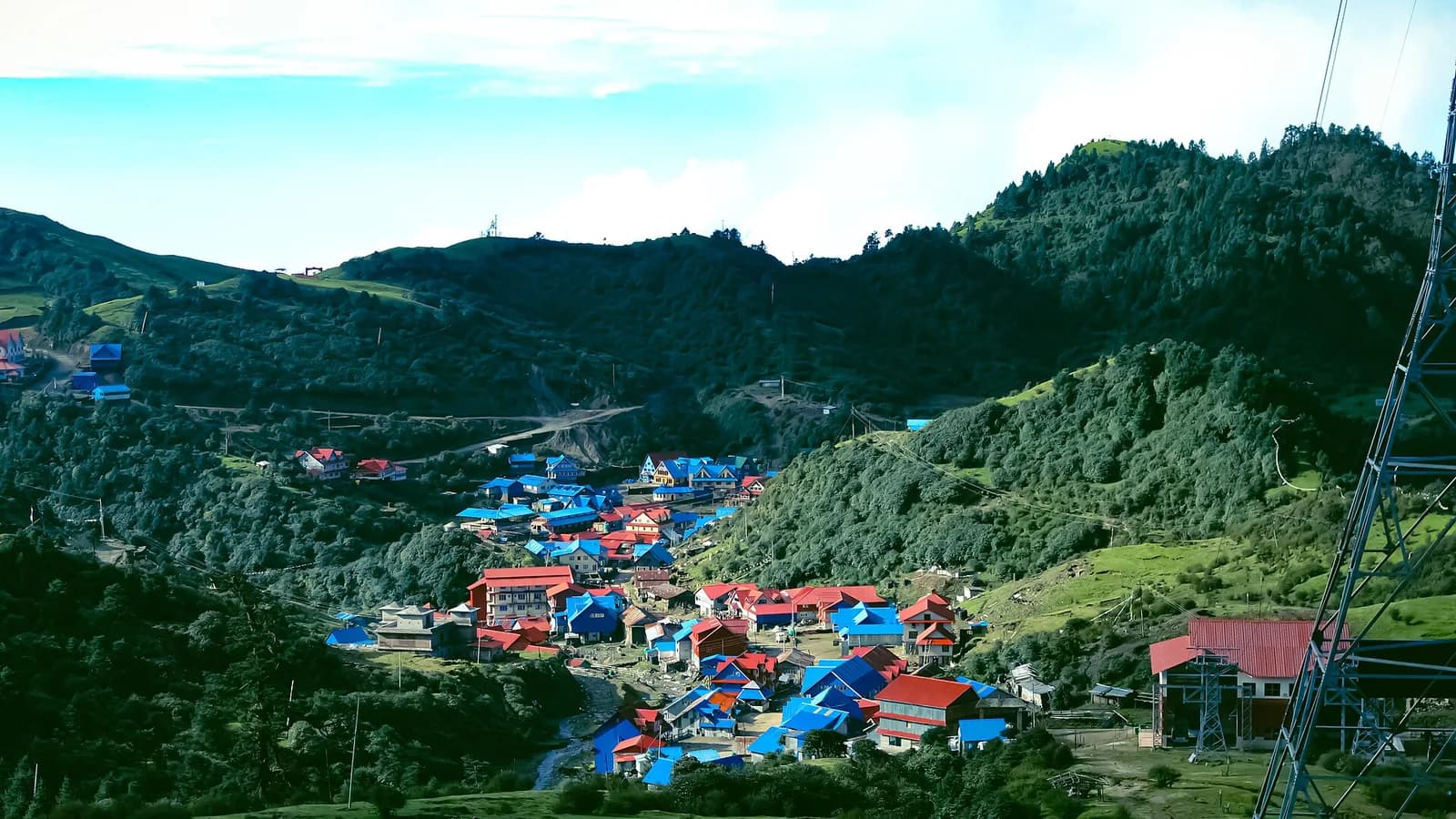
Kuri village itself has become quietly photogenic. Its old stone-walled houses, many now painted with bright blue and red roofs, stand out vividly against green summer hillsides and against snow in winter — a look that has made the village a fixture of Nepali social media.
How to get to Kalinchok from Kathmandu
Reaching Kalinchok is a two-stage journey: a long road trip to Charikot, the Dolakha district headquarters, followed by a rough climb up to Kuri.
Kathmandu to Charikot
The drive from Kathmandu to Charikot runs along the Arniko Highway and connecting roads, covering roughly 130 to 150 km depending on the exact route. Sources consistently describe this as about a six to seven hour drive, longer if traffic, road works or weather slow things down. Charikot is a working hill town and the last place to stock up on supplies, fuel and cash before the final ascent.
Charikot to Kuri village
From Charikot a rougher road of around 18 km climbs steeply to Kuri village. This stretch is usually covered by 4WD jeep and commonly takes a couple of hours, as the surface is unpaved and can be slick after rain or snow. Shared jeeps run this route, and many travellers arrange a vehicle in Charikot or come on an organised package from Kathmandu.
| Stage | Approx. distance | Typical time | Usual transport | | --- | --- | --- | --- | | Kathmandu to Charikot | ~130-150 km | ~6-7 hours | Bus, car or jeep | | Charikot to Kuri village | ~18 km | ~2 hours | 4WD jeep | | Kuri to Kalinchok temple | ~2.5 km | ~5-6 min (cable car) or 1-1.5 hr on foot | Cable car or hike |
If you would rather not drive yourself, Kalinchok is a standard offering from Kathmandu tour operators as a one or two night trip, often bundling transport, a night in Kuri and the cable car. Comparing options is similar to how you would weigh up any trekking agency in Nepal — check exactly what is included before you book.
The Kalinchok cable car
The headline convenience at Kalinchok is the cable car linking Kuri village to the temple ridge. It opened in 2018 and transformed a steep pilgrim climb into a short, scenic glide.
Ride, distance and cabins
The line covers roughly 2.5 kilometres and lifts passengers from Kuri up to the shrine in about five to six minutes. Each cabin seats around eight passengers. Before the cable car existed, devotees walked the same route, a climb of one to two hours — so the gondola has made the temple dramatically easier to reach, especially for older pilgrims and families with children.
Tickets and hours
Fares are set by Kalinchowk Darshan, the operator. On its official ticketing page the round-trip rate is listed at roughly NPR 1,300 for foreigners and NPR 600 for Nepali nationals, with reduced rates for students and senior citizens and free passage for very small children (as of June 2026). One-way tickets are cheaper. Note that fares have been raised before — earlier reports mention a single flat rate around NPR 600 — so always treat any quoted figure as approximate and confirm the current price on the official site or at the counter.
A few practical points worth knowing:
- No advance online booking is offered; tickets are bought on-site at Kuri.
- Operating hours have run from early morning until late afternoon, with earlier opening on Saturdays and holidays, but check before relying on a specific time.
- During snowy weekends and big festivals the queue can be long, so arrive early.
You can still walk up instead. A trail climbs from Kuri to the shrine in about one to one and a half hours, and a popular approach is to hike up for sunrise and ride the cable car back down. Kalinchok is far gentler than a major route like the Annapurna Base Camp trek, but it is still real altitude — take the climb slowly.
The Kalinchok Bhagwati temple
At the top of the ridge stands the Kalinchok Bhagwati temple, an open-air Hindu shrine that is the spiritual heart of the whole site.
Who Bhagwati is
The temple is dedicated to the goddess Bhagwati, worshipped here in her powerful Mahakali aspect — a warrior form revered as a protector of the surrounding villages. Rather than a grand roofed building, the shrine is a cluster of tridents (trishul), bells and sacred symbols out on the exposed rock, which gives it a raw, elemental feel that suits the high setting. Pilgrims offer flowers and tridents in devotion, and holy water from a nearby sacred pond is shared afterward as prasad.
Pilgrimage and festivals
Kalinchok Bhagwati is an important destination for Hindu pilgrims from both Nepal and India. The crowds peak during Dashain and Chaite Dashain, when thousands climb to the ridge for special rituals dedicated to the goddess. If you are travelling around those dates, expect the village and cable car to be busy; you can read more about the festival itself in our guide to Dashain in Nepal. As with any sacred site, dress modestly and follow the lead of local worshippers — our notes on temple etiquette for tourists apply here too.
Snow and the best time to visit
For many domestic visitors the single biggest draw is snow. Kalinchok is one of the closest places to Kathmandu where you have a realistic chance of seeing — and playing in — a snowfall.
When it snows
Snow is most likely in the depths of winter, broadly late December through February, with the coldest weeks offering the best odds of a white ridge. Snowfall depends on passing weather systems and is never guaranteed in any given year, so the smart move is to watch forecasts and recent reports before committing to a snow-focused trip. When it does fall, Kuri's blue-roofed houses under fresh powder are the postcard image everyone comes for.
Other seasons
Outside winter, Kalinchok is still very much worth the trip:
- Spring (March-May): mild days and hillsides of blooming rhododendron and wildflowers.
- Autumn (September-November): clear, stable skies and the sharpest mountain views of the year.
- Monsoon (June-August): lush and green but often cloudy, with the rough Charikot-Kuri road at its most difficult.
For the widest planning picture, see our overview of the best time to visit Nepal and the month-by-month Nepal weather guide.
The mountain views
On a clear morning the Kalinchok ridge delivers one of the better Himalayan panoramas you can reach this easily. Reported peaks visible from the top include Gaurishankar (7,134 m), Langtang Lirung, Dorje Lakpa, the Jugal Himal and Ganesh Himal, with very distant giants occasionally glimpsed in exceptional conditions.
The catch, as always in the hills, is timing. Skies are usually clearest at dawn, especially in the dry autumn and winter months, before haze and cloud build through the day. That is the main argument for staying overnight in Kuri: it lets you be up on the ridge for first light rather than arriving mid-morning when the view may already have softened. If broad mountain panoramas are your priority, it is worth comparing Kalinchok with valley-rim options like the Chandragiri Hills cable car and classic Nagarkot sunrise spots closer to Kathmandu.
Staying in Kuri village
Because the best of Kalinchok happens at sunrise, most visitors spend a night in Kuri village. Accommodation here is simple — a mix of small hotels, lodges and family homestays in and around the old stone houses, offering basic rooms and hearty local food rather than luxury.
Two things are worth planning for:
- Book ahead in winter. During snowfall weekends the limited rooms in Kuri fill up fast and are often pre-booked, so reserve in advance if you are chasing snow.
- Prepare for the cold. At around 3,500 metres Kuri gets genuinely cold at night, and heating is minimal. Bring warm layers, a hat and gloves, and do not underestimate the chill even outside winter.
A typical rhythm is to drive up and reach Kuri in the afternoon, settle in, wake before dawn, take the cable car or hike up for sunrise at the temple, then descend and drive back — comfortably done as a two-day, one-night trip from Kathmandu, or stretched to two nights for a more relaxed pace.
Practical tips
- Acclimatise sensibly. The jump to nearly 3,850 metres is significant; move slowly on the ridge, stay hydrated, and if you have ever been sensitive to altitude, read our altitude sickness guide.
- Carry cash. There is no online booking for the cable car, and mountain villages run on rupees — sort out money in Kathmandu or Charikot.
- Check road and weather conditions before you set off in winter; the Charikot-Kuri road can be slow or hazardous after snow.
- Layer up regardless of season. Even sunny days turn bitter once the wind picks up on the exposed ridge.
- Respect the shrine. It is an active pilgrimage site, so dress modestly and ask before photographing worshippers.
Kalinchok packs an unusual amount into a short trip: a sacred high-altitude temple, a quick and genuinely scenic cable car, a real shot at Himalayan snow, and a stone village that looks like a painting under fresh powder. For travellers who want a taste of the high mountains without committing to a long trek, it is one of the most rewarding short escapes Nepal has to offer.
Sources
- Kalinchowk Darshan — Ticket Rates (official cable car operator)
- Kalinchowk Darshan — Kalinchowk Bhagwati Temple
- Kalinchowk Bhagwati Temple — Wikipedia
- Altitude Himalaya — Best Time to Visit Kalinchowk and snowfall season
- TravelSetu — How to reach Kalinchowk Bhagwati shrine
- Tourism Mail — Kalinchowk cable car fare increase
- Himalayan Geographic — Kalinchowk overview
Frequently asked questions
- How high is Kalinchok and the Bhagwati temple?
- The Kalinchok Bhagwati temple sits at about 3,842 metres above sea level, on a ridge above Kuri village in Dolakha district. Kuri itself lies lower, at roughly 3,500 metres, which is why most visitors stay there overnight and climb to the shrine for sunrise.
- How do I get to Kalinchok from Kathmandu?
- Drive from Kathmandu to Charikot, the Dolakha district headquarters, along the Arniko and BP highways — a trip of roughly 130-150 km that commonly takes about six to seven hours. From Charikot a rough jeep road of around 18 km climbs to Kuri village, taking a couple of hours more.
- How much does the Kalinchok cable car cost?
- On the official Kalinchowk Darshan site the round-trip fare is listed at about NPR 1,300 for foreigners and NPR 600 for Nepali nationals, with reduced student and senior rates (as of June 2026). Prices have changed before, so confirm the current rate on the official site or at the counter.
- How long is the Kalinchok cable car ride?
- The cable car covers about 2.5 kilometres from Kuri village up to the temple ridge in roughly five to six minutes. Before it opened in 2018, pilgrims had to climb the same stretch on foot, which took around one to two hours.
- When is the best time to see snow at Kalinchok?
- Snow is most likely from late December through February, with the heart of winter offering the best chance of a white ridge. Snowfall is never guaranteed in any given year, so treat it as a bonus and watch the forecast before you commit to a snow trip.
- Do I have to take the cable car, or can I hike to the temple?
- You can still walk. A trail climbs from Kuri village to the Kalinchok Bhagwati shrine in roughly one to one and a half hours. Many visitors hike up for sunrise and ride the cable car down, or simply take the cable car both ways if the weather or altitude makes the climb hard.
- What can you see from the top of Kalinchok?
- On a clear morning the ridge opens onto a wide Himalayan panorama including Gaurishankar, Dorje Lakpa, the Langtang and Jugal ranges and Ganesh Himal, with very distant peaks visible in the best conditions. Mornings in autumn and winter are usually the clearest before haze builds.
- Is Kalinchok good for a weekend trip and is it suitable for families?
- Yes — Kalinchok is one of the most popular short snow and pilgrimage getaways near Kathmandu and works well as a one or two night trip. The cable car makes the temple reachable without a hard climb, so families and less experienced walkers can enjoy it, though the altitude and cold still demand warm layers and a slow pace.
Related posts
Kalinchok Snow: When to Go & What to Expect
A focused guide to Kalinchok snow — when it falls, what to wear, road and cable car conditions, and how to plan a winter day in the snow near Kathmandu.
Read postChandragiri Hills Cable Car: Tickets & Guide (2026)
A tourist's guide to the Chandragiri Hills cable car near Kathmandu — fares, ride time, the Bhaleshwor Mahadev temple, Himalaya views and how to get there.
Read postManakamana Cable Car: Tickets, Times & Guide (2026)
A traveller's guide to the Manakamana cable car in Nepal — fares, ride time, the wish-fulfilling temple at the top, how to get there, and what to expect.
Read post